
Affiliate disclosure: As an Amazon Associate, AccurateGoods earns from qualifying purchases. Product links below may earn us a commission at no extra cost to you.
ELECTRICAL TESTING • TOOL COMPARISON
Buy the meter that matches the measurement
A clamp meter and a multimeter can look like two versions of the same tool. Both often have a display, a rotary dial and sockets for test leads. Their biggest difference appears when you need to measure current. Understanding that difference helps you choose a useful tool instead of paying for functions you will rarely use.
Quick answer: clamp meter or multimeter?
Choose a multimeter for battery voltage, continuity, resistance and detailed low-current troubleshooting. Choose a clamp meter when your main job is measuring current through an accessible individual conductor without opening the circuit. Many electricians benefit from owning both. Check the exact model: an AC-only current clamp cannot measure DC current through its jaws, even if it measures DC voltage with leads.
Check Klein MM400 Options on Amazon →
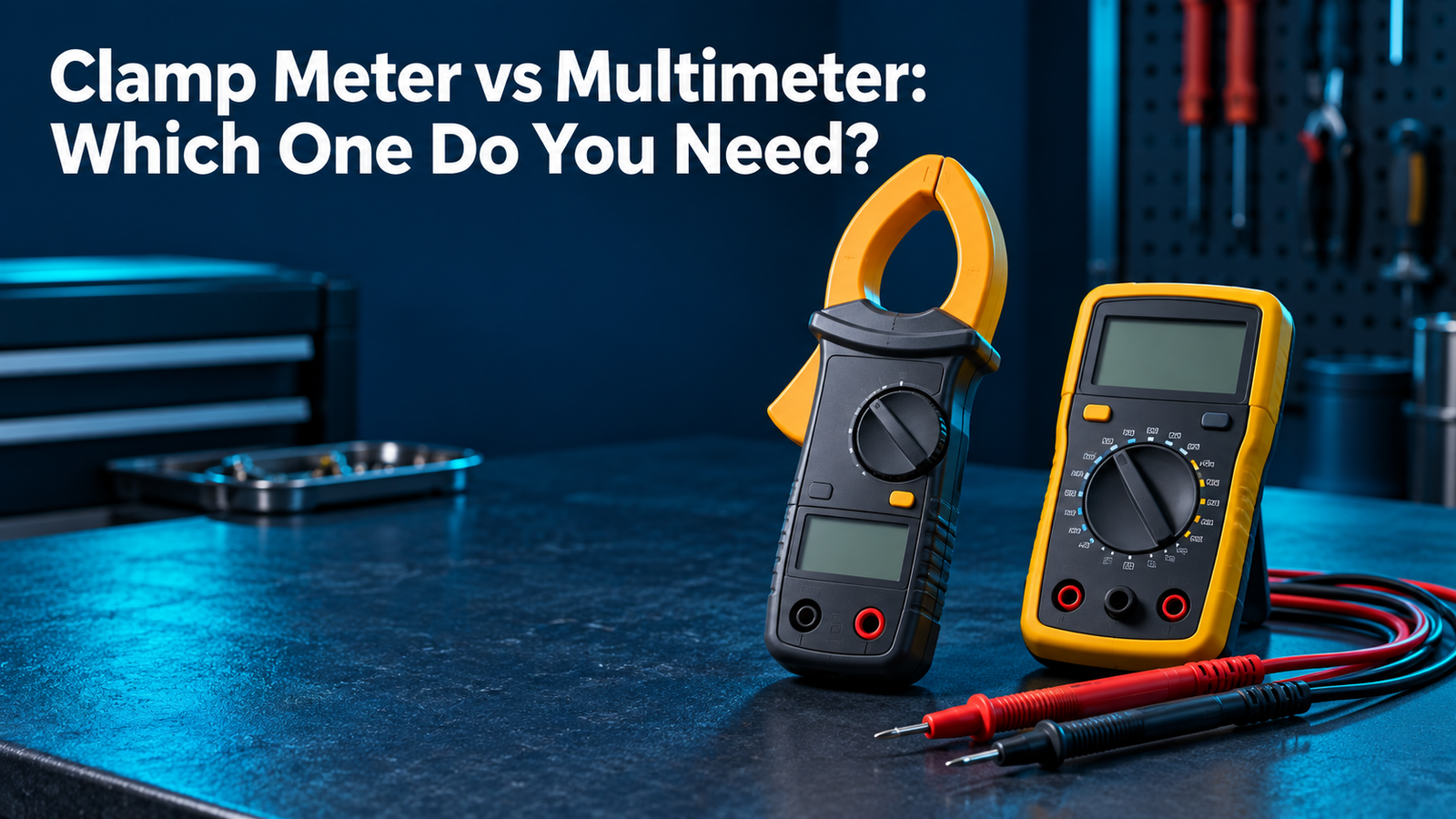
Clamp meter vs multimeter at a glance
| Feature | Clamp meter | Digital multimeter |
|---|---|---|
| Typical strength | Current measurements through jaws | Voltage, resistance and component checks |
| Current connection | Jaws around an individual conductor | Usually a series connection through a fused input |
| Need to open the circuit for current? | Usually no, when a suitable conductor is accessible | Usually yes for direct current measurement |
| AC/DC current | Depends on the clamp sensor and model | Depends on inputs, ranges and model |
| Small-current work | Needs suitable sensitivity; general clamps may struggle | Often offers useful mA or µA ranges |
| Voltage and continuity | Often available using test leads | Core functions on most models |
| Best starting point | Load checks and electrical service | Home, electronics and basic automotive diagnostics |
These are typical roles, not promises about every model. A well-equipped clamp meter may include temperature and capacitance, while a simple multimeter may omit current entirely. Read the manual and specifications rather than choosing by the shape of the case.
What does a clamp meter do?
A clamp meter uses a sensor in its jaws to detect the magnetic field associated with current in a conductor. That lets a suitable instrument measure current without placing its internal current path into the circuit. This is useful when checking equipment load or comparing current under different operating conditions.
The jaws do not normally measure voltage. Voltage readings generally require test leads, appropriate input sockets and the correct dial setting. A non-contact voltage alert, when included, is a separate function and should not be confused with a numerical voltage measurement or a complete absence-of-voltage test.
Access matters as much as the feature list. A clamp only helps if its jaws can fully close around the conductor you need to measure. Jaw opening, body size and working space can make a compact meter more practical than a larger instrument with more functions.
Why you usually clamp around one conductor
For a normal load-current reading, the outgoing and returning conductors must not both sit inside the clamp. Their magnetic fields can cancel, producing a near-zero result despite the equipment drawing power. Clamping around an entire ordinary appliance cord therefore usually does not show its load current.
A purpose-made, correctly rated line splitter can provide access to one conductor for compatible plug-in equipment. Use it according to its own instructions, including any reading multiplier. Do not cut cable insulation, separate energized wiring or modify an extension cord to create a testing point.
Specialized leakage-current measurements can intentionally include multiple conductors. That is a different test with different sensitivity requirements. A general-purpose clamp showing zero around a whole cord does not prove the circuit is off or establish that leakage is absent.
What does a digital multimeter do?
A digital multimeter, often shortened to DMM, measures electrical values through test leads. Most offer AC and DC voltage, resistance and continuity. Depending on the model, you may also get diode testing, capacitance, frequency, temperature or current ranges.
For home tasks, those functions answer useful questions: does a disconnected fuse have continuity, what voltage is present at an accessible low-voltage battery, or is a loose cable conductor broken? A meter does not interpret the whole problem for you. The reading must still be compared with the equipment’s expected behavior.
Direct current measurement is different from voltage measurement. A DMM usually needs to become part of the current path, using the correct fused socket and range. That brings input limits, fuse requirements and sometimes strict time limits. A high voltage rating does not mean the current socket can carry equally demanding loads.
Which meter should you buy first?
For home maintenance: start with a multimeter
If your main tasks involve removable batteries, disconnected cables and simple component checks, a multimeter is a sensible first purchase. Put readable controls, sound leads and a clear manual ahead of the longest specification list. Auto-ranging can reduce the need to select a range manually, but you still must choose the correct function and socket.
A clamp meter becomes useful when measuring load current is a real recurring need and a suitable individual conductor is safely accessible. It is not automatically a better household tool simply because it has a larger body or a higher amp number on its packaging.
For electricians: the two tools complement each other
Electricians may need both load-current measurements and detailed voltage or continuity checks. Buying two tools can also make it easier to monitor separate values without repeatedly moving the same instrument between tasks. The right combination depends on the installations and equipment you actually service.
Our best multimeters for electricians guide covers professional options. For jaw size, current functions and trade-specific choices, see our best clamp meter guide.
For HVAC: choose the required functions first
An HVAC technician may need current, temperature, capacitance and other system-specific measurements. List those needs before deciding whether one meter can cover the work. A clamp with temperature support does not automatically include every sensor or accessory required for your equipment.
Inrush capture, low-pass filtering and small-current ranges are separate capabilities. Ordinary display hold freezes a reading; it does not necessarily capture a brief starting-current event. Match the function to the service procedure rather than assuming that similar labels mean the same thing.
For automotive work: check DC capability and sensitivity
A multimeter is useful for low-voltage battery checks and disconnected fuse or wiring tests. A DC-capable clamp can help with higher-current measurements when the correct cable is accessible. An AC-only jaw will not serve that DC-current task.
Small parasitic draws are harder to measure reliably with a broad-range clamp. Compare low-end accuracy and resolution, not just maximum amperage. High-voltage hybrid and EV systems require specialized training, rated equipment and manufacturer procedures; ordinary automotive familiarity is not enough.
Three practical buying routes
These examples illustrate different tool choices. They are based on manufacturer documentation, not hands-on testing by AccurateGoods. Confirm the exact model, manual, included accessories and seller before ordering. Amazon links open search results; select the matching model yourself.
1. Multimeter route: Klein Tools MM400
The MM400 is an auto-ranging multimeter with AC/DC voltage and current, resistance, continuity and additional component-test functions. It is worth comparing when you want a conventional handheld meter for varied troubleshooting.
Choose this route if: voltage and continuity checks are your main tasks. Check before buying: current-input limits, measurement-category suitability and the accessories supplied with the listing.
Compare Klein MM400 Listings →2. Clamp route: Klein Tools CL800
The CL800 manual specifies AC/DC current through its clamp and true-RMS measurement. It also documents voltage, resistance, continuity, frequency, capacitance and diode functions through leads, temperature through a thermocouple, and a low-impedance mode.
Choose this route if: clamp-current work is central to your needs, with conventional meter functions alongside it. Check before buying: the accuracy of the specific ranges you need, jaw access and whether its available functions replace your existing meter.
Check Klein CL800 Options →3. Two-tool route: a DMM plus a compatible current tool
If your work spans detailed diagnostics and load checks, plan a pair around those jobs. You might buy a dedicated clamp meter, or use a compatible clamp accessory with a DMM. Accessories need the correct output type, conversion scale, bandwidth and ratings.
Choose this route if: your current tool is good but leaves a specific measurement gap. Start with the missing capability rather than replacing your entire kit.
Compare Multimeter and Clamp Meter Kits →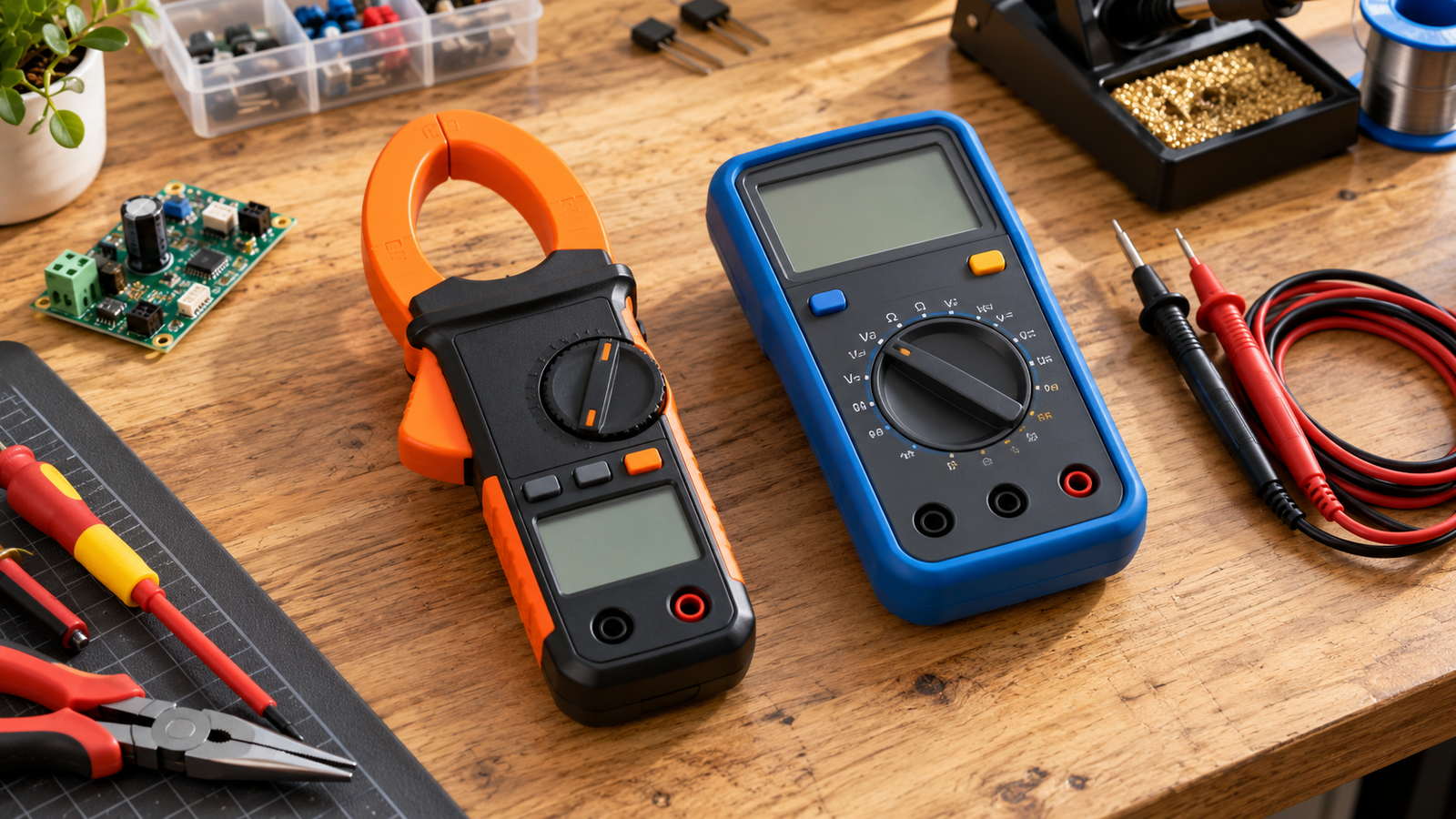
Features that deserve a closer look
AC current is not the same as DC current
Read the current specifications separately from the voltage specifications. A listing that says “AC/DC meter” may describe voltage capability while its jaws measure AC current only. Look for an explicit DC-current clamp range when battery-powered equipment is part of your work.
Accuracy and resolution answer different questions
Resolution is the smallest displayed increment. Accuracy describes the expected error under specified conditions. Extra digits do not guarantee useful accuracy at the bottom of a range. Compare both values at the measurements you expect to make, including any stated temperature or frequency limits.
True RMS has limits too
True-RMS capability can be useful with AC waveforms that differ from a clean sine wave. It does not remove all measurement limits. Frequency response, crest-factor restrictions and the chosen range still matter. For drive outputs or unusual signals, use the meter and settings specified for that application.
Safety ratings apply to the whole setup
Measurement-category markings describe suitability for particular electrical environments, not just a maximum steady voltage. The meter, leads, probes and accessories must all suit the job. The lowest-rated part limits the setup. Follow the manufacturer’s category descriptions and workplace procedures when selecting equipment.
Do not choose a meter for hazardous work from an online headline alone. Check the exact manual and markings, examine the leads, and verify the condition of the instrument. A damaged professional meter can be unsuitable even when its original specifications look impressive.
Common buying and measurement mistakes
- Buying by maximum amps: a large current range can come with insufficient sensitivity for small signals.
- Ignoring physical access: the jaws must close correctly around the intended conductor.
- Assuming every clamp measures DC current: check the jaw specifications explicitly.
- Confusing hold with inrush capture: the labels describe different operations.
- Leaving a lead in the current socket: check the sockets and dial before every new measurement.
- Using resistance mode on an energized circuit: disconnect power, discharge stored energy as instructed, and verify the condition before testing.
- Treating a zero reading as proof of safety: the setup, function and verification procedure determine what the reading means.
A careful routine matters more than speed. Inspect the meter and leads, identify the measurement, confirm the sockets and settings, and follow the equipment procedure. Stop when the reading or setup does not make sense instead of moving probes around until a plausible number appears.
A simple checklist before you order
Write down your three most frequent jobs. Next to each, note the electrical value you need and the expected range. This turns an overwhelming shopping list into a short set of requirements. If you mostly need continuity and battery voltage, focus your money on a suitable multimeter.
Then check practical details: can you read the screen in your workspace, operate the dial with your normal gloves, carry the tool comfortably, and obtain the specified replacement leads or fuses? A useful tool is one you can use correctly and maintain, not simply one with the most features.
Finally, compare the exact listing against the manufacturer’s documentation. Bundles can have different accessories, and marketplace pages can combine model variants. Avoid assuming that an image, review or accessory description applies to the model selected in the purchase menu.
For a simpler starting point, read our best multimeters for home use guide. You can add a current clamp later when your work creates a clear need for it.
Frequently asked questions
Can a clamp meter replace a multimeter?
Sometimes. A clamp with the voltage, resistance, continuity and other functions you need can cover many routine tasks. Compare its ranges, accuracy and sensitivity with your requirements. It may not replace a DMM used for small-current or detailed electronics work.
Can a multimeter measure current without breaking the circuit?
A compatible clamp accessory can make that possible. Direct current measurement through the meter’s current socket normally requires a series connection. Check accessory compatibility, conversion instructions and ratings before using that approach.
Can I clamp around an appliance’s entire power cord?
Not for an ordinary load-current reading. The outgoing and returning currents usually cancel in the clamp. Use an appropriate rated line splitter according to its instructions where suitable; do not alter the cord.
Which tool is better for beginners?
A clearly documented multimeter is usually the more useful first tool for low-voltage battery and disconnected continuity checks. Neither tool makes unfamiliar live electrical work safe. Learn its functions on suitable low-risk tasks and leave mains work to a qualified professional.
Is a clamp meter always safer?
A clamp can avoid opening the current path for certain measurements, but access to energized equipment can still create shock and arc-flash hazards. Training, equipment ratings, condition and the work procedure remain essential.
Do I need true RMS?
It depends on the signals and equipment you service. It can help with non-sinusoidal AC measurements within the meter’s specifications. Choose it alongside suitable bandwidth, ranges and safety ratings rather than treating it as the only buying criterion.
Our recommendation
Buy a multimeter first when voltage, continuity and component checks dominate your work. Buy a clamp meter first when accessible-conductor current measurements dominate it. For broader professional service, build a complementary pair around the tasks each instrument handles well.
Before ordering, verify the functions you need, the measurement environment, physical access and the exact model documentation. That small amount of checking is more valuable than paying extra for a capability that does not help your everyday jobs.
Sources and review approach
This is a manufacturer-documentation comparison, not a laboratory test or a claim of hands-on product testing. We used the resources below to verify measurement methods, model functions and safety points. Pricing, availability and packages can change.
