
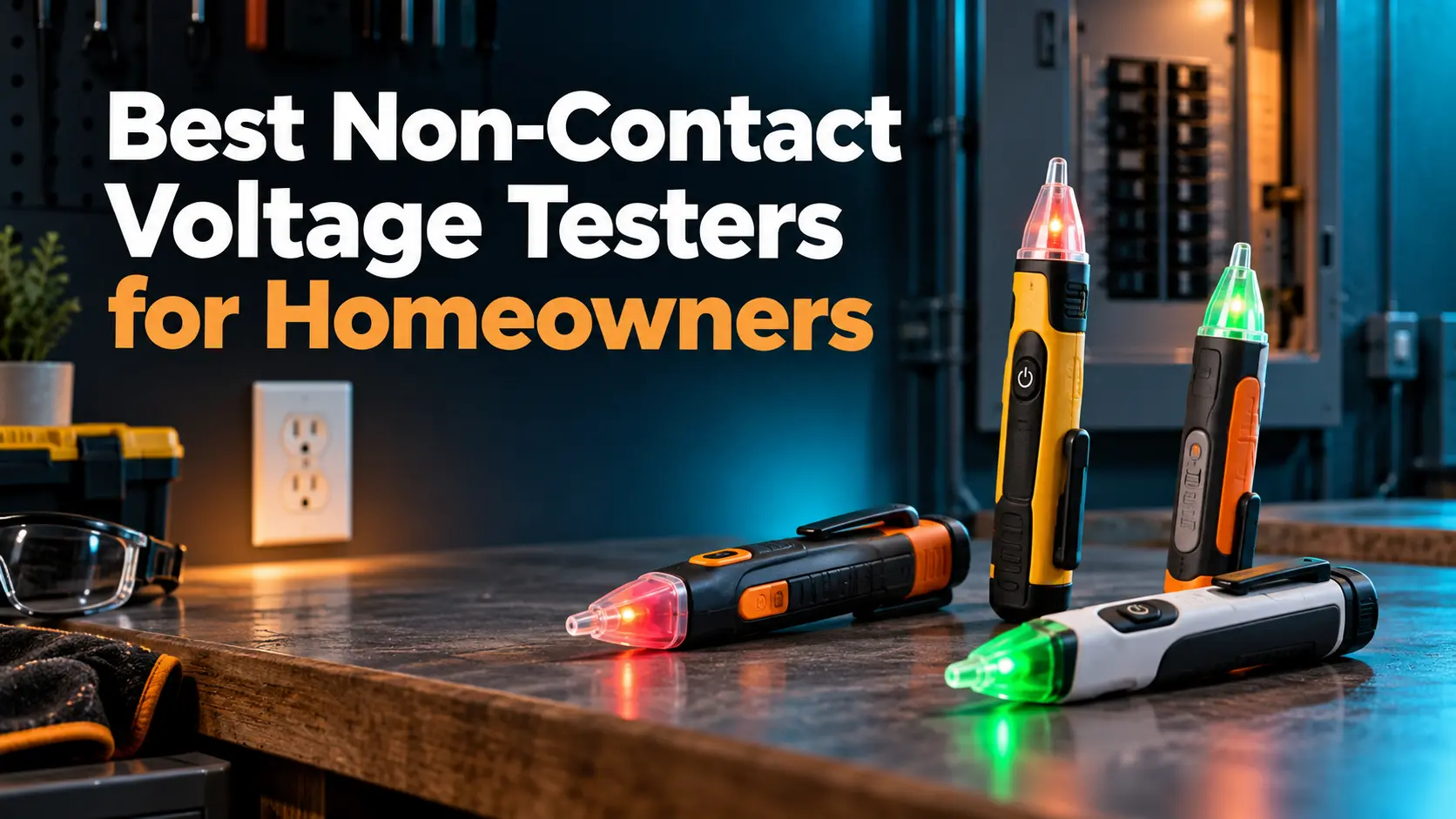
Best Non-Contact Voltage Testers for Homeowners
A good voltage detector helps you make a fast first check at outlets, switches, cords, fixtures, and breaker panels. We compared six practical options by detection range, safety rating, alerts, durability, and ease of use—without pretending a pen tester replaces a multimeter.

Klein NCVT-3P
Dual 12–1000V and 70–1000V AC modes, work light, IP67 protection, and clear sound-and-light alerts.
Fluke 1AC II
A straightforward VoltAlert detector for common mains-voltage checks, backed by a CAT IV 1000V rating.
Klein NCVT3PKIT
Pairs the NCVT-3P with a contact AC/DC voltage tester so you have a stronger follow-up method in one kit.
View Klein Tester Kit on Amazon
Our Top Non-Contact Voltage Tester Picks
| Tester | Best for | Published AC range | Key advantage | Important limitation |
|---|---|---|---|---|
| Klein NCVT-3P | Most homeowners | 12–1000V / 70–1000V | Dual range, flashlight, IP67 | Higher-sensitivity mode can react to nearby fields |
| Fluke 1AC II | Simple mains checks | 90–1000V on common A2 version | Simple operation and CAT IV rating | Not designed for common 12–24V control circuits |
| Milwaukee 3203-20 | Low- and standard-voltage work | 12–49V / 50–1000V | Automatic range differentiation and work light | Confirm the exact generation/model before ordering |
| Greenlee GT-16 | Adjustable sensitivity | 5–1000V AC | User-adjustable detection | Adjustment adds a learning step |
| Gardner Bender GVD-3504 | Budget household checks | 50–600V AC | Simple audible and visual alert | Narrower range and CAT III 600V rating |
| Klein NCVT3PKIT | First check plus confirmation | NCVT: 12–1000V / 70–1000V | Includes non-contact and contact testers | Costs and carries more than a single pen |
1. Klein Tools NCVT-3P
The NCVT-3P offers the most useful mix of range, feedback, durability, and everyday convenience in this group. Its standard mode detects 70–1000V AC, which suits outlets, switches, cords, circuit breakers, and common residential branch wiring. A second, more sensitive mode extends detection down to 12V AC for doorbells, thermostats, irrigation controls, and some low-voltage lighting systems.
Visual and audible indicators make the result easier to notice than a light-only pen. The flashlight works independently from voltage detection, so the tool remains helpful inside dark boxes and utility spaces. Klein publishes a 6.6-foot drop rating and IP67 dust-and-water protection, both valuable for a tool that may live in a garage drawer or tool pouch.
Best for: Homeowners who want one detector for ordinary 120V circuits plus occasional low-voltage checks.
2. Fluke 1AC II VoltAlert
The Fluke 1AC II is appealing when you want a familiar professional brand and uncomplicated operation. The common 1AC II A2 version is designed for 90–1000V AC, making it a natural match for standard household mains checks rather than low-voltage control wiring. When it senses an AC electrostatic field through insulation, its tip glows red and it can produce an audible alert.
The CAT IV 1000V rating is strong for this product class. However, the model suffix matters: Fluke has offered several VoltAlert versions with different sensing ranges and tip styles. Check the exact listing and model designation rather than assuming every 1AC-branded package has the same lower threshold.
Best for: Buyers primarily checking household outlets, cords, fixtures, and other standard-voltage AC systems.
3. Milwaukee 3203-20
Milwaukee’s current dual-range detector with LED is designed to distinguish lower-voltage and standard-voltage ranges automatically. The manufacturer publishes 12–49V AC and 50–1000V AC ranges, which makes it useful for homeowners who encounter both control circuits and regular branch wiring but would rather not manually switch modes.
The independent work light is useful around panels and dim utility spaces. Automatic differentiation also reduces one source of user error: forgetting which sensitivity range is active. That does not remove the need to understand what the alert pattern means, so read the instructions and practice on known sources before using it for a real troubleshooting decision.
Best for: Homeowners who want low-voltage sensitivity without manually toggling between two modes.
Check Milwaukee 3203-20 on Amazon
4. Greenlee GT-16
The Greenlee GT-16 takes a different approach: its sensitivity is adjustable. Greenlee publishes a broad 5–1000V AC rating and describes uses ranging from power wiring to thermostats, lighting, cables, and locating breaks. That flexibility can help when a fixed-threshold detector is either too insensitive or reacts too readily to nearby wiring.
The tradeoff is that an adjustable tool asks more of the user. You need to understand how the sensitivity control changes behavior and compare readings against known energized and de-energized areas. Treat it as a detector, not a voltage measurement instrument: the adjustment does not tell you the actual number of volts present.
Best for: Experienced DIY users who understand why they need adjustable sensitivity for mixed-voltage work.
5. Gardner Bender GVD-3504
The GVD-3504 focuses on common household tasks. Its published 50–600V AC range covers standard North American 120V and 240V circuits, while audible beeping and a flashing light provide two forms of feedback. A built-in safe-test feature helps indicate that the tester and battery are operating, although you should still prove it on a known live source before and after your check.
Its range is narrower and safety category lower than the premium models above, but the simplicity is appropriate for routine outlet, switch, fixture, and extension-cord checks when used within its published limits. It is not a low-voltage detector and should not be chosen for doorbell or thermostat troubleshooting.
Best for: Budget-conscious homeowners who only need basic standard-voltage AC detection.
6. Klein NCVT3PKIT
A non-contact detector is convenient, but it does not directly measure voltage. The NCVT3PKIT addresses that limitation by pairing the NCVT-3P with an AC/DC contact voltage tester. The pen provides the fast first pass; the contact tester provides a different method when the task and instructions call for confirmation.
This kit does not eliminate the need for training or a multimeter when you need an actual numerical measurement. It does, however, create a more responsible starter setup than relying on a non-contact pen alone. Read both manuals and respect the contact tester’s measurement-category and voltage limits.
Best for: Homeowners building a basic electrical-testing kit who want more than a simple go/no-go pen.
View Klein NCVT3PKIT on Amazon
How to Choose the Best Non-Contact Voltage Tester
Choose a useful detection range
Most U.S. household branch circuits are nominally 120V, while some large appliances use 240V. A detector beginning around 50–90V is usually suitable for a first check on these circuits. Doorbells, thermostats, irrigation controls, and some lighting controls can operate at lower AC voltages, so they require a detector whose published lower threshold covers the system. Do not assume that a “voltage pen” detects every voltage. Many do not detect DC at all.
Understand single-range and dual-range testers
A single-range tester is simpler and often less prone to reacting to weak fields when checking ordinary household mains. A dual-range model adds a sensitive low-voltage mode, useful for control wiring but more likely to respond to nearby energized conductors or induced fields. Some tools require manual mode selection; others differentiate ranges automatically. Neither design is always better—the right choice depends on what you plan to test.
Do not ignore measurement-category ratings
CAT ratings describe the transient-energy environment a tool is designed to withstand, not merely the everyday circuit voltage. CAT III tools are associated with building distribution and fixed installations; CAT IV applies closer to the source of an installation. A higher rating is not permission to work beyond your training. Use the tester only as its manufacturer directs, within its marked rating and environment.
Prefer clear power-on and voltage alerts
A detector should make it easy to distinguish “tool is on” from “voltage detected.” Look for documented power-on indication plus an obvious voltage response. Audible feedback helps when you cannot see the tip clearly, while a vibration alert can help in noisy environments. Always check that alerts are working on a known live source.
Consider durability and lighting
Drop ratings, ingress protection, a secure battery cap, and a durable pocket clip matter because these small testers are easy to drop or expose to dust. A built-in flashlight is genuinely useful in panels and utility spaces, especially when it operates independently. Durability features do not make the tool safe to use when wet or damaged; inspect it before every use.
Our practical homeowner choice
For the widest range of ordinary DIY checks, the Klein NCVT-3P offers the best balance of low-voltage capability, ruggedness, lighting, and clear feedback.
How to Use a Non-Contact Voltage Tester More Safely
- Inspect the tester. Do not use it if the housing, tip, battery cap, or clip is cracked, loose, or contaminated.
- Read the manual. Confirm the detection range, mode, alert pattern, environmental limits, and CAT rating.
- Prove it on a known live source. Use an outlet or conductor you know is energized and confirm the expected alert.
- Select the correct range. Use standard sensitivity for household mains unless you specifically need the low-voltage mode.
- Approach slowly. Move the tip around the outlet face, insulated conductor, cable, or device as the manual directs. Keep fingers behind the grip area.
- Treat an alert as voltage present. Stop and follow the correct de-energizing procedure.
- Do not treat silence as final proof. If safety depends on the result, confirm using a correctly rated contact instrument and proper procedure.
- Prove the tester again. Recheck the known live source after the test. This helps reveal a battery or tool failure that occurred during use.
For a step-by-step explanation, see our guide on how to check whether a wire is live. If you are scanning before drilling, also read what stud-finder wire detection can and cannot tell you. Electricians assembling a compact tool pouch may also find our guide to torpedo levels for electrical work useful.
Why False Positives and False Negatives Happen
A non-contact voltage tester senses an alternating electric field. It does not touch the conductor and it does not show a direct voltage measurement. Nearby energized wires can couple a weak field into a disconnected conductor, creating an alert that looks like real power. High-sensitivity modes make this more likely. Bundled cables, crowded boxes, fluorescent lighting, and tool orientation can also affect what the sensor sees.
A false negative is more dangerous. Possible causes include a weak battery, damaged tester, shielded cable, thick or wet materials, improper position, voltage below the tester’s range, or a circuit that is not referenced in the way the detector expects. Personal protective equipment and a non-contact pen do not substitute for safe isolation and verification procedures.
When You Need a Multimeter or Contact Tester
Use an appropriately rated multimeter or contact tester when you need to know the actual voltage, distinguish a ghost or induced voltage from an energized source, diagnose neutral or grounding problems, test DC, verify continuity on a de-energized circuit, or make a safety-critical absence-of-voltage decision. Contact instruments require correct lead placement, range selection, and safe technique. If you do not already know how to perform that test, stop and call a qualified electrician.
Frequently Asked Questions
What is the best non-contact voltage tester for most homeowners?
The Klein NCVT-3P is the most versatile option in this comparison because it combines standard and low-voltage modes, visual and audible feedback, an independent flashlight, IP67 protection, and a CAT IV 1000V rating. A simpler Fluke 1AC II may be preferable if you only check normal household mains.
Can a non-contact voltage tester tell me a wire is safe?
No. A silent result can occur even when voltage is present. Use the pen as a preliminary detector, prove it before and after the test, and confirm critical results with an appropriately rated contact instrument and proper procedure.
Will these testers detect DC voltage?
The non-contact models covered here are designed primarily for AC electric fields. Do not assume they detect automotive, battery, solar, or other DC voltage. Use a suitable contact meter for DC testing.
Why does my voltage pen beep near a dead wire?
It may be responding to induced voltage, an adjacent energized conductor, or a high-sensitivity setting. Separate conductors only after safe de-energizing and use a contact method when the distinction matters.
Should I choose a 12V or 50V lower threshold?
Choose a lower threshold if you intentionally test low-voltage AC controls such as some doorbell or thermostat wiring. For routine 120V household checks, a 50–90V threshold is often simpler and may reduce nuisance alerts.
Does a CAT IV rating make a tester more accurate?
No. The CAT rating concerns protection against transient energy in the intended electrical environment. It does not tell you the sensor’s accuracy or guarantee safe operation.
Final Verdict
Choose the Klein NCVT-3P if you want the best all-around homeowner detector with two ranges, a flashlight, and rugged protection. Choose the Fluke 1AC II if your priority is a straightforward standard-voltage tester from an established test-equipment brand. Choose the Klein NCVT3PKIT when you want a non-contact first check plus a separate contact tester for follow-up work.
Compare Non-Contact Voltage Testers on Amazon
Specification sources checked: Klein Tools NCVT-3P and NCVT3PKIT product documentation; Fluke 1AC II data sheet; Milwaukee 3203-20 product documentation; Greenlee GT-16 product page and manual; Gardner Bender GVD-3504 product page and manual. Specifications may change, so confirm the exact model and manual supplied with your tester.
