
Home Tool Buying Guide • Updated 2026
Choose a meter you can understand, trust, and use safely
The best multimeter for home use is not necessarily the model with the longest feature list. It is the one with a suitable safety rating, clear controls, dependable readings, and the functions you will actually use—whether you are checking batteries, tracing a faulty appliance, testing continuity, or troubleshooting a dead outlet.
Affiliate disclosure: Accurate Goods may earn a commission from qualifying Amazon purchases made through links on this page, at no extra cost to you. Our recommendations are based on features, safety specifications, usability, and practical fit—not commission size.
For most homeowners, the Klein Tools MM450 offers the best balance of true-RMS measurement, automatic ranging, useful test modes, and a CAT III 600V rating. Beginners who only need basic battery and low-voltage checks can spend less, while frequent DIY troubleshooters may appreciate the premium ergonomics and voltage-detection features of the Fluke 117.
Check Klein MM450 Price on Amazon →
Quick Answer: Our Top Picks
Klein Tools MM450
True-RMS, auto-ranging, broad home-use functions, and a sensible safety category.
Fluke 117
A polished professional-grade choice for homeowners who troubleshoot electrical systems often.
Klein Tools MM325
A straightforward manual-ranging meter for basic checks and users who prefer simple controls.
Comparison Table
| Model | Best for | Ranging | True RMS | Safety category | Notable features |
|---|---|---|---|---|---|
| Klein MM450 | Most homeowners | Auto | Yes | CAT III 600V | Temperature, capacitance, frequency, duty cycle |
| Fluke 117 | Premium troubleshooting | Auto/manual | Yes | CAT III 600V | Non-contact voltage, Min/Max/Average |
| Klein MM325 | Budget basics | Manual | No | CAT III 600V | Continuity, diode, battery test, lead alert |
| Extech EX330 | Compact versatility | Auto | No | Check current listing/manual | NCV, temperature, capacitance, frequency |
| Innova 3320 | Beginner and automotive basics | Auto | No | Check current listing/manual | Color-coded LEDs, protective corners |
| Klein MM420 | Rugged value alternative | Auto | No | CAT III 600V | Temperature, capacitance, frequency |
Specifications can change by production run or region. Confirm the current manufacturer manual and product labeling before use.
How We Chose
We prioritized safety classification, measurement capability, ease of use, display readability, probe handling, durability, and value for common household tasks. We also compared manufacturer documentation instead of ranking meters by feature count alone. A homeowner rarely benefits from an advanced function if the interface makes it easy to select the wrong mode.
Our shortlist covers three realistic groups: beginners checking batteries and electronics, DIY users troubleshooting appliances and household circuits, and experienced homeowners who want professional-grade consistency. We gave extra credit to auto-ranging, true-RMS measurement, a clear continuity alert, accessible fuses, protective housings, and controls that remain readable in dim work areas.
Klein Tools MM450
The MM450 is the easiest all-around recommendation because it combines homeowner-friendly auto-ranging with specifications that leave room for more advanced projects. It measures up to 600V AC/DC and 10A AC/DC, with resistance up to 50 megohms. It also covers temperature, capacitance, frequency, duty cycle, diode testing, and continuity.
True-RMS capability is important when a waveform is not a clean sine wave. Modern dimmers, variable-speed motors, electronic power supplies, and some appliances can create distorted signals. A true-RMS meter is better equipped to report a meaningful AC value in those situations. You may not need this every weekend, but it makes the MM450 a meter you are less likely to outgrow.
What we like
- Auto-ranging reduces dial decisions for newer users.
- CAT III 600V labeling suits many building-level electrical measurements when used correctly.
- A broad set of modes supports HVAC, appliance, electronics, and general DIY diagnosis.
- The slim body is easier to hold while positioning probes.
Keep in mind
More modes also mean more responsibility. Always confirm the dial position, input jack, and expected range before touching a circuit. The meter does not replace training or proper protective practices.
Fluke 117
The Fluke 117 is aimed at electrical troubleshooting and feels purpose-built for repeated use. It is a 6000-count true-RMS meter with a CAT III 600V rating. Its built-in non-contact voltage detection can help with an initial scan, while resistance, continuity, frequency, capacitance, and Min/Max/Average recording support deeper diagnosis.
The practical advantage is workflow. If you regularly maintain rental property, renovate rooms, or troubleshoot lighting and appliance circuits, a responsive continuity beeper and predictable interface save time. Fluke also has a long-standing reputation in professional test equipment, although brand reputation never eliminates the need to inspect leads and follow the manual.
Who should buy it?
Choose the 117 if you expect frequent use and place a high value on refined operation. It can be excessive for someone who checks a few AA batteries each year. It also does not make live-panel work appropriate for an untrained user.
Klein Tools MM325
The MM325 is a capable basic meter for users comfortable choosing ranges manually. It measures up to 600V AC/DC, 10A DC, and 2 megohms resistance, and includes continuity, diode, and battery-test functions. The backlit display and lead-alert feature are welcome at this price level, while the CAT III 600V marking and claimed 6.6-foot drop protection add practical confidence.
Manual ranging is both its limitation and its teaching value. You must understand the expected measurement and choose an appropriate range. That takes longer, but it encourages deliberate setup. For low-voltage projects, battery checks, basic continuity, and occasional household diagnosis, it can be enough.
Skip it if
You work around variable-speed equipment or want the convenience of true-RMS auto-ranging. In that case, moving up to the MM450 makes sense.
Extech EX330
The EX330 packs a useful range of functions into a compact 4000-count auto-ranging meter. Manufacturer information lists built-in non-contact voltage detection along with frequency, duty cycle, capacitance, temperature, diode testing, and continuity. That combination works well for a homeowner who moves between electronics, appliances, and HVAC-related checks.
Its main compromise is that it is not a true-RMS model. For ordinary batteries, resistance, continuity, and many clean-waveform measurements, that may not matter. For electronically controlled loads and distorted AC waveforms, a true-RMS model is the better choice.
Best use case
Pick the EX330 when compact size, temperature measurement, and built-in NCV matter more than true-RMS capability. Verify the category rating printed on the exact meter and manual before using it on household mains.
Innova 3320
The Innova 3320 is designed around approachable general-purpose testing. It auto-ranges, covers 0–600V AC/DC, and measures resistance up to 20 megohms. Color-coded indicators and protective corner guards help it feel less intimidating for first-time users, and its feature set crosses naturally between home and automotive basics.
It is not a true-RMS meter, and it lacks the broader electrical-troubleshooting focus of the Klein MM450 or Fluke 117. Treat it as a friendly entry point for battery voltage, continuity, fuses, switches, and simple low-voltage checks—not a shortcut into complex live electrical work.
Klein Tools MM420
The MM420 sits between a basic manual meter and the true-RMS MM450. It is auto-ranging and measures up to 600V AC/DC, 10A AC/DC, and 50 megohms resistance, plus temperature, capacitance, frequency, duty cycle, diode, and continuity. Klein lists CAT III 600V protection and a two-meter drop rating.
This is a sensible alternative when you want the MM450-style convenience and broad functions but do not expect to measure distorted AC waveforms. The tradeoff is clear: without true RMS, it is less versatile around modern electronic loads.
Multimeter Safety: Read This Before Testing
A category rating is not a permission slip. It describes the transient environment the meter was designed to withstand when used as specified. CAT II is generally associated with loads connected to receptacles, CAT III with building distribution, and CAT IV with the service entrance and outdoor conductors. The voltage number and category both matter, and the entire measurement system is only as safe as its lowest-rated component.
- Inspect the case, probe insulation, finger guards, and plugs before every use.
- Put the black lead in COM and confirm the red lead is in the correct jack for the measurement.
- Never measure voltage while the red lead remains in the current jack.
- De-energize the circuit before resistance, continuity, diode, or capacitance testing.
- When possible, prove the meter on a known source before and after a voltage check.
- Keep fingers behind probe guards and avoid working alone around hazardous voltage.
- If you are unsure about a panel, mains circuit, or exposed conductor, stop and call a licensed electrician.
A non-contact tester is useful for screening, but it does not provide a numerical measurement and should not be your only proof of a safe condition. See our guide to the best non-contact voltage testers and learn how to check whether a wire is live. Before drilling, also understand whether a stud finder can detect wires.
Buying Guide: What Matters Most
Auto-ranging versus manual-ranging
Auto-ranging selects a suitable display range after you choose the measurement type. It is faster and reduces setup friction. Manual-ranging models cost less and can respond predictably when the user already knows the approximate value, but choosing too low a range may show an overload indication. For most first-time homeowners, auto-ranging is worth paying for.
True RMS
A basic averaging meter can be accurate on a clean sine wave but misleading on distorted signals. True-RMS meters calculate a more representative heating value across a wider variety of waveforms. This is useful around dimmers, electronic controls, variable-speed drives, and switch-mode power supplies. It is not essential for checking a 1.5V battery, but it adds future-proofing.
Counts and resolution
Display count indicates how finely a meter can show a value before changing range. More counts can reveal smaller differences, but accuracy specifications matter more than a large count alone. Home users should favor a readable display and stable readings over impressive-sounding resolution they do not need.
Continuity response
A fast, clear beeper makes tracing switches, fuses, cables, and connections much easier. Always remove power first. A delayed or inconsistent beep can turn a simple job into frustration, so this is one of the most practical features to compare.
Replaceable fuses and lead quality
Current inputs should be properly fused, and replacement fuse specifications must match the manufacturer requirements. Never substitute a random fuse. Flexible silicone-style leads are easier to position in cold conditions, while sturdy finger guards help maintain distance from energized points.
Functions you will really use
Most homeowners repeatedly use DC voltage, AC voltage, resistance, and continuity. Capacitance helps diagnose motor and HVAC capacitors, temperature can support appliance work, and frequency may help with generators. Current measurement is valuable but introduces setup risks because the meter must be placed in series. Do not pay for specialized modes without understanding their purpose.
Common Home Tasks
Testing household batteries
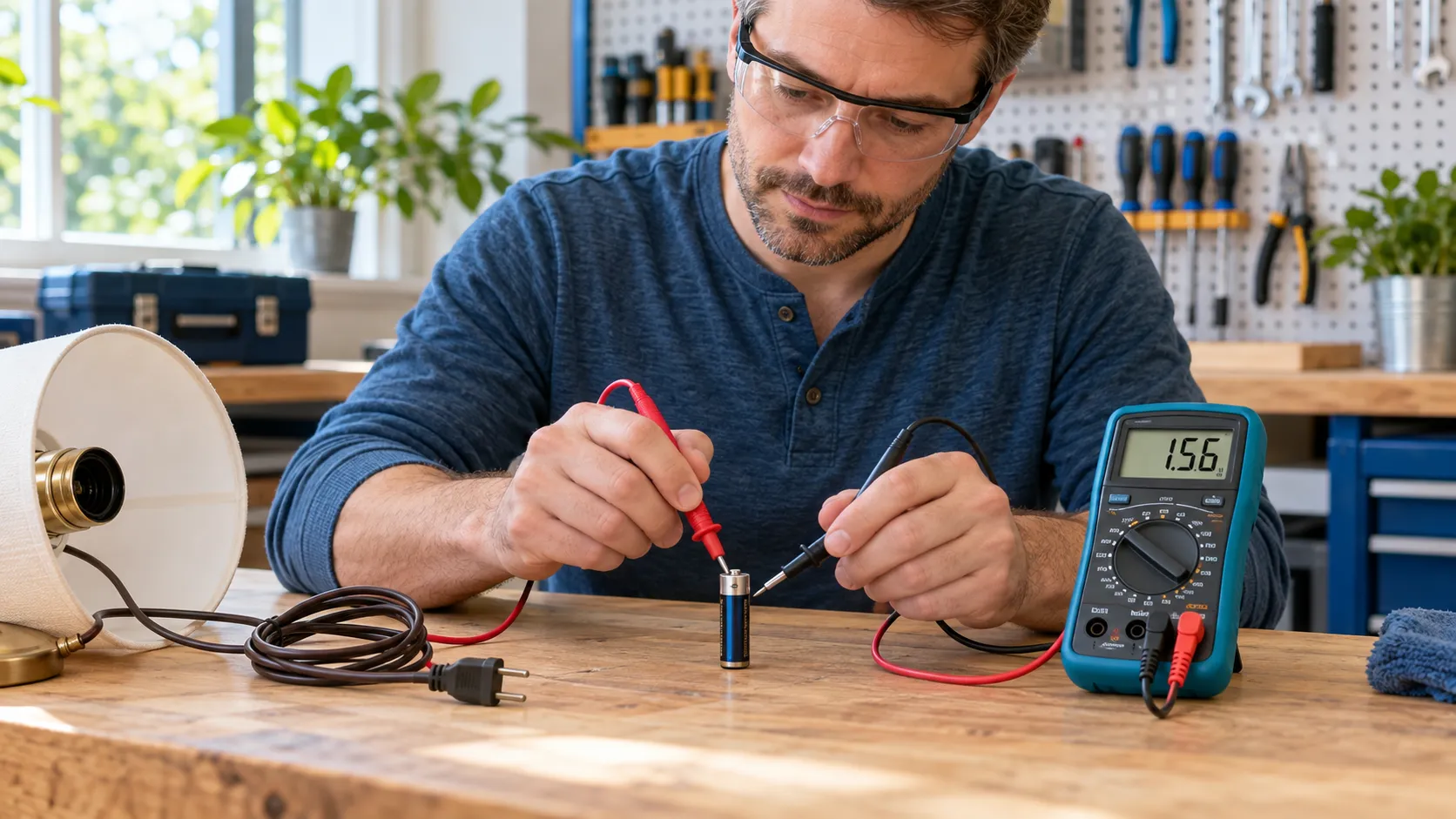
Select DC voltage, connect the leads to COM and V, and touch red to positive and black to negative. Compare the measured value with the battery’s nominal voltage and the device’s requirements. A voltage reading without load does not always reveal remaining capacity, but it is a useful first check.
Checking a fuse or switch
Disconnect power and isolate the component. Select continuity or resistance and touch the probes together to confirm the meter responds. Then test across the fuse or closed switch. A low resistance or beep usually indicates a continuous path; an open indication means the path is broken.
Troubleshooting an outlet
Outlet testing involves hazardous mains voltage. A plug-in receptacle tester is often simpler for common wiring patterns. A multimeter can provide deeper information, but only users trained in safe live-circuit measurements should probe a receptacle. If anything looks damaged or results are confusing, stop.
Automotive checks
A 12V vehicle battery, charging system, fuse, and many sensors can be evaluated with common multimeter modes. Work away from moving belts, fans, hot surfaces, and fuel vapors. Remember that hybrid and electric vehicles contain high-voltage systems that require specialized training and equipment.
Compare Home Multimeters on Amazon →
Frequently Asked Questions
What is the best multimeter for a beginner?
The Klein MM450 is our best overall choice because auto-ranging reduces setup work and true RMS offers room to grow. For basic battery and continuity checks on a tighter budget, the Innova 3320 is approachable.
Do I need true RMS for home use?
Not for simple DC batteries, resistance, or continuity. It becomes useful when measuring AC from electronic controls, dimmers, variable-speed motors, and other loads that distort the waveform.
Is a CAT III meter safe for outlets?
A properly certified CAT III meter may be designed for building-distribution environments, but safe use also requires correctly rated leads, intact equipment, correct settings, and user training. The label alone does not make an action safe.
Can a multimeter replace a non-contact voltage tester?
No. They complement each other. An NCV tester is quick for initial screening; a multimeter provides measured values. Neither should be used beyond its instructions or as a substitute for safe isolation procedures.
Why does my meter show OL?
OL usually indicates an open circuit or a value beyond the selected range, depending on the mode. Check the manual, lead placement, dial setting, and whether the component is isolated from power.
Final Verdict
For the widest range of household users, buy the Klein Tools MM450. Its auto-ranging interface, true-RMS capability, broad functions, and CAT III 600V specification create the strongest mix of usability and long-term value. Choose the Fluke 117 when frequent electrical troubleshooting justifies a premium tool, or the Klein MM325 when your needs are basic and you understand manual ranging.
No meter makes an unsafe procedure safe. Match the instrument to the environment, read its manual, inspect it before use, and hand hazardous mains work to a qualified electrician.
Care and Storage Tips
Remove the leads by gripping their insulated plugs rather than pulling the cable. Wipe the case with a dry or lightly damp cloth and avoid solvents unless the manufacturer approves them. Store the meter, probes, and accessories in a protective pouch where sharp tools cannot cut the insulation. If the display becomes dim or readings behave unpredictably, replace the battery according to the manual before assuming the circuit is faulty.
Periodically inspect and test the meter against a known reference. Replace damaged probes immediately with leads that meet the meter manufacturer’s voltage and category requirements. If a fuse opens, identify why it happened and install only the specified type—never bridge it or improvise. Remove the battery before long-term storage to reduce leakage risk. Careful storage does more than extend tool life: it makes defects easier to notice before your next measurement.
