
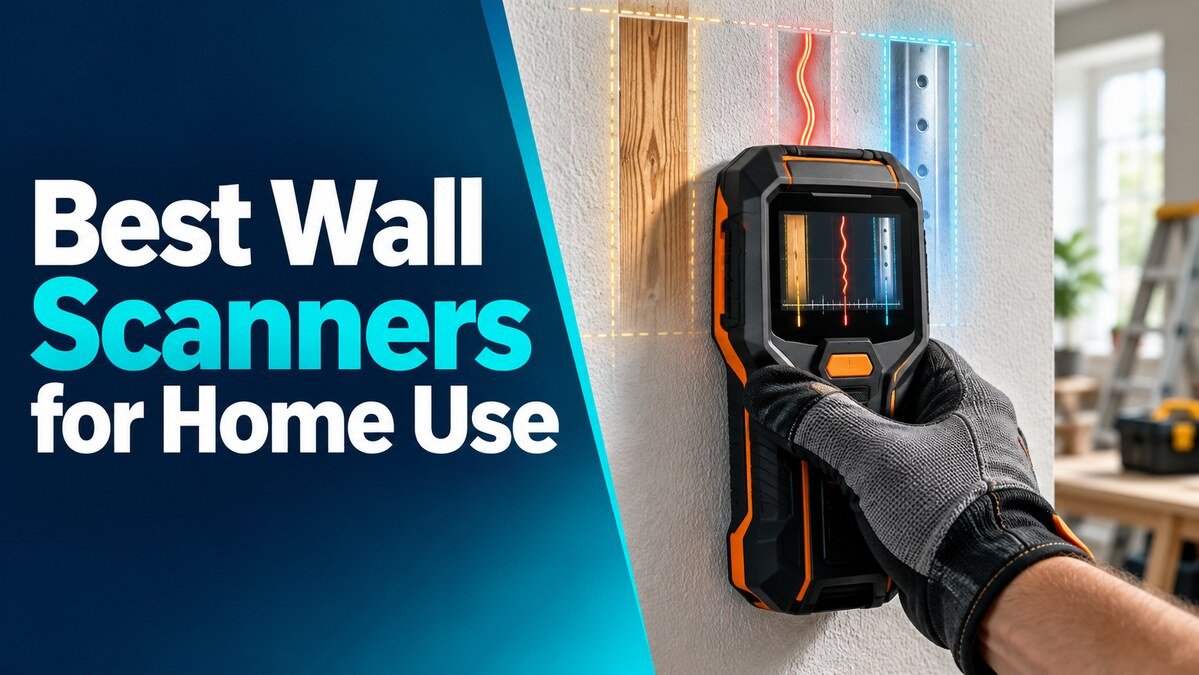
Best Wall Scanners for Home Use
Choose the right detector for studs, metal, pipes, and live-wire warnings—without paying for features your projects will not use.
Compare Wall Scanners on Amazon
Start with a premium professional scanner for demanding work, or compare wider homeowner models for everyday mounting projects.
See Premium Wall ScannersCompare Home Models
As an Amazon Associate, we may earn from qualifying purchases. Price and availability may change.
A good wall scanner can make the difference between a clean installation and an expensive repair. The simplest models locate changes in wall density, while more advanced tools combine multiple sensing methods to display likely wood, metal, pipes, and energized conductors. The challenge is that manufacturers use similar words—deep scan, multi-mode, radar, center finding—for products that deliver very different levels of information.
This guide separates ordinary stud finders from true multi-material scanners, explains which features are useful in real home projects, and recommends three product classes for different budgets. We do not treat any scanner as x-ray vision. Wall construction, moisture, foil insulation, mesh, tile, plaster, closely spaced objects, and the user’s scanning technique can all affect the result.
Our Recommended Wall Scanner Types
Best Premium
Bosch D-tect 200 C class
For serious remodeling, complex materials, and users who want a visual display rather than a simple edge alert.
Best Mid-Range
Bosch GMS multi-detector class
A practical balance for locating likely studs, metal, and live-wire warnings during frequent DIY work.
Best for Studs
Franklin Sensors ProSensor M210 class
Wide sensor coverage and an easy-to-read indication make it convenient for shelves, TVs, and cabinets.
Wall Scanner Comparison at a Glance
| Tool Type | Best For | Main Strength | Main Limitation |
|---|---|---|---|
| Wide multi-sensor stud finder | Drywall mounting and stud-center work | Fast, readable stud location | Limited material identification |
| Multi-detector | Mixed DIY projects | Can distinguish or warn about several target types | Needs careful calibration and repeat scans |
| Radar-style wall scanner | Remodeling, thick assemblies, concrete | More detailed position and depth context | High price and steeper learning curve |
| Magnetic finder | Plaster and simple screw detection | No batteries and very low cost | Finds metal fasteners, not the whole stud |
What Is a Wall Scanner?
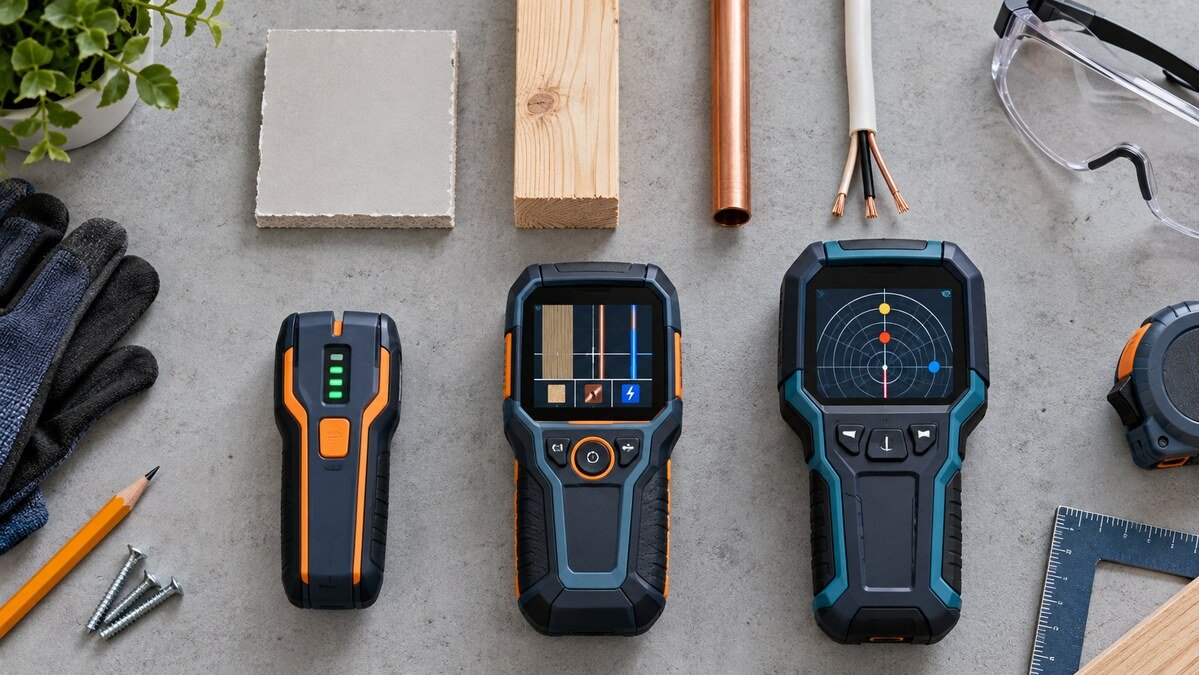
A wall scanner is a handheld detector designed to identify changes or objects beneath a finished surface. Depending on the model, it may respond to density differences, metal, electrical fields, capacitance, or radar reflections. The result may be a light, a row of indicators, an audible alert, a center mark, a material icon, or a visual map on a screen.
The name does not guarantee a particular capability. Some products advertised as wall scanners are essentially electronic stud finders with an added live-wire warning. Professional scanners may detect deeper objects and provide more context, but even those require correct mode selection and interpretation. Always read the manual for the exact surface, target, depth, and safety limits supported by the tool.
How We Chose the Best Options
We prioritized useful capability rather than the longest feature list. For homeowners, a scanner should provide repeatable indications, a clear way to locate the center or edges of a target, simple calibration, and enough feedback to recognize an uncertain scan. We also considered whether the controls can be understood while the tool is held against a vertical surface.
- Detection clarity: The display should communicate more than a vague beep.
- Repeatability: Scanning the same path in both directions should produce a consistent target area.
- Surface versatility: Useful modes should match drywall, plaster, masonry, or other intended materials.
- Live-wire warning: Helpful as a secondary alert, but never treated as proof that no voltage exists.
- Ergonomics: A stable grip and visible marking point reduce positioning errors.
- Value: The price should match the depth, material information, and frequency of use.
Best Premium Choice: Professional Radar-Style Scanner
A Bosch D-tect 200 C–class scanner is the high-ticket choice for remodelers, inspectors, and serious DIY users who regularly work with more than ordinary drywall. Its greatest advantage is not a single claimed depth number. It is the ability to present more visual context about a detected object, helping the user compare its position across repeated passes.
This category makes sense when drilling into walls or floors is part of frequent work, when targets may include pipes or metal behind complex material, or when mistakes would be unusually costly. It is excessive for someone who only hangs an occasional picture. The display also requires interpretation: an on-screen target is evidence to investigate, not permission to drill immediately.
Best Mid-Range Choice: Multi-Detector
A Bosch GMS–class multi-detector is a more affordable step up from a basic stud finder. These tools are intended to help the user locate likely wood substructures, metal, and live electrical activity with different icons or modes. They are useful for installing cabinets, shelves, handrails, televisions, or storage systems when more than one hidden-object type may be present.
The mid-range category rewards careful technique. Start the tool on a clear area when the instructions require calibration, hold it flat, move slowly, and repeat the scan beyond the target. A single alert can result from an edge, a nearby fastener, foil-backed material, or the user’s hand position. The value comes from combining several consistent passes.
Best for Fast Stud Finding: Wide Sensor Array
A Franklin Sensors ProSensor M210–class finder is designed around wide coverage and multiple sensors. Instead of locating one edge and asking the user to calculate the center, the indicator array can show the approximate width and center of a stud area. This is especially convenient when placing several fasteners for a long shelf, cabinet rail, television mount, or garage organizer.
This type is not the most informative choice for distinguishing pipes from other hidden objects. Its strength is fast, intuitive stud finding on compatible wall construction. If your primary question is “Where is the stud?” rather than “What exactly is behind this surface?”, a wide array often provides better everyday value than a complicated display.
Stud Finder vs Wall Scanner
A stud finder usually focuses on locating framing behind drywall. A wall scanner is a broader category that may add metal detection, energized-wire warnings, target depth, material icons, or a visual representation. Marketing language overlaps, so compare the actual modes rather than the product name.
For a deeper look at challenging surfaces, see our guide to the best stud finders for plaster walls. If your main concern is technique rather than buying a new tool, follow how to find studs behind plaster without damaging walls.
Detection Modes Explained
Wood or Drywall Mode
This mode looks for changes associated with framing behind a relatively uniform surface. It can be confused by doubled drywall, lath, adhesive, insulation, moisture, and nearby objects. Mark both sides of the response and compare the center with expected framing spacing.
Metal Mode
Metal detection can help locate screws, nails, metal studs, pipes, mesh, or reinforcement. The scanner may not identify which metal object produced the response. Scan vertically and horizontally to learn whether the signal behaves like a small fastener, a long pipe, a stud, or widespread mesh.
Live-Wire Warning
Electrical warnings sense fields produced under supported conditions. Shielding, depth, moisture, disconnected conductors, cable orientation, grounding, or the way the user holds the scanner may change sensitivity. A missing warning never proves the area is electrically safe.
Deep or Radar Mode
Advanced modes may look deeper or show more target information, but increased sensitivity can also display more objects. Choose the surface type correctly and learn the display on a known test area before relying on it in a critical location.
How to Use a Wall Scanner Correctly
- Read the manual and select the mode intended for the wall material.
- Inspect the wall for outlets, switches, plumbing fixtures, cabinets, and visible clues.
- Place the scanner flat on a clear starting area and calibrate as directed.
- Move slowly in a straight horizontal line without lifting or rocking the tool.
- Mark the first edge, continue past the response, and mark the opposite edge.
- Repeat from the other direction and compare the marks.
- Scan vertically to see whether the response continues like a stud or pipe.
- Use a second method, such as a magnetic fastener finder, nearby outlet position, or small non-destructive confirmation where appropriate.
- Before electrical work, use the correct voltage verification procedure rather than relying on the scanner’s live-wire icon.
Why Wall Scanners Give False Readings
False or shifting indications do not always mean the product is defective. Wall systems contain layers and materials that interact with sensing methods. Plaster over wood or metal lath can create continuous responses. Tile adhesive, foil-faced insulation, metal corner bead, wet material, pipes close to studs, and densely packed wiring can also change the result.
User technique matters just as much. Starting directly over a target, moving too quickly, changing pressure, placing fingers around the sensing area, or failing to scan beyond the object may produce confusing results. Fresh batteries and a clean, flat sensing surface are basic but important. When a result affects a costly or risky cut, repeat the scan with a different mode or tool.
Buying Checklist
- Primary task: Decide whether you mainly need stud centers, mixed-material warnings, or professional imaging.
- Wall construction: Drywall, plaster, tile, masonry, and concrete do not behave the same.
- Display: Choose lights for speed or a visual screen for more context.
- Marking point: A center notch or guide helps transfer the detection location accurately.
- Calibration: Automatic calibration is convenient, but the instructions still matter.
- Power: Consider battery availability, rechargeability, and a visible status indicator.
- Case and protection: Premium scanners deserve a protective case and careful storage.
- Return policy: Test the unit on known walls while the return window is active.
Frequently Asked Questions
Can a wall scanner detect electrical wires?
Many models provide a live-wire warning, but detection depends on depth, load, shielding, grounding, and wall construction. Use the warning as additional information, not as a safety clearance.
Can a wall scanner find water pipes?
Advanced scanners may detect objects consistent with metal or other materials, but a reading may not uniquely identify a water pipe. Consider the route from nearby fixtures and confirm before cutting.
Do wall scanners work through plaster?
Some do, but plaster thickness and wood or metal lath make scanning harder. A magnetic finder can be useful for locating fasteners, and repeated scans with more than one method improve confidence.
Is an expensive scanner worth it?
It can be worthwhile for frequent remodeling, concrete work, or projects where one mistake would exceed the tool’s cost. For occasional drywall mounting, a quality wide-sensor stud finder is usually sufficient.
How do I know if the reading is reliable?
A useful target should appear consistently from both directions and across repeated passes. Compare the response with wall layout, outlets, fixtures, and a second detection method.
Can a wall scanner see through walls like an x-ray?
No. It interprets signals affected by hidden materials and the surface assembly. Even visual-display models provide detection information, not a photographic view inside the wall.
Final Verdict
For most homeowners, a reliable wide multi-sensor finder offers the best balance of speed, simplicity, and cost. Choose a mid-range multi-detector when you regularly work around metal and wiring. Invest in a premium radar-style scanner when your remodeling work involves complex materials, deeper targets, or expensive consequences.
The right purchase is the model whose information you can interpret consistently. Practice on known studs, pipes, and wiring routes before using the scanner for a critical hole. Most importantly, treat every result as one part of a safe inspection process—not as a guarantee that the wall is clear.
Choose the Right Wall Scanner
Compare Professional ScannersCompare Home Wall Scanners
As an Amazon Associate, we may earn from qualifying purchases.
