

Best Wire Tracers for Home Use
Find hidden electrical paths, identify low-voltage cables, and match breakers more confidently with the right transmitter-and-receiver kit.
Affiliate disclosure: Accurate Goods may earn a commission from qualifying Amazon purchases made through links on this page, at no extra cost to you. Recommendations are based on documented capability, homeowner usefulness, safety limitations, and buyer fit.
Quick Answer
The Klein Tools ET450 is our best overall wire tracer for homeowners tackling electrical circuits because its official specification supports tracing energized and non-energized breakers, fuses, and wires. For Ethernet, telephone, speaker, or coax identification, choose a low-voltage tone-and-probe kit instead: the Fluke Networks Pro3000F60-KIT is the premium filtered choice, while the Sperry ET64220 is the value-oriented multi-cable option.
Check Availability on Amazon →
Top Picks Compared
| Model | Best for | Cable state | Key advantage |
|---|---|---|---|
| Klein Tools ET450 | Household electrical circuits | Energized or non-energized per manufacturer | Advanced tracing versatility |
| Fluke Networks Pro3000F60-KIT | Data/phone cable work | Inactive networks | 60 Hz interference filtering |
| Sperry ET64220 | Mixed low-voltage cables | Non-energized wires | Multiple included adapters |
| Extech 40180 | Phone and continuity work | Follow manual limits | Tracing plus line checks |
Safety distinction: “Wire tracer” can mean an electrical circuit tracer or a low-voltage tone generator and probe. Never connect a low-voltage toner to energized wiring. Confirm the exact model, manual, rated use, accessories, and cable state before connecting any transmitter.
1. Klein Tools ET450 Advanced Circuit Tracer Kit
The ET450 is the strongest choice here for a homeowner who needs more than a basic breaker finder. Klein describes it as a professional tracer for energized and non-energized breakers, fuses, and wires. The transmitter injects a traceable signal and the receiver lets the user adjust sensitivity while following that signal at a panel, along a route, or near concealed wiring.
This versatility makes sense during a renovation, when old panel labels are unreliable or a cable disappears behind finished surfaces. The receiver adds a backlit LCD, audible and visual signal indication, a flashlight, and a non-contact voltage function. The kit also includes multiple connection leads and a hard case, so it is better suited to repeated projects than a single-purpose pen.
The ET450 is not magic. Signal behavior depends on grounding, parallel conductors, wall materials, cable depth, and connection method. It is also a more expensive and complex tool than a basic outlet-to-breaker finder. Read the manual before attaching the transmitter, begin with higher-level scanning, and narrow sensitivity only after establishing the general path.
- Traces energized and non-energized circuits as documented
- Adjustable receiver sensitivity
- Useful visual, audible, and LCD feedback
- Flashlight, NCV function, leads, and hard case
- You only identify one breaker occasionally
- You mainly trace Ethernet or speaker cable
- You will not study the connection procedures
View Klein ET450 on Amazon →
2. Fluke Networks Pro3000F60-KIT
The Pro3000F60-KIT is built for tracing communication cabling rather than household power conductors. Its tone generator places an analog signal on a cable, and the handheld probe follows that tone. Fluke Networks documents 60 Hz filtering in the North American version, which helps reduce the familiar electrical buzz that can make a target tone hard to hear near power wiring, lights, or fans.
This is an excellent fit for finding an unlabeled telephone run, identifying a cable at a patch area, or separating a target pair from a group. SmartTone provides different tones for pair identification, and the probe offers adjustable volume, a replaceable tip, and an earphone jack. The official comparison specifies use on inactive networks; users who need active-network identification should look at an appropriate digital model rather than assuming this analog kit is suitable.
For a homeowner with structured wiring, a home office, or an older bundle of phone cables, the filtered probe can save time. It is overkill for someone who only needs to match a single speaker wire once.
- 60 Hz interference filtering for North America
- Clear tone-and-probe workflow
- Adjustable volume and replaceable tip
- Strong fit for inactive communication cabling
- You need to trace household mains wiring
- You need active Ethernet testing
- You want the lowest-cost occasional-use tool
View Pro3000F60-KIT on Amazon →
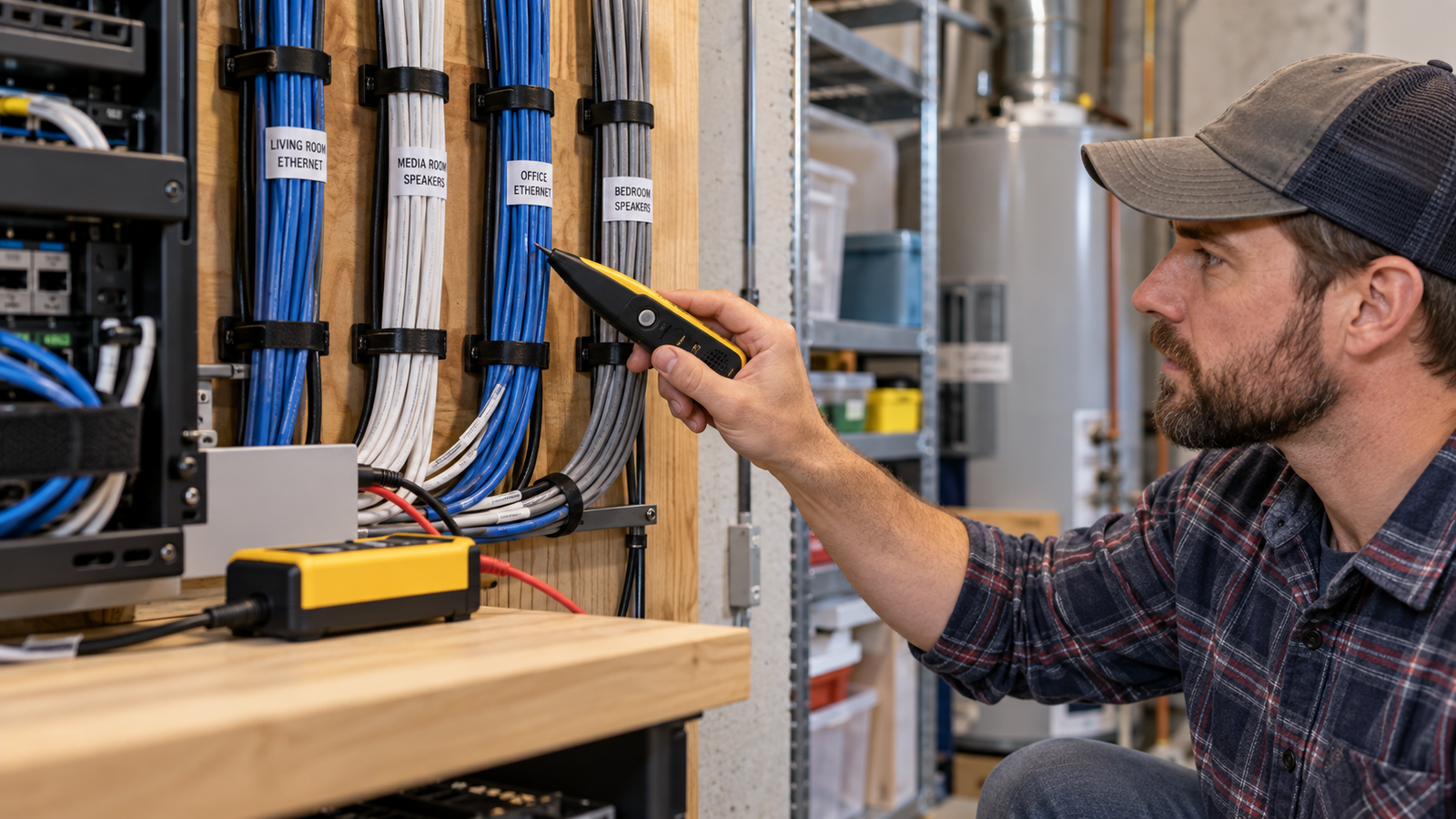
3. Sperry Instruments ET64220 LAN WireTracker
The Sperry ET64220 is the practical value pick for homes with a mixture of coax, CAT 5, speaker, telephone, or other non-energized wire. The official product information lists RJ-45, RJ-11, coax, automotive fuse-blade, and insulated-clamp adapters. That adapter variety makes it convenient when you do not yet know which cable type will become the next weekend project.
The receiver uses audible and visual indication, with adjustable sensitivity to help distinguish one conductor when several run together. Auto shutoff helps conserve batteries after a tracing session. The essential limitation is equally clear: Sperry describes it for non-energized wires. Disconnect the cable from equipment and verify it is not carrying hazardous voltage before attaching the transmitter.
This is not the tool for locating a live 120-volt branch circuit behind drywall. It is better for sorting the low-voltage mystery bundle left by a previous homeowner.
- Adapters for several common cable types
- Audible and visual feedback
- Adjustable sensitivity
- Good homeowner value
- You need energized circuit tracing
- You want advanced network qualification
- Your cable cannot be safely disconnected
View Sperry ET64220 on Amazon →
4. Extech 40180 Tone Generator and Probe Kit
The Extech 40180 combines basic wire tracing with continuity and telephone-line checks. Extech lists wire tracing, continuity testing, clear/busy/ringing line tests, and tip-or-ring identification. That mix is useful in an older house where legacy telephone wiring still feeds an alarm, intercom, DSL line, or repurposed cable run.
The kit is less specialized for hidden household power wiring than the Klein and less focused on interference filtering than the Fluke Networks option. Its strength is the combination of common low-voltage troubleshooting functions in one recognizable kit. Follow the manual’s connection limits and isolate the target cable appropriately before applying a tone.
- Tracing and continuity functions
- Phone-line status checks
- Useful for legacy home wiring
- Clear purpose-specific buyer fit
- You need an energized branch-circuit tracer
- You need professional network certification
- You only trace coax
View Extech 40180 on Amazon →
How to Choose the Right Wire Tracer
Start with the cable type
Household electrical wiring, Ethernet, coax, telephone, doorbell, thermostat, and speaker wire are not interchangeable test environments. A tracer designed for de-energized data cable may be damaged—or create a serious hazard—if attached to a mains circuit. Write down the cable type and whether it can be fully disconnected before comparing features.
Energized versus non-energized capability
Manufacturer documentation must explicitly support the state you intend to trace. A tool with non-contact voltage detection is not automatically approved to inject a tone into live wiring. For low-voltage toner kits, isolate the line from equipment and power. When the circuit cannot be positively identified, use an electrician.
Receiver sensitivity and feedback
Adjustable sensitivity helps begin with a broad search and then narrow the location. Audio is intuitive, while a numerical or bar-style visual indicator is helpful in noisy spaces. A headphone jack can help around furnaces and fans, but you should never reduce situational awareness around an open electrical panel.
Connection accessories
Outlet plugs, alligator clips, RJ-45, RJ-11, coax, and long leads serve different jobs. The most useful kit is not necessarily the one with the most pieces; it is the one that connects safely to your actual wiring without improvised adapters.
Interference control
Nearby power wiring can introduce hum and spread a signal. Filtered probes can improve low-voltage tracing, while a grounded electrical tracer and careful sensitivity adjustment can improve branch-circuit work. Even good tools may produce a wide signal near bundled conductors.
Compare Wire Tracer Kits →
Safe Step-by-Step Tracing Workflow
- Map the job. Identify both likely ends of the cable and note all connected devices.
- Read the model manual. Confirm allowed voltage, cable type, connection method, and category before connecting.
- Inspect the kit. Do not use damaged leads, cracked probes, leaking batteries, or loose adapters.
- Verify circuit state. Use appropriate test equipment and do not rely on a label or switched-off device.
- Connect exactly as documented. Grounding and lead placement strongly affect signal quality.
- Begin at lower precision. Scan the general path, then reduce sensitivity to narrow the signal.
- Confirm at the far end. A strong signal is evidence, not proof. Disconnect and recheck when possible.
- Label the result. Mark both ends and update the panel or cable map so the work is not repeated.
If your immediate goal is breaker identification rather than path tracing, compare our best circuit breaker finders. Before treating any conductor as safe, review how to check if a wire is live. For hidden-wall inspection, see our guide to the best borescopes for home inspection.
Common Mistakes That Cause Weak or Misleading Signals
Connecting the transmitter without isolating equipment can send the tone into multiple paths. Running the receiver at maximum sensitivity may make an entire wall appear active. Bundled wires, grounded shields, metal conduit, wet materials, and parallel branches can also broaden or weaken a signal. Another common error is expecting a low-voltage probe to find a power conductor simply because both devices are called wire tracers.
When the signal is confusing, stop and reset: verify the transmitter is on, confirm batteries, disconnect competing branches when safe, improve the documented ground connection, scan from both ends, and lower sensitivity as you approach the target. Never open a panel or expose conductors merely to “get a better signal” unless you are qualified and using appropriate protection.
What a Wire Tracer Cannot Tell You
A successful trace identifies the strongest path for the transmitted signal; it does not certify that the cable is undamaged, correctly sized, properly grounded, or safe under load. A tracer cannot replace insulation-resistance testing, a circuit analyzer, a cable certifier, or a qualified visual inspection. It also cannot guarantee the precise centerline of a conductor behind a finished wall. Signal energy may couple into neighboring wires, metal framing, shielding, pipes, or grounded components.
Do not use the result as the sole reason to drill or cut. Compare the traced path with likely electrical routes, outlet and switch positions, both sides of the wall, building plans when available, and a suitable wall scanner. Start with the least invasive inspection method. If a hidden route crosses plumbing, a panel, a wet area, or a structural member, professional help is usually cheaper than repairing an avoidable mistake.
Likewise, a tracer cannot determine whether an Ethernet link meets its rated category, whether coax has acceptable signal loss, or whether speaker-wire polarity is correct unless the kit includes a separate function designed for that measurement. Match each question to the proper test instrument. The tracer’s job is identification and route estimation—not complete electrical or network diagnosis.
Frequently Asked Questions
Can a wire tracer find wires through drywall?
Some electrical circuit tracers can follow a transmitted signal through drywall, but depth, wall material, grounding, conductor bundles, and sensitivity affect precision. Treat the result as an estimated path, not a guaranteed drilling clearance.
Can I use a network toner on live electrical wire?
No, not unless the exact manufacturer documentation explicitly permits that voltage and connection. Common tone-and-probe kits for Ethernet, telephone, or speaker wire are intended for non-energized lines.
What is the difference between a breaker finder and a wire tracer?
A breaker finder primarily matches an outlet or circuit to a breaker. A wire tracer may follow a conductor’s route or identify one cable among many. Advanced kits can perform both jobs.
Why does the signal appear across a wide area?
High sensitivity, shared grounding, parallel conductors, bundles, or signal coupling can spread the indication. Reduce sensitivity gradually and compare the path from multiple directions.
Is the Klein ET450 suitable for homeowners?
It can be, especially for experienced DIY renovators willing to study the manual. Buyers who only need occasional breaker identification may get better value from a simpler finder.
Do I still need an electrician?
Yes for service panels, uncertain circuit states, damaged wiring, overheating, water exposure, repeated trips, aluminum branch wiring concerns, or any task beyond your competence. A tracer is a diagnostic aid, not authorization for energized work.
Final Verdict
The Klein Tools ET450 is the best wire tracer for most serious home electrical projects because it covers energized and non-energized tracing under its documented procedures and includes the accessories needed for varied work. For inactive communication cabling, the Fluke Networks Pro3000F60-KIT earns the premium recommendation, while the Sperry ET64220 offers flexible value across common household low-voltage cables.
See Our Top Pick on Amazon →
