
AccurateGoods may earn a commission from qualifying purchases made through links on this page, at no extra cost to you.
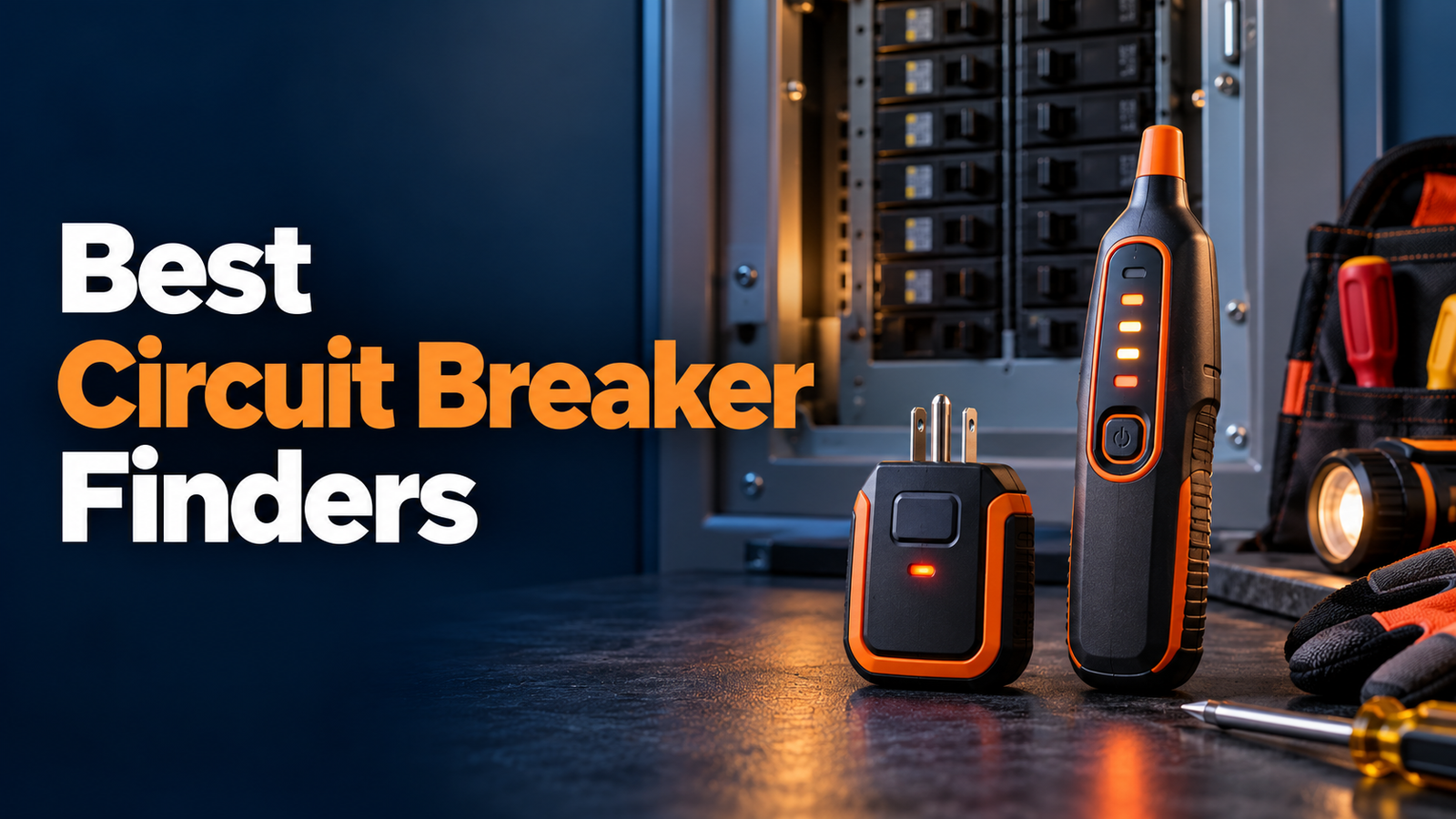
The best circuit breaker finder can save time when an electrical panel has incomplete, inaccurate, or missing labels. Instead of switching breakers off one at a time, a transmitter sends a signal through the circuit while a handheld receiver helps identify the corresponding breaker at the panel. For most U.S. homeowners and maintenance users, the Klein Tools ET310 is the strongest all-around choice because it combines automatic breaker identification with receptacle wiring and GFCI checks.
Klein Tools ET310
IDEAL 61-534
Extech CB10
Klein Tools ET450
Check Klein Tools ET310 on Amazon
Best Circuit Breaker Finder Comparison
| Model | Best for | Operating scope | Standout feature |
|---|---|---|---|
| Klein ET310 | Most users | 90–120V AC | GFCI/outlet tester |
| IDEAL 61-534 | Everyday value | 120V receptacles | Automatic identification |
| Southwire 41210S | Easy routine checks | 120V energized circuits | GFCI test |
| Extech CB10 | Adjustable control | 110–125V AC | Variable sensitivity |
| Zircon Breaker ID | Simple homeowner use | 110–120V AC | Snap-together storage |
| Zircon Pro 300 | Commercial flexibility | 80–300V AC | Accessory-rich kit |
| Klein ET450 | Advanced tracing | Energized/de-energized circuits | Wire tracing + LCD |
Specifications vary by model revision. Confirm the current manual, voltage rating, included adapters, and safety category before use.
1. Klein Tools ET310 — Best Overall
The ET310 is our top recommendation for ordinary North American residential work. Its transmitter plugs into a grounded receptacle while the receiver scans the panel. Klein specifies operation on 90–120V AC circuits, visual and audible identification, a 9V-powered receiver, and an auto-off function. The transmitter draws power from the connected circuit and docks into the receiver for tidy storage.
Its integrated receptacle indicators and GFCI test control add genuine value. A user can screen the outlet wiring condition before walking to the panel, then locate the supplying breaker. This does not replace a complete outlet diagnosis, but it combines two common tasks in one compact kit. Optional adapters can extend the transmitter to compatible light sockets and other connection scenarios; those jobs require careful adherence to the manual.
- Choose it if: you want the easiest balanced pick for routine outlet-to-breaker mapping.
- Skip it if: you need to trace de-energized conductors, wiring through walls, or circuits above its rated range.
2. IDEAL 61-534 — Best Value
The IDEAL 61-534 is a straightforward automatic circuit identifier with a digital receiver and a 120V GFCI receptacle tester. Its operating procedure uses two passes across the breakers: the first establishes relative signal information, while the second narrows the result to the breaker powering the transmitter. Visual and audible feedback indicate the match.
This model is appealing when you want common residential functions without moving into the price or complexity of a professional wire tracer. The receiver can power down after inactivity to preserve its 9V battery. As with every finder, the final step matters: switch off the indicated breaker and confirm that power at the transmitter is gone before treating the identification as correct.
- Choose it if: you want automatic identification and GFCI testing at a practical level.
- Skip it if: you need a full accessory kit for non-receptacle connections.
3. Southwire 41210S — Best Easy-Use Alternative
The Southwire 41210S is designed to identify the breaker supplying an energized 120V circuit. The transmitter sends a locator signal through the outlet wiring, and the receiver is used at the panel to pinpoint the likely breaker. Southwire also integrates a GFCI test function and describes the product as automatically calibrating for simple operation.
It is a sensible alternative for homeowners, inspectors, and maintenance workers who value a familiar transmitter-and-receiver workflow. The kit helps reduce accidental shutoffs during circuit mapping. However, it is still necessary to verify the result by turning the identified breaker off and checking the original outlet with an appropriate tester.
View Southwire 41210S Listings
4. Extech CB10 — Best With Variable Sensitivity
Extech’s CB10 locates 110–125V AC breakers and fuses while also serving as a receptacle wiring and GFCI tester. Its distinguishing feature is variable sensitivity adjustment. That control lets an experienced user reduce broad responses and more precisely separate the target signal from neighboring breakers.
Manual sensitivity can be helpful in densely packed panels, but it also demands a little more technique than a fully automatic finder. Start with the manufacturer’s recommended scan method and avoid turning the adjustment into guesswork. Clear audible and visual indications support the process, and the receiver uses a 9V battery.
- Choose it if: you want direct sensitivity control and combined outlet testing.
- Skip it if: you strongly prefer an automatic, no-adjustment workflow.
Check Extech CB10 Availability
5. Zircon Breaker ID — Best Simple Homeowner Pick
The standard Zircon Breaker ID uses a transmitter for 110–120V AC outlets and a receiver with automatic calibration. The first scan allows the tool to learn the panel, and the second scan identifies the target with a green LED and audio tone. The transmitter and receiver snap together, which makes the pair easier to store and less likely to become separated.
This is a focused product for mapping ordinary receptacles. It is not the choice for complex commercial voltages or tracing a conductor path inside a wall. For a homeowner labeling an incomplete panel, though, its simple two-pass method is easy to understand.
6. Zircon Breaker ID Pro 300 — Best Commercial-Range Kit
The Breaker ID Pro 300 expands the working range to 80–300V AC and supports single- and three-phase identification within the limits stated by Zircon. It includes a case, receiver, transmitter, 120V plug adapter, rated alligator clips, assorted blades, a light-socket adapter, and a 9V battery. Automatic sensitivity adjustment keeps the basic scan procedure approachable.
This broader compatibility makes it a better fit for contractors and facilities personnel who encounter more than standard household receptacles. The included connection accessories increase capability but also increase responsibility. Higher-voltage and three-phase systems are not beginner projects. Use only approved connections, stay within the CAT/voltage rating, and follow the manufacturer’s instructions and workplace procedures.
Check Zircon Breaker ID Pro 300
7. Klein Tools ET450 — Best Advanced Circuit Tracer
The ET450 belongs in a different class from a basic plug-in finder. Klein describes it as a professional tracer for energized and non-energized breakers, fuses, and wires. The receiver offers adjustable sensitivity, audible and visual signal-strength feedback, a backlit LCD, a flashlight, and a non-contact voltage function. The kit includes multiple leads, clips, adapters, batteries, and a hard case.
It can trace wires through drywall, cement block, and underground under supported conditions, and the transmitter provides external AC/DC voltage indications at multiple levels. Its CAT III 600V rating and advanced connection options make it the pro pick—but not a shortcut around training. Users must understand circuit state, grounding, leads, sensitivity, and the manual before making any connection.
- Choose it if: your work goes beyond receptacle-to-breaker mapping.
- Skip it if: you only need to label ordinary household outlets; the added cost and complexity will be unnecessary.
How a Circuit Breaker Finder Works
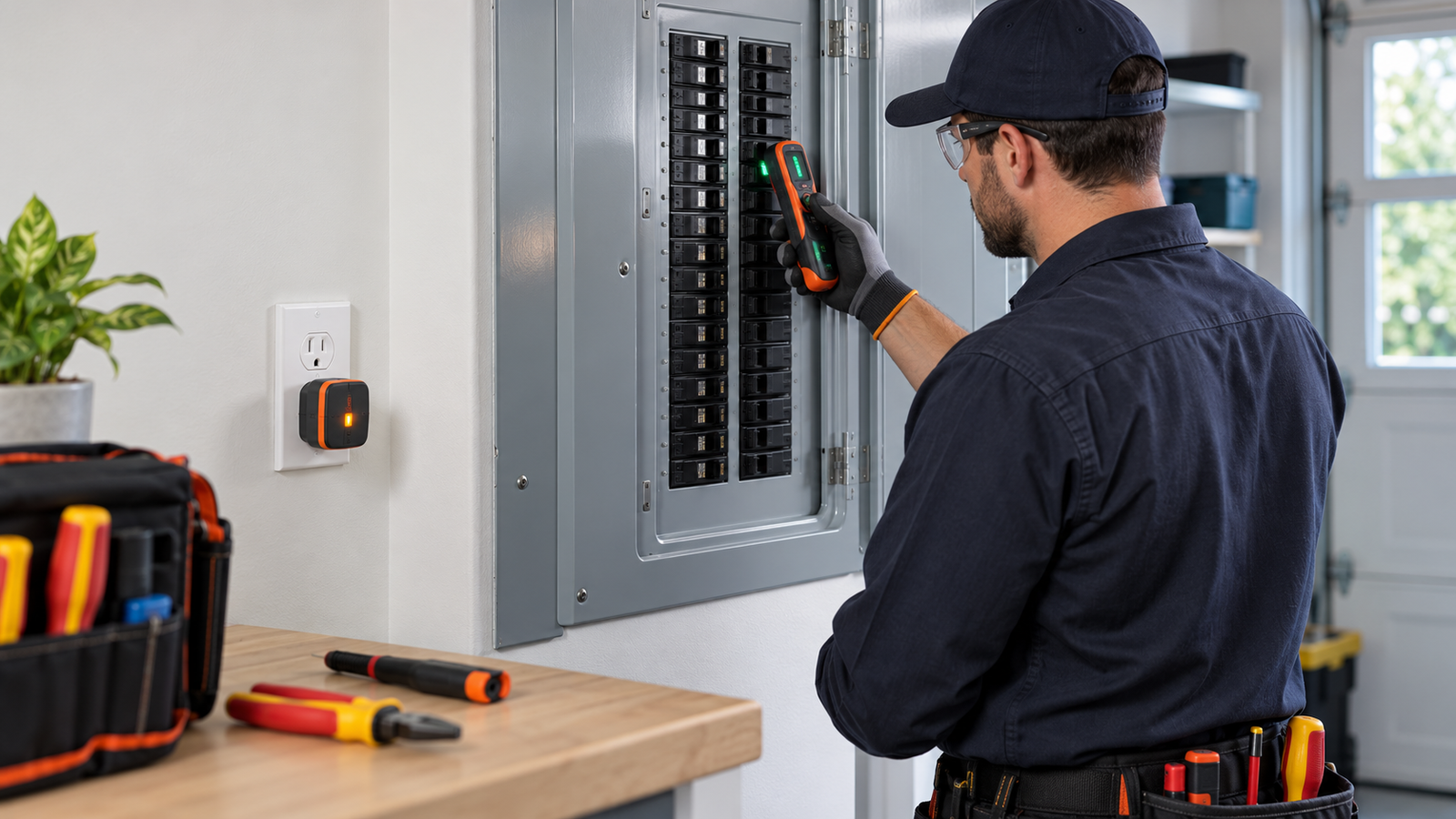
A typical finder has two matched parts. The transmitter connects to an energized outlet and places a distinct signal onto the branch circuit. The receiver senses that signal as you pass its tip over the breakers. Automatic models learn the panel during an initial sweep; adjustable models allow the user to change sensitivity as the signal becomes more localized.
Neighboring conductors, panel construction, breaker layout, circuit length, and user technique can affect the response. That is why most instructions require a slow first pass followed by a second pass. Holding the receiver at the specified angle and distance is important. Rapid random scanning can produce multiple apparent hits.
The finder suggests which breaker supplies the connected point. It does not prove that every conductor in a box is de-energized, identify every shared or multiwire arrangement, or replace an approved absence-of-voltage procedure.
How to Use a Circuit Breaker Finder
- Inspect the equipment. Do not use a damaged transmitter, receiver, lead, or adapter.
- Confirm ratings. Match the model’s voltage range, circuit type, connection method, and environment to the job.
- Verify the outlet first. If the transmitter includes a wiring display, stop if it reports an abnormal condition. A separate outlet tester can also help screen common receptacle faults.
- Connect the transmitter. Plug it fully into a compatible energized receptacle. Do not improvise adapters or attach leads to exposed conductors unless qualified and the manual explicitly permits it.
- Reset or calibrate away from the panel. Follow the device-specific sequence.
- Scan every breaker slowly. Keep the sensing tip in the orientation required by the manual. Complete the first learning pass even if the receiver beeps.
- Make the second pass. Watch and listen for the distinct target indication.
- Verify the result. Switch off the identified breaker and confirm the transmitter loses power. Then use an appropriate method to confirm the work area is de-energized.
- Label clearly. Update the panel directory using accurate room and load descriptions.
Why a Finder May Indicate More Than One Breaker
Multiple responses do not always mean the tool is defective. During the first scan, automatic models intentionally learn relative signal strengths. Adjacent circuits can also pick up a weaker coupled signal. Scan every breaker, then repeat the pass at the specified speed and orientation. On adjustable models, reduce sensitivity gradually as directed.
If the receiver still gives equally strong results at several breakers, check the transmitter connection, receiver battery, and instructions. Crowded panels, subpanels, unusual wiring, shared neutrals, or a circuit outside the device’s intended range can complicate identification. Do not choose a breaker based only on the loudest first beep.
Buying Guide
Automatic vs. adjustable sensitivity
Automatic calibration is best for most homeowners because it reduces setup decisions. Variable sensitivity can help an experienced technician separate close signals in a dense panel. Neither design excuses an incomplete scan or final power-off verification.
Voltage and safety category
Residential plug-in models are commonly limited to approximately 120V AC circuits. A broader voltage rating does not automatically make a device appropriate for every panel. Check the measurement category, maximum voltage, connection instructions, and required protective practices.
GFCI and receptacle testing
An integrated outlet tester adds convenience when mapping kitchens, bathrooms, garages, and outdoor circuits. It can reveal several common wiring states and initiate a functional GFCI trip test. Like any three-light tester, it cannot detect every unsafe condition.
Adapters and leads
Light-socket adapters help identify lighting circuits. Clip leads and blade adapters support more connection types, but exposed-conductor work carries substantially greater risk. Buy advanced accessories only when your training and intended work justify them.
Visual, audible, and display feedback
A clear LED and distinct continuous tone are easier to interpret than a subtle change in beeping. For advanced tracing, an LCD signal-strength display can help. Also consider auto-off, battery indication, flashlight, docking, and a protective case.
Finder vs. wire tracer
A basic finder maps an energized receptacle to a breaker. A professional tracer can follow conductors, find faults, or work on de-energized lines when designed for those tasks. If you only need household panel labels, the simpler tool is faster and safer to learn.
Circuit Breaker Finder vs. Other Electrical Testers
| Tool | Primary job | What it does not replace |
|---|---|---|
| Breaker finder | Maps circuit point to breaker | Absence-of-voltage verification |
| Outlet tester | Screens common receptacle faults | Complete wiring diagnosis |
| Multimeter | Measures electrical quantities | Training and safe procedures |
| NCVT | Preliminary voltage indication | Direct-contact verification |
Build a safer toolkit with our guides to the best multimeters for electricians, best clamp meters, and best non-contact voltage testers. If you are learning the basics, read how to check if a wire is live.
Which Circuit Breaker Finder Should You Buy?
Buy the Klein ET310 if you primarily map standard household receptacles and want an integrated GFCI/outlet test. Choose the IDEAL 61-534 or Southwire 41210S when availability or brand preference makes one the better practical value. Select the Extech CB10 if you specifically want manual sensitivity adjustment.
The Zircon Breaker ID is a clean homeowner option; the Pro 300 is intended for users who need a wider AC range and accessories. Step up to the Klein ET450 only when professional wire and circuit tracing—not merely breaker identification—is part of the job.
Compare Circuit Breaker Finders on Amazon
Frequently Asked Questions
Can a breaker finder be wrong?
Yes. Technique, weak batteries, neighboring conductors, panel layout, or an unsuitable circuit can cause confusing indications. Always turn off the identified breaker and verify loss of power at the transmitter and work location.
Does the circuit need to be energized?
Most basic plug-in finders require an energized compatible outlet to power the transmitter. Advanced tracers such as the Klein ET450 are designed for supported energized and de-energized tracing modes. Follow the exact manual.
Can it find a breaker for a light?
Some models support a screw-in light-socket adapter, either included or sold separately. Turn the fixture off before installing an adapter and follow its instructions. Never connect a basic outlet transmitter to a dimmer output unless expressly allowed.
Will it work through a subpanel?
Performance depends on the model and system. The Zircon Pro 300 specifically describes use with multiple subpanels within its rated applications. Basic models may not reliably support every configuration.
Can I use a 120V finder on a 240V outlet?
No. Never exceed the transmitter’s rating or improvise a connection. Use equipment specifically rated for the circuit and qualified procedures.
Is a breaker finder the same as a non-contact voltage tester?
No. A finder follows a transmitter signal to a breaker. An NCVT senses an electric field as a preliminary voltage indication. Neither alone proves a circuit is safe to touch.
Do I need to open the electrical panel?
Ordinary receiver scanning is performed across the installed breaker faces with the dead front in place. Do not remove covers or expose energized parts for routine identification.
How We Selected These Picks
We compared current manufacturer documentation for voltage range, identification method, receiver feedback, outlet/GFCI functions, accessories, storage, and intended user. We excluded the discontinued Klein ET300 in favor of its current ET310 successor. We did not use changing marketplace prices or retailer star ratings as technical evidence, and we do not claim hands-on laboratory testing that was not performed.
Final Verdict
The Klein Tools ET310 is the best circuit breaker finder for most U.S. homeowners, inspectors, and maintenance users. It balances automatic identification, clear feedback, compact storage, and useful outlet/GFCI checks. For professional tracing on energized and de-energized wiring, the Klein ET450 offers a much broader toolset—along with a higher skill requirement.
