
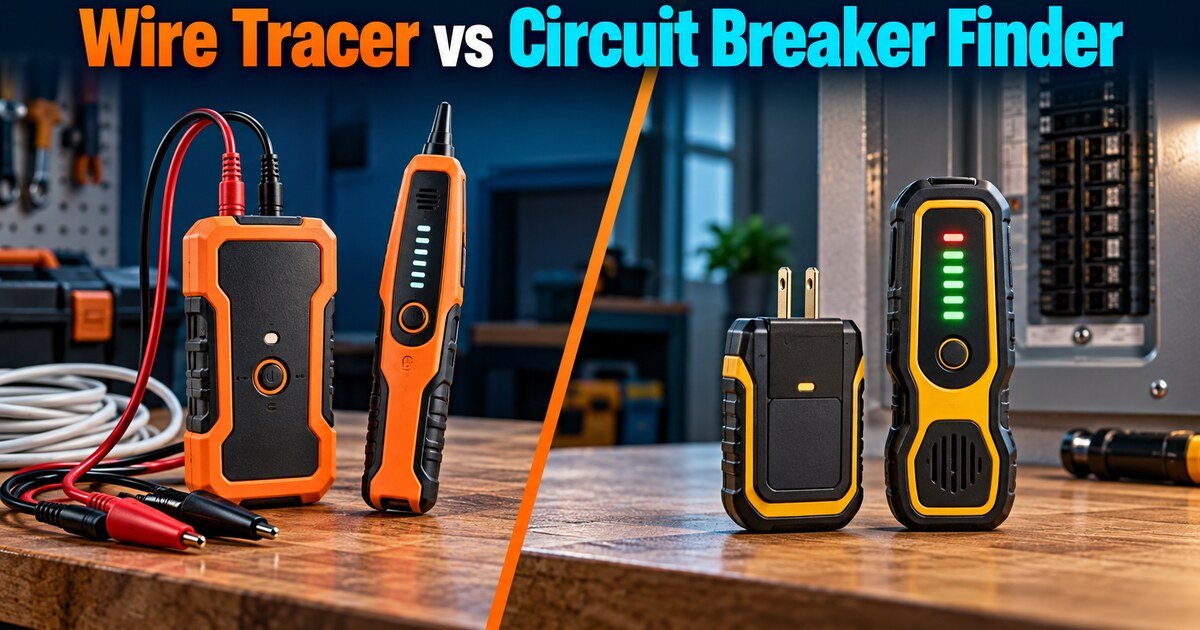
Wire Tracer vs Circuit Breaker Finder: Which Tool Do You Need?
Choose the right diagnostic tool for hidden cables, outlet-to-breaker matching, troubleshooting, and safer home electrical work.
Need the Right Tool for Your Project?
Compare current wire tracer kits and circuit breaker finders before you buy.
See Wire Tracers on AmazonSee Breaker Finders on AmazonAs an Amazon Associate, we may earn from qualifying purchases. Price and availability may change.
When a cable disappears behind drywall or a breaker panel is labeled poorly, the right tester can turn a frustrating guessing game into a controlled diagnostic process. The problem is that “wire tracer,” “circuit tracer,” and “breaker finder” are sometimes used loosely in product listings. That makes it easy to buy a tool that detects a signal but cannot answer the question you actually have.
This comparison explains how both tools work, what each one can and cannot do, which projects suit each tool, and what safety limitations matter. It is written for U.S. homeowners, serious DIYers, maintenance workers, and buyers comparing electrical testing equipment.
Wire Tracer vs Circuit Breaker Finder at a Glance
| Feature | Wire Tracer | Circuit Breaker Finder |
|---|---|---|
| Primary job | Identify or follow a particular cable | Match an outlet or circuit to a breaker |
| Typical target | Ethernet, phone, coax, speaker, alarm, or supported de-energized wiring | Energized household branch circuits |
| Main components | Tone generator and inductive probe | Plug-in transmitter and panel receiver |
| Can follow a wall route? | Sometimes, depending on depth and construction | Usually not with useful precision |
| Can identify a breaker? | Only specialized models or configurations | Yes—this is its main purpose |
| Common limitation | Signal bleed into neighboring cables | False indication on adjacent breakers |
What Is a Wire Tracer?
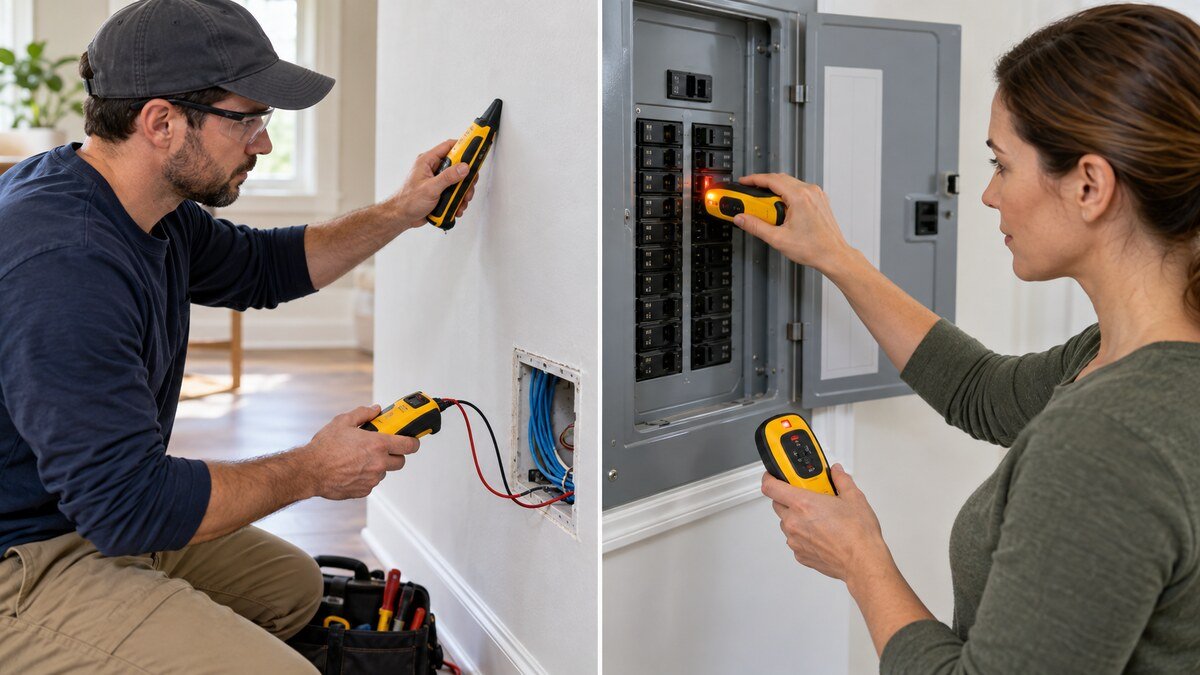
A wire tracer normally includes a transmitter, often called a toner or tone generator, and a handheld receiver probe. The transmitter applies a recognizable low-energy signal to the target conductor. The probe senses the electromagnetic field associated with that signal and converts it into sound, lights, vibration, or a screen indication.
The receiver is moved along a wall, cable run, termination panel, or cable bundle. A stronger response usually means the probe is closer to the tagged wire. Adjustable sensitivity lets you find a broad signal first and then narrow the result.
Best uses for a wire tracer
- Finding the far end of an unlabeled Ethernet or telephone cable
- Identifying speaker, alarm, thermostat, or doorbell wire
- Separating one cable from a bundle
- Following a supported cable through a wall or ceiling
- Locating a suspected break or open conductor with a compatible model
A basic communications toner is not automatically safe for energized building wiring. Always check the voltage limits and application listed in the manufacturer’s manual. For a complete operating guide, read how to use a wire tracer safely.
What Is a Circuit Breaker Finder?
A circuit breaker finder also uses a transmitter and receiver, but the transmitter is designed to place an identifying signal onto an energized branch circuit. The transmitter commonly plugs into a receptacle. The receiver is scanned over the breakers until it identifies the breaker carrying the strongest matching signal.
Some kits include socket or alligator-clip accessories for light fixtures or exposed conductors, but those accessories require more care. A standard plug-in transmitter is the simplest configuration for homeowners because it avoids contact with bare wiring.
Best uses for a breaker finder
- Finding which breaker controls a particular outlet
- Correcting incomplete or inaccurate panel labels
- Confirming a circuit before outlet replacement
- Mapping rooms and receptacles to breakers
- Reducing repeated trips between a room and panel
A breaker finder does not prove that a conductor is de-energized. After switching off the identified breaker, verify the outlet or conductor with an appropriate voltage tester. See our comparison of the best circuit breaker finders for product-level guidance.
The Most Important Difference: Your Question
“Where does this cable go?”
Use a wire tracer. It is designed to give one cable an identifiable electronic signature and locate that signature elsewhere.
“Which breaker powers this outlet?”
Use a circuit breaker finder. It is designed to identify the matching breaker at the service panel.
This distinction prevents the most common buying mistake. A wire tracer may detect a signal near an electrical panel, but a general-purpose toner is not necessarily designed to identify a live branch-circuit breaker. A breaker finder can identify the correct breaker, but it usually cannot show the exact path a cable takes through several wall cavities.
How a Wire Tracer Works
The transmitter connects to the accessible end of a cable through alligator clips, an RJ45/RJ11 plug, a coax adapter, or another supported connector. It sends an alternating tone along the conductor. The probe detects the signal without needing electrical contact with the conductor at the search end.
High sensitivity helps find the approximate area. Lower sensitivity improves discrimination among adjacent cables. Metal conduit, foil insulation, dense masonry, depth, and closely bundled conductors can reduce accuracy or spread the apparent signal. Our detailed explanation of how a wire tracer works covers these effects.
How a Circuit Breaker Finder Works
The transmitter draws or injects a coded signal onto the energized circuit. At the panel, the receiver looks for that coded signature. Better technique usually requires two scans: the first teaches or calibrates the receiver to the panel, and the second narrows the result to one breaker.
Scanning too quickly, holding the receiver inconsistently, or skipping calibration can cause false identification. Adjacent breakers can carry similar signal strength. After the receiver identifies a breaker, turn it off and verify at the original outlet. Label the panel only after confirmation.
Can One Tool Do Both Jobs?
Some advanced electrical circuit tracers can locate breakers, follow energized or de-energized conductors, and estimate cable position. These systems cost more and require careful setup. Their capabilities depend on the transmitter, accessories, sensing method, circuit conditions, and safety category.
Do not assume a product does both jobs simply because the title says “circuit tracer.” Read the supported applications. Look for explicit statements about live-circuit tracing, breaker identification, maximum voltage, cable type, and included adapters.
Which Tool Is Better for Homeowners?
For most homeowners who mainly replace outlets, install fixtures, or correct panel labels, a circuit breaker finder is the more immediately useful purchase. It answers a frequent household question and requires little setup when used with a standard receptacle.
A wire tracer is better for structured wiring, renovations, home theaters, security systems, networking, and older homes with unidentified low-voltage cables. Serious DIYers may eventually want both because they solve different stages of a project.
Accuracy and False Readings
Wire tracer false readings
Signal can couple into neighboring cables, especially in tight bundles or at high sensitivity. Confirm the target by reducing sensitivity, separating candidate cables, tracing several points, and testing continuity or cable mapping at the end.
Breaker finder false readings
Several adjacent breakers may trigger the receiver during the first pass. Follow the tool’s scan procedure, keep the receiver orientation consistent, repeat the scan, switch off the suspected breaker, and verify power at the outlet.
Safety Differences
Basic low-voltage tone generators should normally be connected only to compatible de-energized wiring. Circuit breaker finders are designed for energized circuits within their stated rating. Never exceed the device rating, use damaged leads, or open a service panel if you are not trained and comfortable doing so.
If you see burned insulation, moisture, melted plastic, buzzing, loose breakers, or unexplained readings, stop and contact a licensed electrician. Diagnostic tools reduce guesswork; they do not remove electrical hazards.
Buying Checklist
| Check | Why It Matters |
|---|---|
| Supported voltage and cable type | Prevents using a low-voltage toner on an unsupported circuit |
| Adjustable sensitivity | Helps isolate one cable or breaker from nearby signals |
| Adapters included | Determines whether the kit works with outlets, coax, Ethernet, or loose conductors |
| Audible and visual indication | Makes results easier to interpret in noisy or dim spaces |
| Continuity or cable mapping | Adds useful confirmation after a wire is located |
| Clear instructions and ratings | Supports safer setup and correct scanning technique |
A Practical Two-Tool Workflow
When a project involves both the service panel and an unknown cable route, the two tools can be used in sequence. First, use a circuit breaker finder to identify the controlling breaker while the receptacle is energized and accessible. Mark the breaker, switch it off, and verify the circuit is de-energized with an appropriately rated tester. Only then should you disconnect or expose conductors if the work requires it.
After the circuit is safely isolated, a compatible wire tracer can help distinguish that cable from other de-energized runs. Connect the transmitter exactly as its manual specifies, scan from a known point, and lower receiver sensitivity as you approach the target. Confirmation matters: compare the signal at more than one location and use continuity, cable mapping, or visual inspection whenever possible.
This workflow shows why the devices are complements rather than substitutes. The breaker finder establishes panel identity; the tracer helps establish route or endpoint identity. Neither result alone confirms that conductors are safe to touch, and neither replaces correct lockout, verification, or professional help when wiring conditions are uncertain.
Common Selection Mistakes to Avoid
Do not buy a low-voltage toner solely because the listing says “wire tracer” and then assume it can connect to household mains. Product names are broad, while voltage limits are specific. Check the manual, supported connection methods, measurement category, and maximum voltage before purchase and again before use.
Likewise, do not expect the least expensive breaker finder to map a cable behind drywall. A conventional model is optimized for matching an energized outlet or fixture adapter to a breaker. If your main goal is route tracing, look for an electrical circuit tracer explicitly designed for that task and circuit type. Finally, avoid choosing by detection range alone. Adjustable sensitivity, clear indicators, useful adapters, and repeatable confirmation often improve real-world accuracy more than an impressive maximum-distance claim.
Frequently Asked Questions
Can a circuit breaker finder trace wires in a wall?
A standard breaker finder is mainly designed to identify a breaker, not map the complete cable route. Advanced circuit tracers may provide route-finding functions.
Can a wire tracer identify the correct breaker?
A specialized electrical tracer may do so, but a basic low-voltage tone-and-probe kit should not be connected to an energized household circuit unless its manual explicitly permits it.
Do breaker finders work on GFCI outlets?
Many plug-in transmitters work when the outlet is energized, but device design and circuit condition matter. Follow the model instructions and confirm the result after switching the breaker off.
Which tool finds a broken wire?
A compatible wire tracer may help narrow an open conductor, but results vary with cable construction, depth, grounding, and the type of break. Continuity testing or professional fault-location equipment may be required.
Should I buy both tools?
Buy both if you routinely map household circuits and identify communications or low-voltage cables. For occasional outlet work, start with a breaker finder; for networking and cable identification, start with a wire tracer.
Final Verdict
A wire tracer and a circuit breaker finder are complementary tools. The wire tracer answers where a cable goes; the breaker finder answers which breaker controls a circuit. Choose based on the question you need to solve, not the similarity of the product names.
For cable endpoints, hidden routes, and low-voltage bundles, choose a wire tracer. For outlets and panel mapping, choose a circuit breaker finder. If you need advanced live-circuit tracing, select a purpose-built professional system and verify its voltage rating and instructions before use.
