
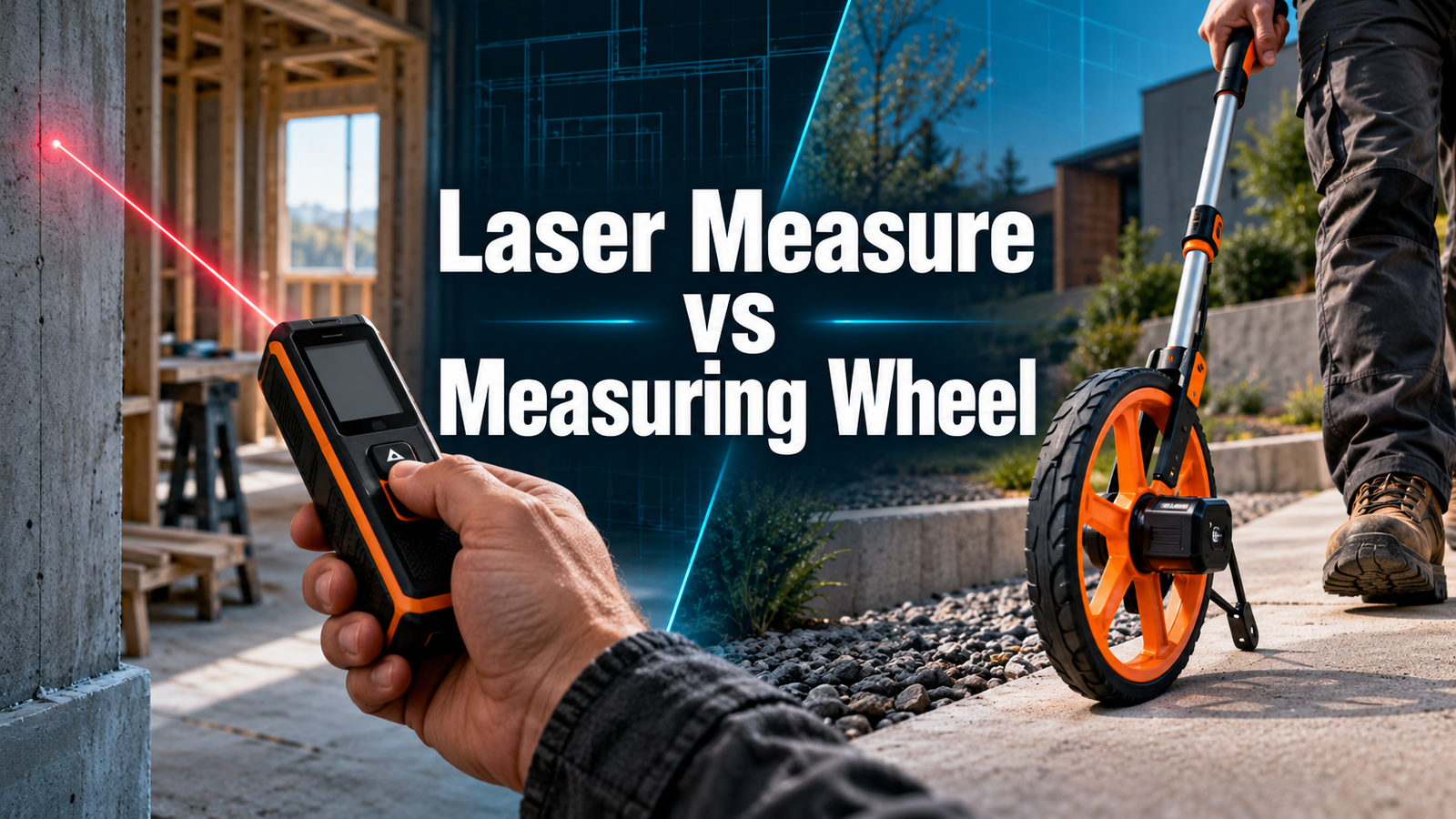
Laser Measure vs Measuring Wheel
A laser measure and a measuring wheel can both handle distances that are awkward for a tape, but they solve different problems. A laser is usually the fast, precise choice for straight-line indoor dimensions. A wheel is often the practical choice for long ground routes, curved paths, lawns, driveways, and property layouts. This guide explains where each tool wins, where it can mislead you, and which one makes sense for your projects.
Compare Laser Measures & Measuring Wheels on Amazon →Affiliate disclosure: As an Amazon Associate, AccurateGoods earns from qualifying purchases. Product availability, included accessories, and listing details may change. Confirm the current model and manufacturer specifications before ordering.
Laser Measure vs Measuring Wheel at a Glance
| Comparison | Laser Measure | Measuring Wheel |
|---|---|---|
| Best environment | Indoor rooms and straight visible spans | Outdoor ground routes and large layouts |
| How it measures | Calculates distance from a reflected laser signal | Counts wheel rotations along the traveled surface |
| Typical strength | Fast, precise one-person measurements | Follows curves, corners, and ground contours |
| Main limitation | Needs a usable target and clear line of sight | Bumps, slipping, wandering, and debris can add error |
| Good for calculations | Many models calculate area, volume, and indirect distance | Some electronic wheels calculate area; mechanical models usually focus on distance |
| Portability | Pocket-size on many models | Bulkier, though many handles fold or telescope |
| Curved paths | Poor fit without dividing the route into segments | Excellent fit when rolled carefully along the curve |
| Indoor finish work | Usually the better choice | Useful for long floors, but not ideal for cabinets or trim |
Laser Distance Measure
Choose this for fast room dimensions, high ceilings, wall-to-wall measurements, material estimates, and one-person measuring. A camera-equipped outdoor model can also handle long straight shots when a suitable target is available.
- Compact and quick
- High precision under suitable conditions
- Area and volume functions on many models
- Convenient for renovation documentation
Measuring Wheel
Choose this for sidewalks, driveways, lawns, fence lines, curved routes, construction layouts, and large outdoor distances. Large wheels generally cross rough ground more smoothly than compact wheels.
- Follows curves and turns
- No reflective target required
- Practical over long ground distances
- Easy to understand at a glance
How a Laser Distance Measure Works
A laser distance meter sends a laser beam toward a target and analyzes the returned signal to determine the distance. The result appears on a digital display. You normally place the rear or front reference edge of the tool at the starting point, aim at a flat target, and press the measure button. Better models may also provide continuous measurement, addition and subtraction, area, volume, indirect height, memory, an inclinometer, Bluetooth, or a camera viewfinder.
The important phrase is straight-line distance. A laser measure reports the direct path between the instrument and the point it reaches. It does not automatically follow a curved walkway, a winding garden border, or every bump in the ground. If you point diagonally across a space, the display gives the diagonal—not the horizontal span you may have intended.
For example, Bosch lists the GLM400C with a range up to 400 feet and typical accuracy of ±1/16 inch under suitable conditions. It includes a digital viewfinder, Bluetooth connectivity, a 360-degree inclinometer, and multiple measuring functions. Those features make it capable for rooms and many outdoor straight-line tasks, but they do not remove the need for a steady setup, a clear target, and correct reference selection.
Where a Laser Measure Is Most Useful
- Measuring a room for flooring, paint, or furniture planning
- Checking ceiling height without extending a long tape
- Recording wall lengths for a floor plan
- Estimating area and volume when the tool supports those modes
- Measuring across an obstacle when both endpoints remain visible
- Collecting many dimensions alone without a second person holding a tape
If you are new to the tool, our step-by-step laser measure guide explains reference points, target selection, and common modes. You can also compare current homeowner options in our best laser distance measures guide.
How a Measuring Wheel Works
A measuring wheel converts the wheel’s rotation into distance. You reset the counter at the starting point, place the wheel on the route, and roll it to the endpoint. Mechanical models turn a counter as the wheel rotates. Electronic models use a sensor and digital display, and some add unit conversion, memory, or area calculation.
Because the wheel touches the ground, it measures the route you physically follow. That makes it useful for a curved sidewalk, a long fence line, a driveway edge, or the perimeter of a landscaped area. It also means the reading can be affected by the surface. A wheel that bounces over rocks, slides through wet grass, spins on loose gravel, or wanders side to side may register more or less distance than the intended route.
Wheel size changes how the tool behaves. Keson explains that its large 4-foot-circumference MP401 wheel spans dips that smaller wheels may enter, helping it roll over uneven ground. The company’s smaller RoadRunner wheels are more compact and suitable for short indoor runs or curved surfaces, while medium and large models are generally better suited to outdoor layouts.
Where a Measuring Wheel Is Most Useful
- Measuring sidewalks, curbs, driveways, and paved paths
- Estimating fence lines and landscaping borders
- Walking the length of a lawn, field, parking area, or property route
- Following curves that cannot be captured accurately with one straight laser shot
- Marking construction layout distances along the ground
- Taking long approximate ground measurements without a distant target
Accuracy: Which Tool Is More Precise?
For short and medium straight-line measurements under good conditions, a quality laser measure is generally more precise. A direct electronic reading avoids wheel slip, surface bumps, and a wandering walking line. That is one reason laser meters are popular for room dimensions, cabinetry planning, and detailed renovation estimates.
A measuring wheel is not automatically inaccurate. It is simply influenced by different variables. Keson’s electronic MP401E documentation, for example, specifies accuracy of 2 inches in 100 feet, or 99.8 percent, when used correctly. That is entirely useful for many outdoor estimates, but it is not the same precision category as a laser rated to a small fraction of an inch under favorable conditions.
Real-world accuracy depends on matching the tool to the job. A laser may fail to capture the intended distance if the target is dark, reflective, transparent, very bright, hidden, or difficult to aim at. A wheel may produce an excellent practical result on a curved path that a laser cannot measure directly at all. Precision on paper matters less if the tool cannot represent the geometry of the route.
How to Improve Laser Measure Accuracy
- Confirm whether the reference point is the front, rear, tripod position, or an extended endpiece.
- Aim squarely at a stable, solid target instead of a diagonal or reflective surface.
- Brace the tool or use a compatible tripod for long shots.
- Use a target plate when conditions make the laser difficult to see or return.
- Repeat important measurements and investigate any unexpected difference.
How to Improve Measuring Wheel Accuracy
- Reset the counter exactly at the starting mark.
- Keep the wheel upright and follow the intended line without weaving.
- Walk at a steady pace and avoid lifting, spinning, or dragging the wheel.
- Clear small debris when possible and choose a wheel size suited to the surface.
- Measure the route in both directions; a large difference suggests technique or surface error.
For a deeper explanation of specifications and real-world conditions, see how accurate laser measures are.
Indoor Projects: Laser Measure Usually Wins
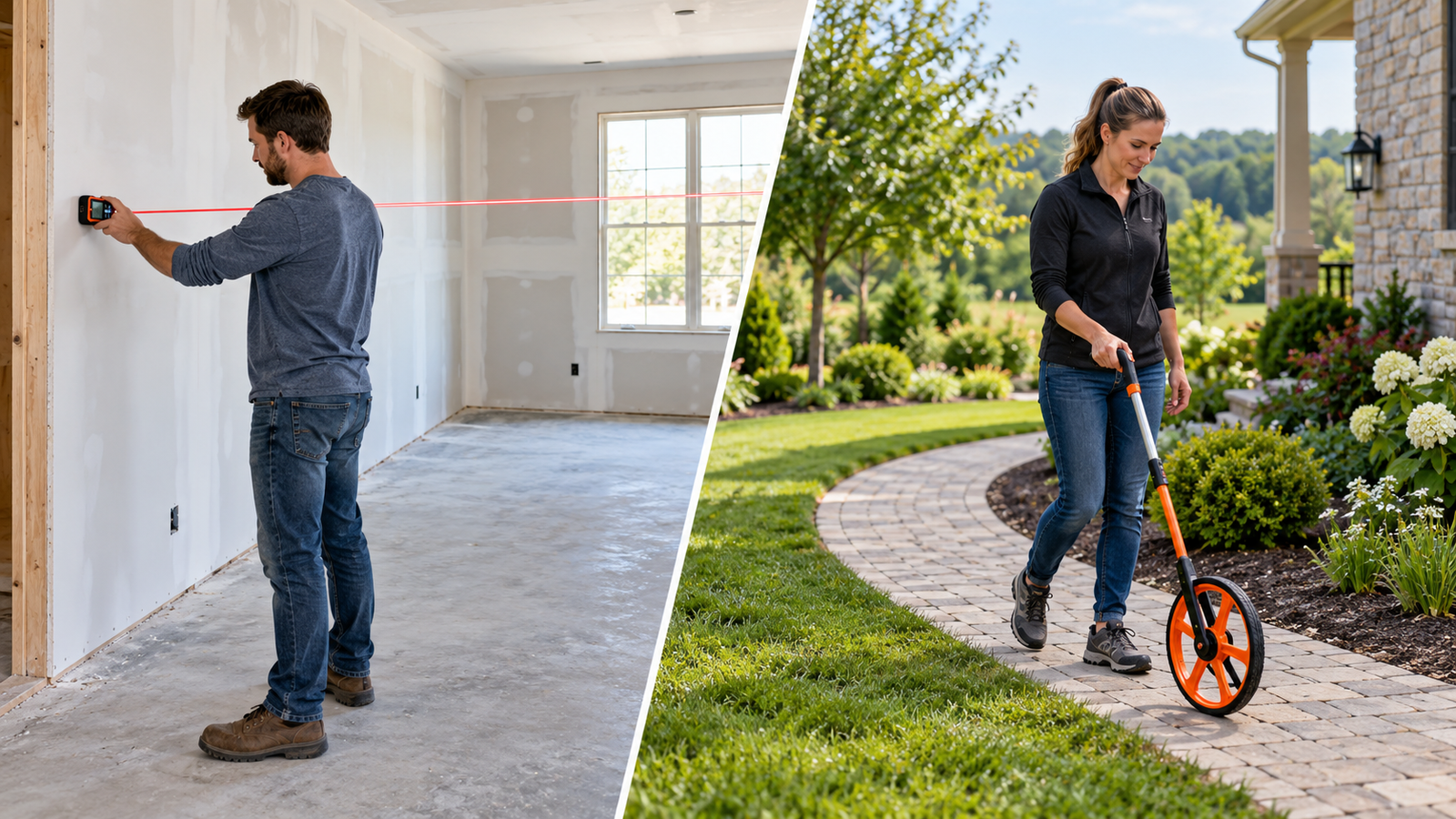
Indoors, a laser measure is usually faster and easier because walls provide convenient targets. You can stand at one side of a room, take the length, turn, measure the width, and calculate area without dragging a wheel around furniture. Ceiling heights and diagonal room checks are also much simpler with a direct beam.
A wheel still has occasional indoor uses. A compact wheel can follow a curved hallway, trace the length of a large warehouse aisle, or measure a floor route when walls are obstructed. However, thresholds, rugs, cords, transitions, and furniture can interrupt the roll. For cabinet openings, countertops, trim, doors, and finish carpentry, a tape measure or laser is normally more appropriate.
Remember that a laser distance meter does not replace a tape for every cut. A laser is excellent for space dimensions, but a tape lets you hook an edge, mark material directly, and check a short object. Our laser distance measure vs tape measure comparison explains that division of work.
Outdoor Projects: The Route Determines the Winner
Outdoors, first ask whether the distance is a straight visible span or a traveled ground route. For a straight distance between two accessible points, a long-range laser with a viewfinder may be quicker and more precise. It can be helpful for exterior walls, lot features, large rooms open to the outside, or property improvements where you have a stable target.
For a winding path, lawn edge, driveway curve, or fence line that changes direction, a wheel is the natural choice. It follows the route rather than cutting straight across it. A large wheel also keeps working when there is no vertical target at the endpoint. Sunlight may make a laser dot hard to see, whereas the wheel remains readable as long as it maintains contact with the surface.
Neither tool is a substitute for a professional boundary survey. A wheel can help estimate materials or plan a project, but it cannot establish a legal property line. Likewise, a consumer laser distance meter does not replace surveying equipment, control points, or professional judgment.
Curves, Slopes, and Uneven Ground
Curves are where the measuring wheel has its clearest advantage. Roll along the centerline or chosen edge of the route and the wheel accumulates that traveled distance. Be consistent about the line you follow. The inside and outside edges of a curved path have different lengths, so decide which measurement your project needs before you start.
On a slope, both tools can give valid but different answers. A wheel rolled uphill reports the surface distance along the slope. A laser aimed from the bottom to the top reports the direct sloped distance. If you need horizontal distance, you must use a level reference, an inclinometer calculation, or a different layout method. Do not assume the ground distance and horizontal plan distance are interchangeable.
Rough ground increases wheel error. A larger wheel can bridge shallow dips and cross small obstacles better than a tiny wheel, but no size eliminates every problem. Walk slowly, keep contact, and break a difficult route into repeatable sections. On extremely soft, overgrown, or broken ground, verify the result with another method before ordering expensive materials.
Speed and One-Person Convenience
For room measurements, the laser is hard to beat. One person can capture several dimensions in seconds, and connected models can transfer readings into an app. Bosch’s MeasureOn system, for example, supports measurements, photos, notes, and project organization with compatible tools. This can reduce transcription mistakes during a renovation.
For long outdoor paths, rolling a wheel may be faster than repeatedly repositioning a laser and finding targets. The counter remains visible as you walk, and there is no need to place a reflector at every turn. A wheel also communicates the measurement process clearly to a second person watching the route.
The most efficient professional workflow may use both. Capture buildings, rooms, and straight offsets with a laser, then use a wheel for paths, boundaries, and curved layouts. Record which tool produced each number so nobody later mistakes a surface distance for a straight-line distance.
Cost and Long-Term Value
Entry-level versions of both tools can be affordable, but price alone should not decide the purchase. For a laser, prioritize useful range, stated accuracy, display readability, reference options, environmental protection, and aiming help. Bluetooth and advanced modes add value only if you will actually use them.
For a measuring wheel, prioritize the correct units, wheel diameter, counter readability, frame durability, handle comfort, folding or telescoping storage, and serviceable parts. A small wheel is easy to transport but reacts more to rough ground. A large wheel crosses outdoor irregularities more smoothly but occupies more space.
Homeowners who mainly renovate interiors will usually get more value from a laser. Landscapers, property managers, coaches, paving estimators, and people planning long outdoor routes may use a wheel more often. If your work crosses both environments, buying one of each can prevent repeated compromises.
Common Buying Mistakes
- Buying for maximum range only: usable aiming, target conditions, and route geometry matter more than the largest number on the box.
- Choosing the wrong wheel size: a tiny wheel is convenient indoors but may bounce and dip across rough outdoor ground.
- Ignoring units: verify whether a wheel reads feet and inches, decimal feet, metric, or multiple units.
- Expecting a laser to follow a curve: it measures direct point-to-point distance unless you divide the curve into segments.
- Expecting a wheel to provide finish accuracy: rolling error may be acceptable for landscaping but not for cabinetry.
- Trusting one critical reading: repeat, reverse, or cross-check any measurement that controls costly cutting or ordering.
Which Tool Should You Buy?
| Your Main Project | Best Choice | Reason |
|---|---|---|
| Flooring or paint estimate | Laser measure | Fast room dimensions and area calculations |
| Kitchen or cabinet planning | Laser plus tape | Space dimensions plus direct finish checks |
| Fence line or driveway | Measuring wheel | Follows the intended ground route |
| Curved garden path | Measuring wheel | Accumulates distance through the curve |
| High ceiling or stairwell | Laser measure | Measures an inaccessible straight span |
| Large outdoor straight shot | Outdoor laser with viewfinder | Fast direct reading when a target is available |
| Mixed property and renovation work | Both | Each covers geometry the other handles poorly |
Final Verdict
Choose a laser measure if your work is mainly indoors, point-to-point, and accuracy-focused. It is the stronger all-around first purchase for most homeowners because it handles rooms, walls, ceilings, and material estimates quickly.
Choose a measuring wheel if your work follows the ground—especially long, curved, or obstacle-filled routes. It is the more honest tool for sidewalks, driveways, landscaping, and fence layouts because it measures the path you actually travel.
Choose both if you routinely work across buildings and property. They are complementary tools, not true substitutes.
Frequently Asked Questions
Is a laser measure more accurate than a measuring wheel?
Usually yes for straight-line measurements under suitable conditions. A measuring wheel can still be the better tool for curves and ground routes because it follows the actual surface path.
Can a measuring wheel be used indoors?
Yes. Small wheels can measure hallways, warehouses, and long floors, but thresholds, rugs, furniture, and tight spaces may interfere. A laser is normally faster for standard rooms.
Can a laser measure be used outdoors?
Yes, especially a model designed for outdoor use with a camera viewfinder or aiming aid. Bright sunlight, poor targets, and long distance can make outdoor readings harder.
Does a measuring wheel measure a slope or horizontal distance?
It measures the distance traveled along the surface. On a hill, that is the sloped ground distance, not the horizontal map distance.
What size measuring wheel is best?
Small wheels are convenient for short indoor or smooth-surface work. Medium wheels are versatile. Large wheels are usually better for long outdoor routes, soft ground, debris, and uneven surfaces.
Do I still need a tape measure?
Often yes. A tape is useful for short objects, direct marking, hooked-edge measurements, and final checks before cutting. A laser, wheel, and tape each serve different measurement geometry.
Choose the Right Measuring Tool
Compare the current model details, units, accessories, and manufacturer specifications before buying. Select the laser for straight visible spans and the wheel for traveled ground routes.
Manufacturer references: Bosch GLM400C specifications; Keson professional measuring wheels; Keson MP401E specifications.
