
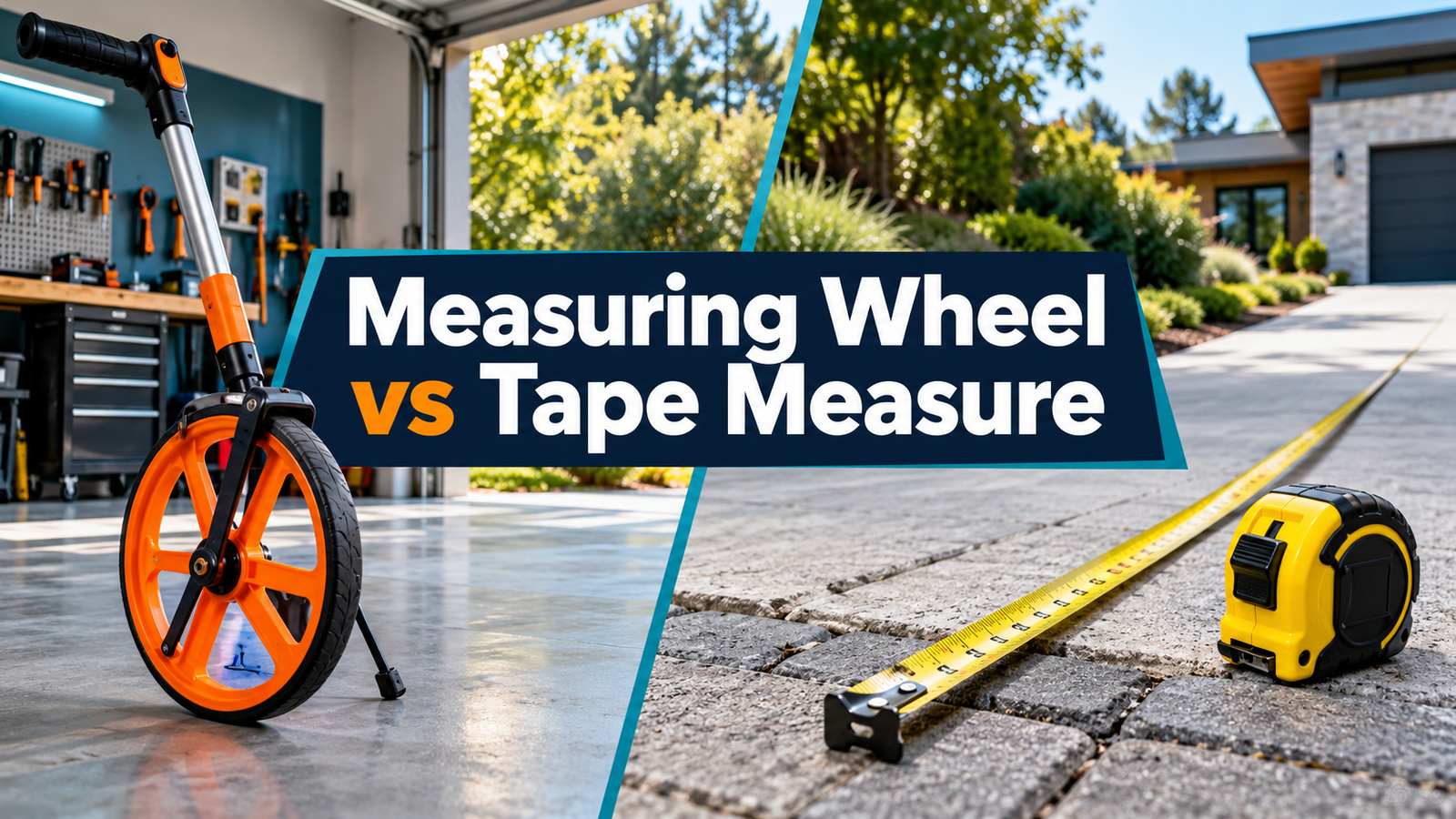
Measuring Wheel vs Tape Measure
A measuring wheel and a tape measure both turn distance into a number, but they do it in very different ways. A tape measure is the dependable choice for short, straight, detail-oriented work. A measuring wheel is designed for long ground distances, outdoor routes, and layouts that would make a tape slow or awkward. This guide explains accuracy, speed, surfaces, curves, common errors, and the best tool for each project.
Compare Measuring Wheels & Tape Measures on Amazon →Affiliate disclosure: As an Amazon Associate, AccurateGoods earns from qualifying purchases. Availability and listing details can change. Confirm the current model and manufacturer information before ordering.
Related guides: Compare a wheel with electronic distance measurement in Laser Measure vs Measuring Wheel, explore our Best Tape Measure guide, or learn practical setup techniques in How to Use a Laser Level.
Measuring Wheel vs Tape Measure at a Glance
| Comparison | Measuring Wheel | Tape Measure |
|---|---|---|
| Best use | Long ground routes and outdoor layouts | Short, straight dimensions and detail work |
| Typical workflow | Reset, place wheel, walk the route, read counter | Hook one end, extend blade, align, read markings |
| Curved routes | Practical when the wheel follows the curve | Difficult unless the tape can bend safely along it |
| Uneven terrain | Usable, but bumps and wheel slip affect results | Can bridge gaps and measure a straight span |
| Fine measurements | Not the preferred tool | Usually the better choice |
| One-person use | Excellent for long routes | Easy at short range; long spans may need help |
| Storage | Bulkier, though many handles fold | Compact and toolbox-friendly |
How the Two Tools Actually Measure
A tape measure uses a marked blade or ribbon. The user stretches it between two reference points and reads the graduation at the endpoint. The measurement is direct: the markings physically span the distance. This makes a tape intuitive for carpentry, remodeling, appliance fit checks, and almost any task where the start and finish are visible and reachable.
A measuring wheel uses wheel rotation. As the wheel rolls, a mechanical or electronic counter converts revolutions into distance. Large professional wheels can roll smoothly over outdoor surfaces and small irregularities. Keson describes its MP401 as a four-foot-circumference wheel designed to span dips that may affect smaller wheels. The method is fast, but the wheel must stay in contact with the intended route.
This difference matters. A tape usually measures the straight line between its endpoints. A wheel measures the path traveled by its contact point. If you roll around a curve, the result includes the curve. If the wheel bounces, slips, or wanders from the planned line, the reading can change.
Measuring Wheel
Ideal for estimating fence lines, driveway length, landscaping borders, walking paths, and large floor or site layouts. A larger wheel generally rolls over rough surfaces more confidently, while compact wheels are easier to store and maneuver.
- Fast over long distances
- Natural for curves and routes
- Comfortable one-person workflow
- Easy reset-and-walk operation
Tape Measure
Ideal for framing, furniture, room details, cabinets, appliances, trim, and material cuts. A locking retractable tape is compact, familiar, and better suited to measurements where fractions of an inch influence fit.
- Fine readable graduations
- Useful against edges and corners
- Compact and inexpensive
- Works without batteries
Which Tool Is More Accurate?
For a short, straight dimension, a good tape measure normally gives the user more control. You can place the hook against an edge, keep the blade aligned, and read a fine graduation at the endpoint. The result is easy to repeat and inspect. Accuracy still depends on technique: a bent blade, angled pull, loose hook, poor lighting, or an estimated mark between graduations can introduce error.
A measuring wheel can be highly consistent on a flat, even test surface, but real projects rarely resemble a test track. The effective travel changes when the wheel rides over gravel, drops into a depression, slips on wet grass, or moves side to side. This does not make the tool unreliable; it means the result represents the route the wheel traveled. For layout and estimating, that is often exactly what you need.
The right question is not simply which tool has the smaller theoretical error. Ask which tool can follow the measurement you actually want. A tape is more suitable for the width of a door opening. A wheel is more suitable for the length of a curved walkway. Using the wrong method precisely can still produce an unhelpful number.
Where a Measuring Wheel Wins
Long outdoor distances
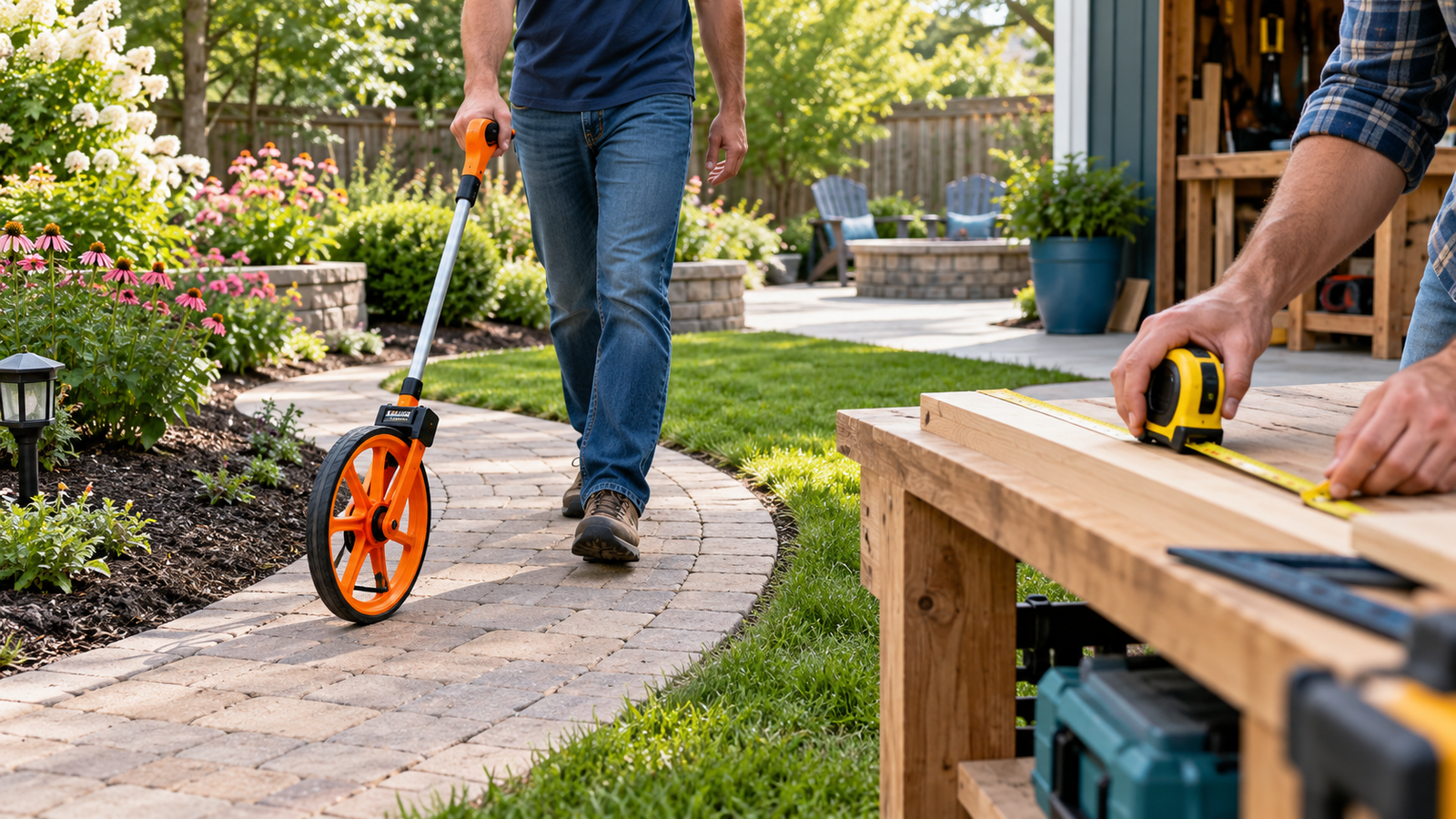
Stretching a short tape repeatedly along a 150-foot driveway is slow and creates opportunities for alignment errors. A wheel lets one person walk the route in a continuous pass. It is especially useful when a quick estimate is more valuable than cut-level precision.
Curved paths and perimeter routes
A wheel follows the ground path, making it practical for estimating edging, irrigation tubing, landscape lighting cable, or a curved fence. Keep the wheel on the same side of the line for repeatability, because inside and outside curves have different lengths.
Large preliminary layouts
Before placing stakes or ordering material, a wheel can help you understand scale. You can check the approximate length of a yard, parking area, playing surface, or proposed path without dragging a long tape through obstacles.
Solo work
Long tapes may require a stake, nail, helper, or careful anchoring. A wheel is naturally a one-person tool. Reset the counter, align the start point, walk smoothly, stop over the endpoint, and read the total.
Where a Tape Measure Wins
Carpentry and material cuts
A measuring wheel should not replace a tape for cutting boards, setting cabinet widths, locating wall studs, or checking trim. These tasks require compact access and fine graduations. The tape blade can rest against a surface, bridge a small opening, and transfer a mark directly to the workpiece.
Vertical and overhead dimensions
A wheel needs a surface to roll on. A tape can measure wall height, shelf spacing, window openings, and many overhead spans. Blade standout varies by model, but even a basic tape provides options a wheel cannot.
Small spaces
Inside closets, cabinets, bathrooms, and crowded workshops, a full-size wheel may not have room to start or stop accurately. A compact tape can reach into corners and measure between opposing surfaces.
Repeat measurements
When several pieces must match, a tape makes it easy to repeat the same dimension and mark each part. A wheel is better suited to accumulating distance than transferring precise cut marks.
Surface Conditions and Measurement Error
The ground is the measuring wheel’s reference surface, so inspect it before trusting the number. Loose gravel can roll under the tire. Tall grass can lift the wheel. Mud may cause slipping or change the effective contact. Curbs, roots, cracks, and steep transitions can add travel that may or may not belong in your intended measurement.
Use a larger wheel when the route includes mild debris or uneven ground. Keson’s guidance notes that its large 15.7-inch, four-foot-circumference MP401-series wheels are intended for overgrown, debris-covered, and soft surfaces where smaller wheels may get stuck. That does not remove the need for careful technique, but it explains why wheel diameter is more than a storage decision.
Tape measures have their own surface problems. A tape pulled across a lawn can sag, snag, or curve. A metal blade can kink when extended too far. For a true horizontal span over sloped ground, keep the tape level rather than laying it on the slope. For the surface length of the slope, follow the surface intentionally. Define the measurement before choosing the technique.
How to Use a Measuring Wheel Correctly
- Choose a clear route. Remove movable obstacles and decide whether you are measuring a straight line, curve, centerline, or edge.
- Inspect the wheel. Confirm it turns freely, the counter resets, and the tire is clean.
- Reset at the start. Put the wheel’s contact point directly over the reference mark before resetting.
- Walk at a steady pace. Keep the wheel upright and avoid bouncing or side-to-side wandering.
- Stop precisely. Finish with the same reference point on the wheel positioned over the endpoint.
- Repeat the route. Two close readings build confidence. A large difference signals a path or surface problem.
How to Use a Tape Measure Correctly
- Use the correct reference. Hook an outside edge or press the hook against an inside surface as the task requires.
- Keep the blade aligned. An angled tape measures a diagonal and can read longer than the intended span.
- Control tension. Pull the blade straight without distorting the hook or bowing the tape.
- Read squarely. View the mark from directly above to reduce parallax.
- Lock safely. Prevent the blade from retracting unexpectedly, then release it under control.
- Confirm critical cuts. Measure twice and mark once, especially when replacement material is expensive.
How to Choose a Measuring Wheel
Wheel diameter: Large wheels are typically easier over uneven outdoor surfaces. Smaller wheels are lighter and more maneuverable indoors, but may react more to cracks and debris.
Counter type: Mechanical counters are simple and readable without batteries. Electronic counters can offer unit conversion, memory, or area functions. Keson’s MP401E, for example, lists multiple units, memory, area, and radius-related functions. Decide whether those features simplify your work or add controls you do not need.
Handle and storage: A folding or telescoping handle is useful in a car trunk or crowded garage. Check the locking mechanism and extended working height so you can walk naturally instead of bending forward.
Brake and kickstand: A hand brake can help hold a reading, while a stable kickstand is useful when recording measurements. Prioritize sturdy construction if the tool will ride in a work truck.
How to Choose a Tape Measure
Length: A 25-foot tape is a versatile household and workshop size. Shorter tapes are lighter for everyday indoor checks; longer tapes help with rooms and outdoor work but add bulk.
Blade readability: High-contrast markings are easier to read in mixed lighting. Fraction labels can help occasional users, while experienced tradespeople may prefer a cleaner blade.
Hook and case: The hook should move as designed for inside and outside measurements without feeling excessively loose. A durable case, reliable lock, and comfortable belt clip matter when the tape is used repeatedly.
Blade control: Wider, stiffer blades may extend farther before folding, but no tape should be allowed to snap back uncontrolled. Choose a tool that feels manageable in your hand.
Compare Current Measuring Tool Options →Best Tool by Project
| Project | Better choice | Why |
|---|---|---|
| Measure a door or window | Tape measure | Fine readings and easy corner access |
| Estimate a driveway length | Measuring wheel | Fast one-person ground measurement |
| Plan a curved garden border | Measuring wheel | Follows the intended curve |
| Cut lumber or trim | Tape measure | Transfers precise marks to material |
| Estimate a fence line | Measuring wheel | Efficient across long outdoor routes |
| Check appliance clearance | Tape measure | Works in tight interior spaces |
| Measure a rectangular yard | Wheel, then tape for details | Fast perimeter estimate plus precise openings |
Common Mistakes to Avoid
- Using a wheel for a precision cut where a tape is more appropriate.
- Allowing a wheel to wander instead of following a defined line.
- Rolling over obstacles that should not count toward the planned route.
- Forgetting to reset the counter before starting.
- Pulling a tape diagonally across a rectangular opening.
- Letting a long tape sag while assuming it represents a straight horizontal span.
- Trusting one reading when the surface or endpoint is uncertain.
- Recording a number without noting whether it follows the ground or a straight line.
Do You Need Both?
For a basic apartment toolbox, a tape measure is the first purchase because it handles more small and precise household tasks. For a homeowner planning landscaping, fencing, paving, drainage, or exterior cable routes, a measuring wheel becomes valuable quickly. It saves time and makes long solo measurements practical.
Professionals often carry both because each tool answers a different question. The wheel estimates the scale and route. The tape confirms openings, offsets, material sizes, and final placement. Used together, they reduce the temptation to force one tool into a job it was not designed to do.
Frequently Asked Questions
Is a measuring wheel more accurate than a tape measure?
Not universally. A tape is usually better for short straight dimensions and precise material work. A wheel is more practical for long ground routes and curves. Accuracy depends on the surface, tool condition, route definition, and user technique.
Can a measuring wheel be used on grass?
Yes, but short grass and firm ground produce more repeatable results than tall, soft, or wet grass. A larger wheel can handle uneven outdoor conditions better than a very small wheel.
Can I use a tape measure for a curved path?
A flexible long tape can follow some curves, but it can be awkward to position and anchor. A measuring wheel is usually faster when you need the length along the path itself.
What size measuring wheel is best for homeowners?
A medium wheel is versatile for driveways, sidewalks, and yard layouts. Choose a larger wheel if rough ground is common, or a compact wheel if portability and indoor maneuverability matter most.
What length tape measure should I buy?
A 25-foot tape covers many household, workshop, and remodeling tasks. A shorter model is convenient for small checks, while longer tapes are useful for rooms and exterior spans.
Should I measure the same route twice?
Yes. Repeat measurements reveal wheel slip, path drift, tape sag, or an uncertain endpoint. Critical layouts should also be checked against known reference points.
Sources and Further Reading
- Keson Metal Professional Spoked Measuring Wheels
- Keson Measuring Wheel FAQ
- Keson MP401E Product Information
Final Verdict
Choose a tape measure when the job demands fine graduations, compact access, and a straight reference between two points. Choose a measuring wheel when the job involves a long ground route, curve, perimeter, or outdoor estimate. The most reliable setup for an active homeowner is a quality 25-foot tape for detail work plus a durable wheel sized for the surfaces you measure most often.
Shop Measuring Tools on Amazon →