
Best Measuring Wheels for Homeowners
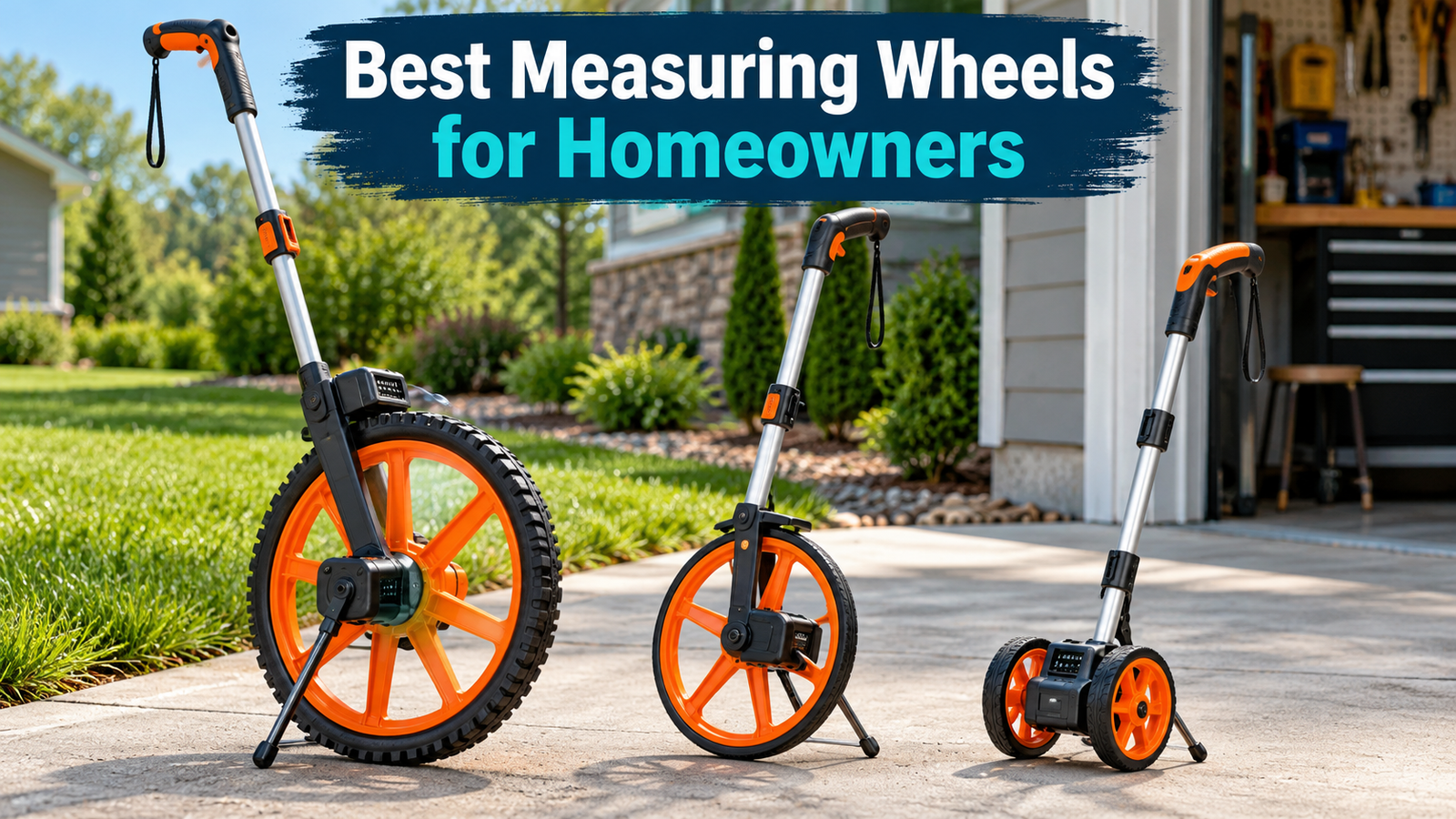
A measuring wheel turns long driveways, fence lines, garden paths, lawns, and property layouts into a manageable one-person job. The best model is not automatically the largest or most expensive. Wheel diameter, terrain, counter style, storage, and the units you use determine which design will be easiest to trust. This guide compares five practical choices using manufacturer-published features and homeowner-focused use cases.
Compare Measuring Wheels on Amazon →Affiliate disclosure: As an Amazon Associate, AccurateGoods earns from qualifying purchases. Product availability, included accessories, and listing details can change. Confirm the current model and manufacturer information before ordering.
Related guides: See Measuring Wheel vs Tape Measure for tool selection, compare electronic methods in Laser Measure vs Measuring Wheel, and use our Best Tape Measure guide for precision detail work.
Our Five Practical Picks
| Pick | Best for | Key advantage |
|---|---|---|
| Milwaukee 12-Inch Measuring Wheel | Best overall homeowner choice | Top-handle reset and full-size outdoor format |
| Keson MP401 | Rough ground and long property routes | Large four-foot-circumference wheel |
| Crescent Lufkin CMW12 | Landscaping and general property work | Handle-mounted counter and collapsible design |
| Milwaukee 6-Inch Measuring Wheel | Compact storage and smooth surfaces | Portable format for short and indoor runs |
| Milwaukee 12-Inch Digital Wheel | Saved readings and mixed units | Digital display, conversion, and memory |
1. Milwaukee 12-Inch Measuring Wheel
The Milwaukee 12-inch mechanical model is the most balanced format in this list for a typical homeowner. A wheel of this size is large enough for driveways, sidewalks, lawns, and fence layouts without becoming as bulky as a heavy professional field wheel. Milwaukee highlights a top-handle clearing function, so the user can reset between measurements without repeatedly bending down.
This type of wheel makes sense if your projects vary. It can estimate the run from a house to a detached garage, trace a straight fence line, measure a garden perimeter, or help plan landscape lighting cable. A mechanical counter also avoids battery dependence and keeps the operating process simple: reset, roll, stop, and read.
Why it stands out
- Versatile 12-inch format for common outdoor routes
- Handle-level reset improves convenience
- Mechanical operation is easy to understand
- Suitable for occasional and repeated property projects
Keep in mind: Like every measuring wheel, it is an estimating tool. Loose gravel, wheel slip, side-to-side wandering, and bumps can influence the result.
Check Milwaukee 12-Inch Wheel on Amazon →2. Keson MP401 Measuring Wheel
The Keson MP401 is the specialist choice for larger properties and surfaces that challenge smaller wheels. Keson describes it as a large 15.7-inch-diameter, four-foot-circumference wheel. The manufacturer explains that the size helps span dips that smaller wheels can fall into, while its spoked design and professional metal frame are intended for demanding field use.
This is the model to consider when the route includes long grass, minor debris, soft areas, or uneven ground. It is also useful for long driveway, acreage, farm, drainage, and fencing estimates. The protected mechanical counter is designed to remain readable and less exposed to ground contact, and the frame folds using a barrel clamp for storage.
Why it stands out
- Large wheel rolls over small surface irregularities more easily
- Rugged frame suits repeated outdoor work
- Mechanical counter requires no batteries
- Folding design helps transport and storage
Keep in mind: The large format occupies more space and may be unnecessary for smooth patios or short indoor routes. Select it for terrain performance rather than compactness.
Check Keson MP401 on Amazon →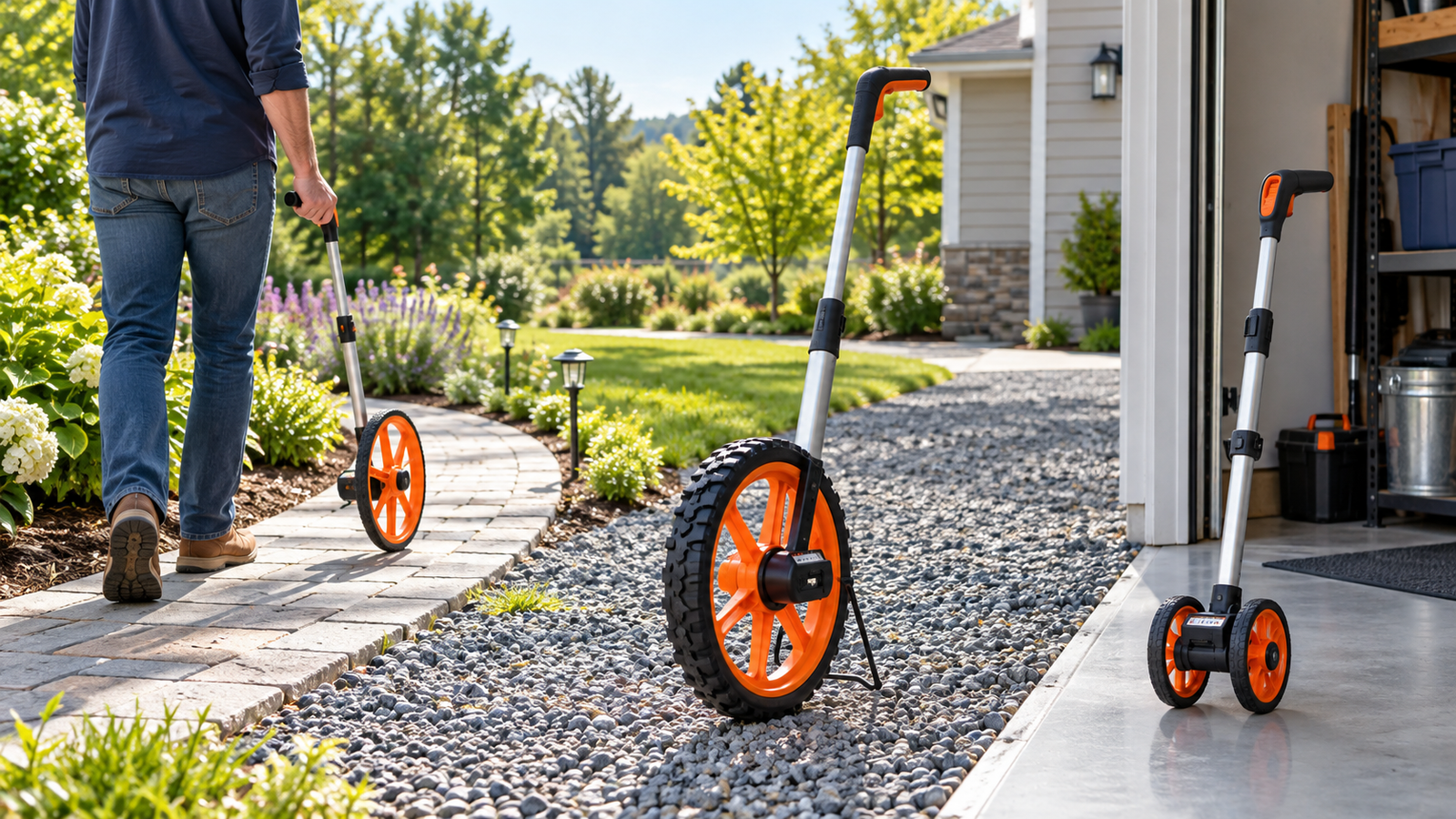
3. Crescent Lufkin CMW12 12-Inch SAE Wheel
The Crescent Lufkin CMW12 is another homeowner-friendly 12-inch option. Crescent positions the design for contractors, surveyors, landscapers, utility crews, and property measurement. Its handle-mounted counter improves visibility and makes the reset control easier to reach. The design also includes an ergonomic grip, collapsible storage, and a folding kickstand.
Those details matter for real home projects. A kickstand keeps the tool upright while you record a number, compare a plan, or move a marker. A collapsible frame helps when garage wall space is limited. The 12-inch wheel is a practical middle ground for lawn borders, driveways, walkways, and site planning.
Why it stands out
- Visible handle-mounted counter
- Accessible reset control
- Collapsible design for storage
- Kickstand supports measurement recording
Keep in mind: Verify that you are ordering the SAE version if you want feet and inches. Crescent also offers metric models, and the similar appearance can make unit selection easy to overlook.
Check Crescent Lufkin CMW12 on Amazon →4. Milwaukee 6-Inch Measuring Wheel
A compact wheel is useful when portability and maneuverability are more important than rough-terrain performance. Milwaukee’s 6-inch measuring wheel is designed for a smaller footprint than a full-size 12-inch model. This makes it easier to store in a vehicle, closet, or packed garage and easier to maneuver through finished interiors.
Choose this format for smooth floors, short driveways, rooms, workshops, curved surfaces, or quick estimates where a large wheel feels cumbersome. Compact wheels are popular with real-estate, appraisal, maintenance, and homeowner users because they can measure alone without extending a long tape across a space.
Why it stands out
- Easy to carry and store
- Better maneuverability in tighter areas
- Useful for smooth indoor and paved surfaces
- Convenient for vehicle-based property checks
Keep in mind: A small wheel follows more small bumps and depressions, so it is not the best choice for overgrown grass, deep gravel, or debris-covered routes.
Check Milwaukee 6-Inch Wheel on Amazon →5. Milwaukee 12-Inch Digital Measuring Wheel
The Milwaukee 12-inch digital wheel is designed for users who want more than a mechanical counter. According to Milwaukee, the handle-mounted digital interface can save up to four measurements and convert among Imperial, Metric, and Engineer scales. The controls allow one-handed operation, and the backlit display helps with reading in changing light.
This is a strong fit when you regularly record several property dimensions, switch units for plans or materials, or want to hold a reading before writing it down. Digital memory can reduce transcription mistakes during multi-step projects such as yard layouts, drainage routes, and fence planning.
Why it stands out
- Saves multiple measurements
- Converts between three measurement systems
- Handle-mounted display and controls
- Backlit screen for visibility
Keep in mind: Digital features add batteries and electronics. A mechanical model may be the better value if you only need an occasional distance and are comfortable recording it immediately.
Check Milwaukee Digital Wheel on Amazon →How We Chose These Measuring Wheels
We prioritized verified manufacturer information, practical homeowner use cases, and meaningful differences between designs. The list is not based on invented star ratings, unverified sales claims, or a temporary price. Each pick represents a distinct need: balanced general use, rough terrain, ergonomic property work, compact portability, or digital record keeping.
Wheel size received particular attention because it changes how the tool behaves. Keson’s published guidance divides measuring wheels into large, medium, and small formats. Large wheels are better for overgrown, soft, and debris-covered surfaces. Medium wheels are versatile for most outdoor and some indoor applications. Small wheels are best for smoother, shorter, and more compact work.
We also considered counter placement, reset access, frame storage, kickstand support, measurement units, and whether electronic features create a genuine benefit. A tool that is easy to reset and record is more likely to deliver repeatable results than a model whose controls interrupt your workflow.
Buying Guide: What Homeowners Should Look For
1. Match wheel diameter to the surface
A 12-inch wheel is the safest general recommendation. It is large enough for many lawns and paved routes while remaining manageable in a garage. Choose a larger wheel when the property has rough ground or long outdoor routes. Choose a compact wheel for smooth floors, short distances, curves, and storage convenience.
2. Select the right measurement units
SAE wheels may display feet and inches or feet and tenths. Feet and inches feel natural to many homeowners and match common construction measurements. Decimal feet are useful for calculations and plans. Metric wheels use meters and decimeters or centimeters. Check the exact model designation because manufacturers often sell similar versions with different counters.
3. Mechanical or digital?
A mechanical wheel is simple, dependable, and always ready. It is ideal for occasional property work. A digital wheel can convert units, save readings, and reduce handwritten calculations. Choose digital when those functions will be used regularly, not merely because a screen appears more advanced.
4. Handle controls and comfort
A handle-mounted brake or reset lets you control the reading without bending down. This matters across repeated measurements. Look for a comfortable grip and an extended height that lets you walk naturally. A wheel pushed at an awkward angle is harder to keep on line.
5. Storage and transport
Telescoping or folding handles reduce the footprint. Check how the frame locks because a weak joint can introduce movement. A carrying case helps protect the counter in a vehicle, while a kickstand keeps the tool upright during project planning.
6. Counter protection
The counter is central to the tool. A protected or elevated counter is less likely to strike the ground when the wheel is set down. For digital models, consider housing protection and keep the battery compartment dry and clean.
How Accurate Is a Measuring Wheel?
A measuring wheel can be very consistent on a flat, even track, but it remains an estimating tool in field conditions. Keson states approximately 99.7% accuracy for its wheels under normal conditions while emphasizing that route shape, ground evenness, slippage, and maintenance affect readings. That is a helpful reminder: technique matters as much as the tool.
The wheel measures the path traveled by its contact point. If you weave around obstacles, the number includes that extra travel. If the wheel drops into holes or climbs over stones, it measures those surface changes. If you need a straight horizontal distance across a slope, use a long tape or an appropriate electronic method instead of automatically following the ground.
For planning a fence, ordering landscape edging, or estimating cable, a wheel is often accurate enough when used carefully and checked twice. For a precision cut, property boundary, legal survey, or structural layout, use the appropriate precision instrument or qualified professional.
How to Get Repeatable Measurements
- Define the route. Decide whether you need a straight line, centerline, edge, curve, or surface distance.
- Inspect the tool. Confirm the wheel turns freely, the tire is clean, the handle locks, and the counter resets.
- Mark both endpoints. Vague start and stop positions are a common source of disagreement.
- Start with the contact point aligned. Position the bottom of the wheel directly over the reference mark before resetting.
- Walk steadily. Keep the wheel upright and avoid side-to-side wandering.
- Do not count unwanted obstacles. Clear movable debris or note when a bump belongs to the real route.
- Stop precisely. Finish with the same reference position used at the start.
- Repeat the measurement. Two close readings build confidence; a large difference signals technique or terrain problems.
Which Size Is Best for Your Project?
| Project | Recommended size | Reason |
|---|---|---|
| Driveway or sidewalk | 12-inch medium | Good balance of control and outdoor rolling |
| Fence line across rough grass | Large 15-inch class | Rolls over small irregularities more easily |
| Indoor rooms or smooth floors | 4- to 6-inch compact | Easier maneuverability and storage |
| Garden path or landscape border | 6- to 12-inch | Follows curves without excessive bulk |
| Mixed-unit renovation planning | 12-inch digital | Conversion and memory simplify records |
| Large rural property | Large professional wheel | Better terrain handling and field durability |
Common Buying Mistakes
- Buying the largest wheel when most work will be indoors.
- Choosing a tiny wheel for tall grass or deep gravel.
- Ordering a metric or decimal-feet model when you expect feet and inches.
- Paying for digital memory that will never be used.
- Ignoring folded dimensions when garage storage is limited.
- Assuming a wheel replaces a tape measure for precision cuts.
- Trusting one field reading without repeating the route.
- Using wheel measurements as legal property-boundary evidence.
Frequently Asked Questions
What is the best measuring wheel size for homeowners?
A 12-inch wheel is the best general-purpose size for many homeowners. It handles common outdoor routes while remaining easier to store than a large professional wheel.
Are larger measuring wheels more accurate?
Not automatically, but larger wheels can produce more repeatable results on rough ground because they bridge small dips and roll over debris more easily. On smooth floors, a compact wheel can be easier to control.
Is a digital measuring wheel worth it?
It is worthwhile when you regularly save several readings, convert units, or work from plans using different scales. For occasional single measurements, a mechanical counter is simpler.
Can I use a measuring wheel on grass?
Yes. Short, firm grass is easier than tall, wet, or soft grass. Choose a larger wheel for overgrown or uneven areas and repeat the route to check consistency.
Can a measuring wheel measure curves?
Yes. A wheel follows the path it rolls, making it useful for garden borders, curved walkways, and cable routes. Maintain a consistent centerline or edge throughout the curve.
Do I still need a tape measure?
Yes. A measuring wheel is best for long routes and estimates. A tape measure is better for openings, furniture, lumber, cabinets, and measurements used for precise cutting or fit.
Sources and Manufacturer References
- Keson Measuring Wheels
- Keson Measuring Wheel FAQ
- Milwaukee 12-Inch Measuring Wheel
- Milwaukee 12-Inch Digital Measuring Wheel
- Crescent Lufkin CMW12
Final Verdict
For most homeowners, start with a 12-inch mechanical measuring wheel because it offers the best balance of outdoor performance, simple operation, and storage. Choose the Keson MP401 when rough ground is the priority, a 6-inch compact wheel for smooth and tight spaces, or the Milwaukee digital wheel when memory and unit conversion will save real project time.
Compare Current Measuring Wheel Options →