A well-built 25-foot tape measure is the best all-around choice for most people
Choose a 25-foot model with clear markings, a dependable lock, controlled retraction, and enough blade reach for solo measurements. Homeowners and DIY users usually benefit more from a compact, readable tape than from the biggest case. Trade users may prefer a wider blade, magnetic hook, higher visibility, or digital measurement storage.
Best general-purpose size: 25 ft
Affiliate disclosure: As an Amazon Associate, AccurateGoods may earn from qualifying purchases at no additional cost to you. Product specifications and availability can change; verify the current Amazon listing and manufacturer guidance before buying.
Top Tape Measure Picks
These three recommendations serve different buyers instead of repeating the same tool three times: a dependable everyday tape, a premium digital workflow tool, and a rugged magnetic jobsite model.

DEWALT Atomic Compact Series 25 ft
A compact conventional tape with fractional graphics, a finger brake, and a listed 13-foot maximum reach.
Best for: Home projects, DIY, repairs, and general jobsite measuring.
- 25-foot blade
- Integrated finger brake
- Listed accuracy: ±1/16 in
Check Current Price on Amazon
Price and availability may change. Confirm the model and specifications on Amazon.

REEKON T1 Tomahawk 25 ft
A premium digital tape with an e-paper display, saved measurements, Bluetooth, and a green alignment laser.
Best for: Installers and professionals who record many measurements.
- 25-foot physical tape
- 1,000+ measurement memory
- Claimed better than 1/32-in accuracy
View the Digital Features
Check current device/app compatibility and listing details before purchase.
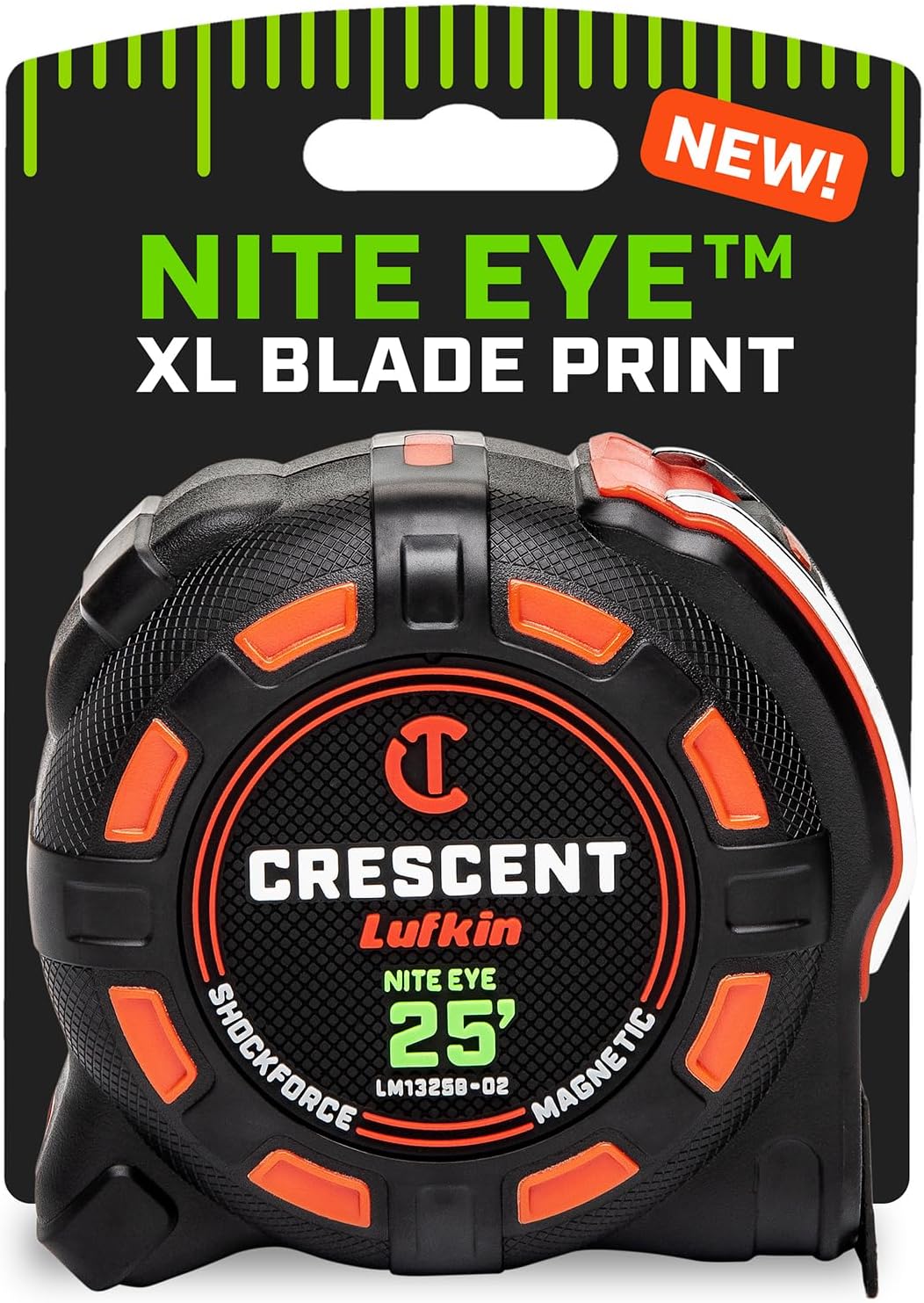
Crescent Lufkin SHOCKFORCE NITE EYE
A wide-blade jobsite tape with high-contrast markings, a magnetic hook, and a listed 17-foot reach.
Best for: Steel framing, longer solo reaches, and demanding site use.
- 25 ft × 1-1/4 in blade
- 360-degree magnetic end hook
- Tri-color NITE EYE XL markings
Check Current Price on Amazon
Confirm the exact LM1325B-02 model and current specifications on Amazon.
How We Chose the Best Tape Measures
A good tape measure has to do more than extend to the advertised length. We prioritized real purchase factors: readable markings, practical blade length, unsupported reach, lock and brake control, hook design, case size, durability, and the amount of effort required to get a repeatable reading. We also separated general-purpose tools from specialized models so a premium feature has a clear reason to exist.
For most U.S. households and mixed jobsite tasks, 25 feet is the useful middle ground. A 16-foot tape is lighter for furniture, cabinets, and indoor work, while a 30-foot or longer model can help outdoors but adds bulk. Digital features earn a recommendation only when they improve measurement capture or documentation—not simply because they make a tool more expensive.
Tape Measure Comparison
Swipe horizontally to compare all specifications →
| Product | Best for | Length | Reach / accuracy | Hook | Control | Digital features | CTA |
|---|---|---|---|---|---|---|---|
| DEWALT Atomic DWHT38125S | Everyday DIY and general use | 25 ft | 13-ft max reach; ±1/16-in listed accuracy | Standard; further detail not independently verified | Slide lock + finger brake | None | View DEWALT on Amazon |
| REEKON T1 Tomahawk | Digital measurement workflow | 25 ft | Manufacturer claims better than 1/32 in / 0.5 mm | Standard physical-tape hook | Push-button lock + digital controls | Display, 1,000+ memory, Bluetooth, green alignment laser | View REEKON on Amazon |
| Crescent Lufkin LM1325B-02 | Rugged magnetic jobsite use | 25 ft | 17-ft listed reach; accuracy not independently verified | 360-degree magnetic end hook | Conventional lock | None | View Lufkin on Amazon |
Detailed Product Recommendations
DEWALT Atomic Compact Series 25 ft Tape Measure
The DWHT38125S is the easiest model here to recommend to the widest audience. Its 25-foot length covers rooms, lumber, shelving, doors, furniture, and most common renovation checks without the size penalty of a 30-foot case. DEWALT lists a 13-foot maximum reach, which is useful when one person needs to bridge a gap before the blade bends.
The integrated finger brake gives the user another way to control blade movement, while the slide lock holds a measurement. Fractional blade graphics can also make common readings faster for buyers who do not use a tape every day. Amazon lists measurement accuracy at ±1/16 inch; that is a listing claim, not a substitute for checking the tape against a known reference before precision work.
Advantages
- Versatile 25-foot capacity
- Compact general-purpose design
- Fractional graphics and finger brake
Considerations
- No magnetic hook or measurement memory
- Shorter listed reach than the Lufkin pick
Who should buy it: Homeowners, DIYers, maintenance users, and tradespeople who want a straightforward tape that can live in a toolbox or work bag.
REEKON T1 Tomahawk 25 ft Digital Tape Measure
The T1 is the premium option for readers whose work creates many measurements. It remains a physical 25-foot tape, but adds an e-paper display, onboard storage for more than 1,000 measurements, Bluetooth, and a green alignment laser. The manufacturer claims better than 1/32-inch (0.5 mm) accuracy with self-calibrating measurement correction.
The value is workflow, not novelty. A remodeler can retain a run of measurements instead of repeatedly reaching for a notebook, and compatible digital transfer can reduce retyping. The green laser is for alignment; it should not be described as a laser distance-measuring replacement. Buyers who measure only occasionally may be better served by the simpler DEWALT.
Advantages
- Digital display and measurement memory
- Bluetooth-supported workflow
- Replaceable blades and green alignment laser
Considerations
- Higher cost and charging requirement
- App/device compatibility needs checking
Who should buy it: Installers, fabricators, contractors, estimators, and serious renovators who can save time by retaining and transferring repeated measurements.
Crescent Lufkin 25 ft SHOCKFORCE NITE EYE Magnetic Tape
The LM1325B-02 is designed for buyers who care more about reach, visibility, and metal-surface utility than compactness. Its 1-1/4-inch blade is listed for 17 feet of reach, while tri-color NITE EYE XL markings aim to remain easier to read in inconsistent jobsite light.
The 360-degree diamond-coated magnetic end hook can attach to ferrous surfaces from more than one angle. Crescent also specifies a three-times clear-coated blade, Mylar protection on the first six inches, STABLEWING blade design, a deep-pocket clip, and a 120-foot drop-test claim. That does not establish an IP/weather rating, so do not present the tape as waterproof.
Advantages
- Long listed unsupported reach
- High-contrast blade markings
- Magnetic hook and impact-focused design
Considerations
- Bulkier than a compact tape
- Magnetic hook may collect metal debris
Who should buy it: Framers, metalworkers, installers, and frequent DIY users who regularly measure across gaps or against steel.
What Tape Measure Length Should You Buy?
16 feet: compact indoor work
A 16-foot tape is easy to carry and usually enough for furniture, cabinets, pictures, appliances, and many workshop projects. It becomes limiting when you start measuring full rooms, long walls, or exterior layouts.
25 feet: the best all-around size
For most buyers, 25 feet balances capacity and portability. It reaches across common rooms and handles typical lumber or remodeling work without forcing you to carry an oversized case. Blade readability, reach, lock quality, and retraction control matter more than choosing the heaviest model.
Best everyday match: The DEWALT Atomic is the natural fit when you want a conventional 25-foot tape with a compact case and easy control.
30 feet or longer: outdoor and layout work
Longer tapes can help with landscaping, foundations, large rooms, and exterior projects, but they are heavier and more cumbersome. For distances beyond a normal pocket tape, a long reel or a suitable laser distance meter may be more practical.
Features That Matter Most
Readable markings
High contrast is more important than decorative styling. Large numerals, consistent tick marks, fractional labels, and printing on both sides can reduce reading errors. Choose markings that match the way you actually work rather than assuming every professional prefers the same blade.
Blade reach and stability
Reach describes how far the blade can extend before it collapses under its own weight. Longer reach helps when measuring alone, but advertised reach is not the same thing as accuracy. A wide, curved blade tends to extend farther, while a narrower blade can keep the case compact.
Hook condition and movement
The end hook normally shifts slightly to compensate for inside and outside measurements. That movement is intentional. A bent, loose, dirty, or damaged hook can still create errors, so inspect it regularly and compare the tape against a known reference.
Magnetic versus standard hooks
A magnetic hook can be extremely helpful on steel studs, conduit, machinery, and other ferrous surfaces. It adds less value when most work involves wood, drywall, or furniture, and it can attract metal filings.
Best magnetic match: Choose the Crescent Lufkin when long reach, high-contrast markings, and attachment to steel matter more than a small case.
Case comfort, lock, and retraction
A case should feel secure without becoming tiring to grip. The lock should hold the blade consistently, and retraction should be controlled enough to protect fingers and the hook. A finger brake offers useful fine control, but it does not replace safe handling.
Tape Measure vs. Laser Measure
A tape measure is still better for short physical spans, checking object dimensions, hooking an edge, and marking material. A laser distance meter is convenient for long rooms, ceiling heights, and calculations where there is a clear target surface. Many professionals carry both because the tools solve different problems.
The REEKON T1 remains a physical tape measure. Its green laser creates an alignment line; it is not a substitute for a laser distance meter that calculates distance from reflected light.
Best advanced workflow: Consider the REEKON when saved readings and digital transfer would reduce repeated note-taking on measurement-heavy projects.
How to Check Tape Measure Accuracy
- Inspect the hook for bends, debris, loose rivets, or unusual movement.
- Compare the tape with a trusted rule or reference over several distances, not just one inch.
- Test both an outside measurement, where you pull the hook, and an inside measurement, where you push it.
- Repeat the measurement with normal tension and from a straight viewing angle.
- Stop using the tape for precision work if the blade is kinked, the markings are worn, or the hook no longer compensates consistently.
Even a well-made tape is a working tool that can be damaged. Consistent technique and periodic comparison matter as much as a manufacturer’s accuracy claim.
Also Consider
The original guide included several additional choices that remain useful for readers with different brand preferences or budgets:
- Stanley FatMax 33-725: a familiar wide-blade 25-foot jobsite option.
- Milwaukee 48-22-0325: a magnetic tape aimed at demanding trade use.
- Klein Tools 9225: a robust conventional tape for users who prefer Klein’s tool ecosystem.
- CRAFTSMAN CMHT37225: a straightforward value-oriented 25-foot choice.
- LEXIVON LX-201: an alternative hybrid-style option, though the current top digital recommendation has stronger verified documentation.
These alternatives are kept for informational breadth. They are not given affiliate CTAs here because the three featured products create clearer, better-documented buyer paths.
Which Tape Measure Is Right for You?
Choose everyday simplicity
Pick the DEWALT if you want one compact 25-foot tape for repairs, rooms, lumber, and routine work.
Choose a digital workflow
Pick the REEKON if saved readings, a display, Bluetooth, and alignment features can reduce repeated steps.
Choose magnetic reach
Pick the Crescent Lufkin if you work around steel and prioritize a wide blade, bold markings, and longer reach.
Frequently Asked Questions
What tape measure length is best for home use?
A 25-foot tape is the best all-around size for most homes because it can measure common rooms, furniture, lumber, and renovation projects without the bulk of a longer model. A 16-foot tape can be more comfortable for small indoor tasks.
Is a wider tape-measure blade better?
A wider, more curved blade usually provides greater unsupported reach and can be easier to read, but it also creates a larger and heavier case. Choose wide for long solo reaches and compact for frequent carrying.
Why does the end hook move?
The hook is designed to slide by roughly its own thickness so the tape can compensate between outside measurements, where the hook is pulled, and inside measurements, where it is pushed. Excessive looseness, damage, or debris can still affect readings.
Is a magnetic tape measure worth it?
It is worth considering when you regularly work with steel studs, conduit, machinery, or other ferrous surfaces. For woodwork and ordinary household measuring, a standard hook is often lighter and sufficient.
Does a digital tape measure replace a laser distance meter?
No. A digital tape such as the REEKON T1 measures with a physical blade and adds display, memory, or connectivity features. A laser distance meter calculates distance to a target surface and is usually better for long rooms or heights.
How often should I check a tape measure?
Check it whenever the hook takes a hard impact, the blade kinks, or a measurement seems inconsistent. Frequent professional users should compare it periodically with a trusted reference and inspect the hook and markings.
Final Verdict
For most readers, the DEWALT Atomic Compact Series 25 ft Tape Measure offers the clearest balance of useful length, compact handling, readable fractional graphics, reach, and blade control. Choose the REEKON T1 when digital capture can improve a professional workflow, or the Crescent Lufkin when magnetic attachment, bold markings, and longer reach matter more than compact size.