
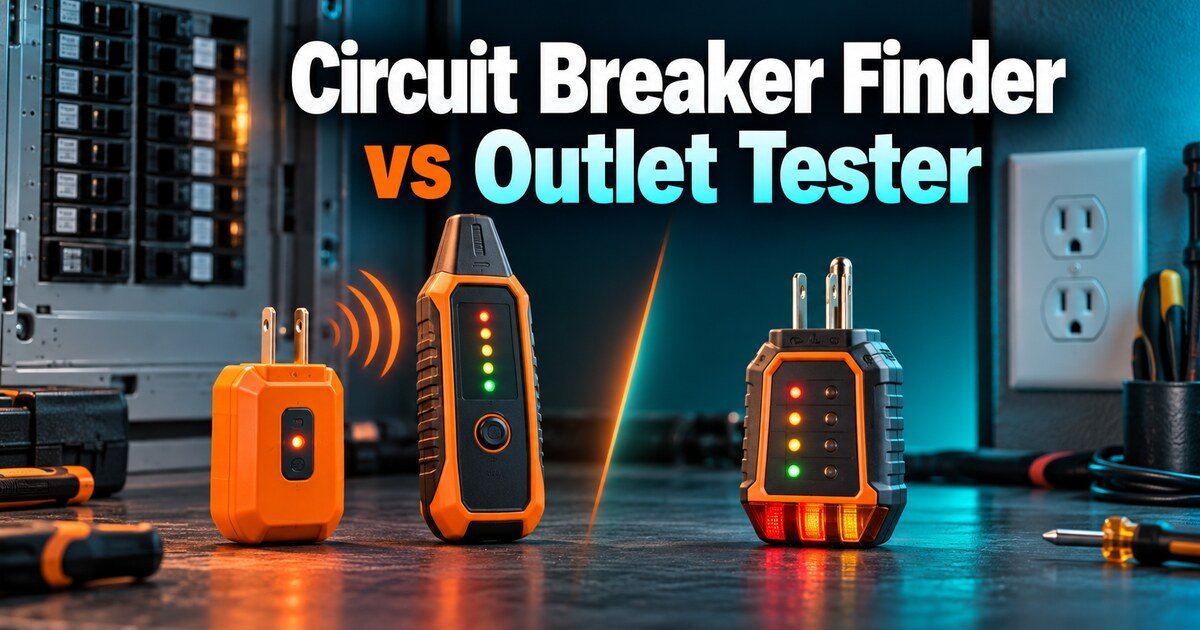
Circuit Breaker Finder vs Outlet Tester: Which Tool Do You Need?
Understand what each plug-in electrical tester can diagnose, what it cannot prove, and which one belongs in your home toolkit.
Choose the Right Electrical Tester
Compare breaker finders for panel mapping or outlet testers for quick receptacle checks.
See Breaker FindersSee Outlet TestersAs an Amazon Associate, we may earn from qualifying purchases. Price and availability may change.
Both tools plug into a standard receptacle, often use colored indicator lights, and are sold beside each other in electrical-testing aisles. That visual similarity creates a common buying mistake: expecting an outlet tester to identify a breaker, or expecting a breaker finder to diagnose every wiring fault.
The better approach is to start with the question you need to answer. Are you trying to map an outlet to the electrical panel, or are you trying to screen the receptacle for a common wiring condition? This guide explains the difference, shows where combined kits help, and identifies the safety limits that matter before you work.
Circuit Breaker Finder vs Outlet Tester at a Glance
| Feature | Circuit Breaker Finder | Outlet Tester |
|---|---|---|
| Main purpose | Match an energized outlet to its controlling breaker | Screen a receptacle for common wiring patterns |
| Typical parts | Plug-in transmitter plus handheld receiver | Single plug-in tester with indicator lights or display |
| Used at panel? | Yes, receiver scans breaker faces | No, basic use is at the receptacle |
| Identifies open ground? | Only if transmitter includes that test feature | Often, within the tester’s supported fault chart |
| Tests GFCI trip? | Some transmitters include a GFCI button | Many models include a GFCI test button |
| Confirms zero voltage? | No | No |
| Best for | Panel labeling, circuit mapping, outlet projects | Fast receptacle screening and GFCI checks |
What Is a Circuit Breaker Finder?
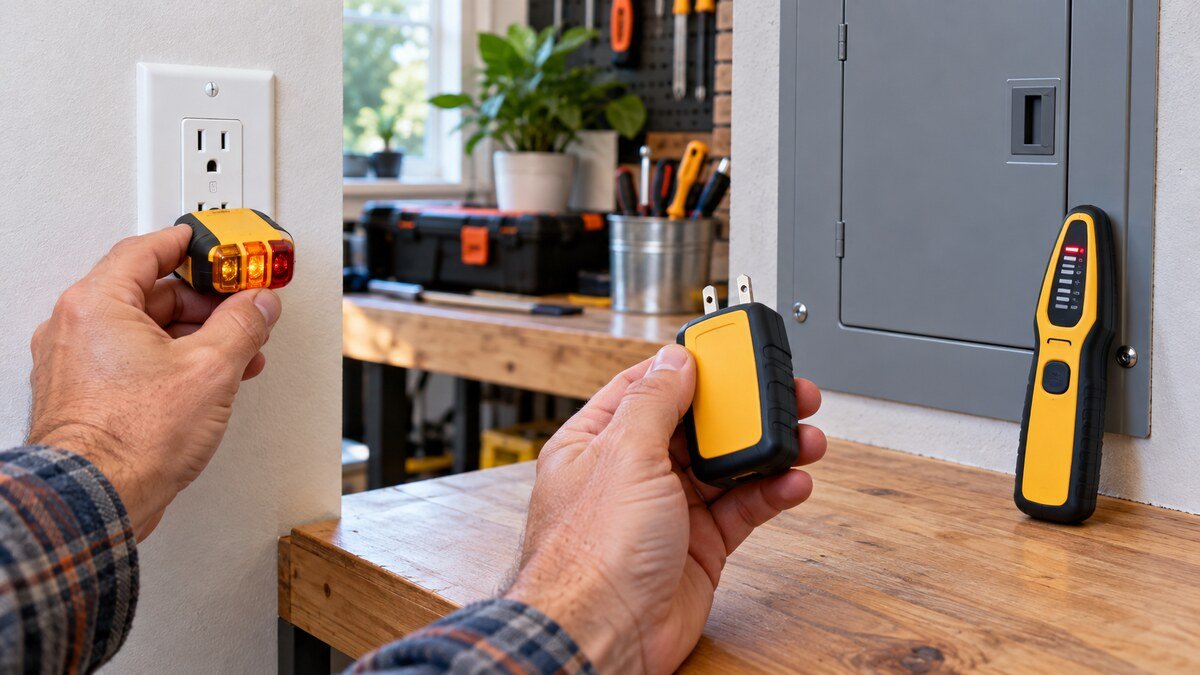
A circuit breaker finder is a two-part electronic tracing tool. Its transmitter plugs into an energized receptacle and places a coded signal on the branch circuit. The receiver is moved across the breaker faces at the panel until it identifies the strongest matching signal.
Modern receivers commonly calibrate during the first scan and narrow the result during a second pass. The finder reduces repeated trips between the room and panel, especially when panel labels are incomplete or inaccurate. It is useful when replacing an outlet, mapping a recently purchased home, or documenting circuits for future maintenance.
What a breaker finder can do
- Match a receptacle to its likely controlling breaker
- Help build or correct a panel directory
- Reduce trial-and-error breaker switching
- Work with approved light-socket or clip adapters on compatible models
- Provide basic outlet or GFCI testing when integrated into the transmitter
What it cannot prove
The receiver indication does not prove that conductors are safe to touch. After switching off the identified breaker, you must verify the circuit condition with an appropriately rated tester. A standard breaker finder also does not map the exact cable route through walls. For that distinction, read wire tracer vs circuit breaker finder.
What Is an Outlet Tester?
An outlet tester, also called a receptacle tester, is a compact plug-in device that interprets voltage relationships among the hot, neutral, and equipment-ground contacts. A simple three-light model uses a printed legend to show patterns associated with common wiring conditions. Digital models may display voltage and provide clearer text or icons.
Many outlet testers include a button that introduces a small intentional imbalance to evaluate whether a compatible GFCI receptacle or upstream protective device trips. This is a functional check, not a complete verification of installation quality or trip-current performance.
What an outlet tester can do
- Indicate whether a standard receptacle is energized
- Screen for common conditions such as open ground or open neutral
- Flag a hot-neutral reversal on many configurations
- Perform a basic GFCI trip check on compatible grounded circuits
- Help compare receptacles during a home walkthrough
What it cannot prove
A basic three-light tester cannot detect every dangerous wiring condition. Some false-ground or bootleg-ground configurations can fool simple testers. It does not evaluate conductor size, terminal torque, insulation condition, arc-fault protection, voltage drop under meaningful load, or the overall quality of work inside the box.
The Core Difference: Location vs Condition
“Which breaker controls this outlet?”
Use a circuit breaker finder. The transmitter marks the circuit electronically, and the receiver locates its breaker at the panel.
“Is this outlet wired normally?”
Use an outlet tester. Its indicator pattern screens the receptacle for a limited set of common wiring conditions.
This one distinction resolves most purchasing confusion. A breaker finder answers an identity question. An outlet tester answers a limited condition question. A combination breaker-finder kit may answer both, but only because its transmitter incorporates receptacle-test electronics in addition to sending the tracing signal.
How a Circuit Breaker Finder Works
Once plugged in, the transmitter draws or injects a recognizable signal onto the energized branch circuit. At the panel, the receiver senses that signature. Because signals can couple into adjacent conductors, the first pass may trigger on several nearby breakers. Calibration helps the receiver reject weaker candidates.
For reliable results, scan every breaker at the same speed and orientation, then repeat the complete panel. Switch off the strongest candidate and return to the outlet to confirm loss of power. If you are seeing inconsistent alerts, use our guide to a circuit breaker finder not working.
How an Outlet Tester Works
Inside a basic tester, small indicator circuits connect between the plug contacts. Different voltage relationships illuminate different combinations of lights. You compare the pattern with the legend printed on the tester. The result is useful only for the conditions the chart describes.
A GFCI test button adds a controlled leakage path that should create an imbalance and cause a properly connected GFCI to trip. Testing can interrupt power to downstream outlets, refrigerators, computers, network equipment, alarms, or other loads, so identify what the protective device controls before pressing the button.
Can One Tool Replace the Other?
A plain outlet tester cannot locate a breaker because it does not provide a handheld receiver designed to compare the coded signal at the panel. A plain breaker-finder transmitter may show only that it has power and may not provide a detailed wiring legend.
Combination kits bridge the gap. The transmitter may incorporate multiple outlet-test lights and a GFCI button, while the receiver handles breaker identification. This can be a practical choice for homeowners because both functions fit in one kit. However, the two functions should still be understood separately, and the included outlet test remains a screening tool rather than a comprehensive electrical diagnosis.
Which Tool Should a Homeowner Buy First?
For the lowest-cost general check of ordinary receptacles, an outlet tester is often the first purchase. It is compact, simple, and useful during move-in inspections or basic troubleshooting. Choose a model with a clear legend and, if needed, a GFCI test button.
A circuit breaker finder is more valuable when you actively replace outlets or fixtures, map rooms, correct panel labels, or frequently need to isolate a branch circuit. A combined kit is usually the most convenient starting point for serious DIY work because the transmitter can perform quick outlet checks before the receiver is used at the panel.
| Your Main Task | Better Choice | Reason |
|---|---|---|
| Map unlabeled panel circuits | Circuit breaker finder | Designed to identify the controlling breaker |
| Check several outlets during a walkthrough | Outlet tester | Fast and compact for common wiring patterns |
| Replace one receptacle safely | Breaker finder plus voltage tester | Finds the breaker, then supports correct verification |
| Test GFCI operation | GFCI outlet tester | Provides a dedicated functional test button |
| Do both tasks regularly | Combination kit | Combines outlet screening and breaker location |
| Trace hidden cable routes | Purpose-built circuit or wire tracer | Standard plug-in tools are not route-mapping instruments |
Accuracy and Common Misreadings
Breaker finder errors
Adjacent breakers may alert during calibration because wiring is physically close. Inconsistent wrist angle, scanning too fast, weak receiver batteries, power strips, and noisy electronic loads can also affect results. Repeat the full scan and confirm by switching the candidate breaker off.
Outlet tester errors
Users sometimes read the tester upside down, apply the wrong legend, or assume any illuminated pattern means the outlet is safe. The legend is model-specific. A tester may also miss dangerous combinations that produce normal-looking voltage relationships at the receptacle face.
Safety Workflow for Using Both Tools
- Inspect the receptacle and tools for cracks, heat damage, moisture, or loose parts.
- Check each tool’s voltage rating and instructions before use.
- Plug the outlet tester or combined transmitter directly into the receptacle.
- Read the indicator pattern using the exact legend for that model.
- If needed, leave the breaker-finder transmitter connected and scan the panel completely.
- Repeat the receiver scan to narrow the strongest candidate.
- Switch off the identified branch breaker.
- Confirm the transmitter is no longer energized.
- Use an appropriately rated tester and correct live-dead-live procedure before touching conductors.
- Label the breaker only after confirming the controlled outlets or fixtures.
Never remove the service-panel dead front simply to improve receiver sensitivity. Basic breaker finders are intended to scan from the accessible breaker faces. If identification remains uncertain, stop rather than reaching near energized panel components.
Buying Checklist
For a circuit breaker finder, prioritize automatic or straightforward calibration, audible and visual feedback, a receiver that is easy to orient, clear instructions, and compatibility with your system. Useful accessories may include a light-socket adapter, approved clip leads, a carrying case, and integrated receptacle testing.
For an outlet tester, choose a readable legend, solid plug construction, bright indicators, and the specific functions you need. A digital voltage display can add context, but it does not replace a multimeter or professional diagnosis. If testing GFCI protection matters, verify that the model supports it and understand that two-wire ungrounded installations may affect the test.
Avoid buying solely from a large claimed feature count. Safety ratings, instructions, repeatable indications, useful adapters, and trustworthy support matter more than decorative modes. Do not rely on unverified star ratings, exact pricing, or vague “professional” wording.
Frequently Asked Questions
Does an outlet tester tell me which breaker controls the outlet?
No. A standard outlet tester checks limited wiring patterns at the receptacle. Breaker identification requires a transmitter and compatible receiver.
Do breaker finders test outlet wiring?
Some transmitter units include a three-light outlet tester or GFCI button, but not every model does. Check the instructions and printed legend.
Can either tool confirm that wires are dead?
No. Use an appropriately rated voltage tester and a correct verification procedure before contacting conductors.
Can an outlet tester detect a bootleg ground?
A basic three-light tester can be fooled by certain neutral-to-ground connections. More investigation is required when wiring history or symptoms raise concern.
Will a breaker finder work on a GFCI outlet?
Often yes when the receptacle is energized, but the circuit and product design matter. Follow the specific tool instructions and confirm the result after switching the candidate breaker off.
Should I buy a combination kit?
A combination kit is convenient for homeowners who want both quick receptacle screening and breaker identification. It does not replace a voltage tester or comprehensive electrical evaluation.
Final Verdict
Choose a circuit breaker finder when your main question is which breaker powers an outlet. Choose an outlet tester when you want to screen receptacles for common wiring patterns or perform a basic GFCI trip check. For frequent DIY work, a combined breaker-finder and receptacle-tester kit offers the best convenience because it supports both tasks without confusing their purposes.
Whichever option you buy, remember the limit: neither device alone proves a circuit is safe to touch. Use the correct voltage-testing procedure, keep the panel cover in place, and call a licensed electrician when readings are inconsistent, equipment is damaged, or wiring behaves unexpectedly.
