
This Bosch D-TECT200C review examines whether a premium radar wall scanner is a sensible upgrade for renovation and installation work. The buying question is straightforward: do your projects need more information about concealed objects, or do you mainly need to locate a stud for an occasional shelf?
Editorial approach: A specification-based buying review, checked October 30, 2026, using Bosch product documentation. We have not conducted hands-on detection or durability tests. Product photographs are supplied by Bosch. As an Amazon Associate, we earn from qualifying purchases. This article also contains Walmart affiliate links; we may earn a commission at no extra cost to you.
Quick verdict: shortlist it for demanding inspection work
Our buying judgment: consider the D-TECT200C when concealed-service investigation is a recurring part of your work and you will invest time in learning the instrument. For occasional drywall mounting, begin with a simpler tool and a careful verification process.
A premium scanner still cannot certify that a wall is clear or that drilling is safe.
These links open retailer searches. Prices, stock, sellers and matching product availability have not been verified. Confirm the exact model and bundle before ordering.
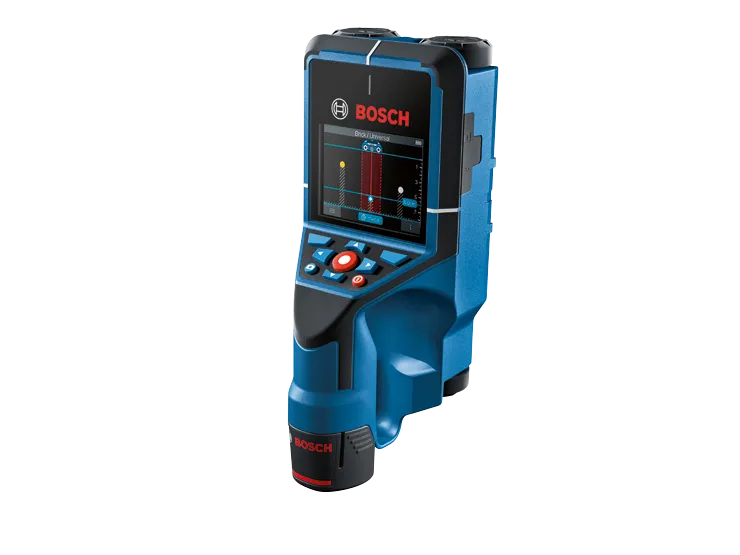
Manufacturer product photograph. Source: Bosch.
Buy the tool that matches the job
Start with the surfaces you work on, the information you need and how frequently you will use it. A costly scanner is easier to justify when it solves a repeated problem than when it sits unused between small household projects.
For a broader starting point, see our wall scanner buying guide.
Bosch D-TECT200C review: the documented feature set
| Feature | Bosch specification |
|---|---|
| Detection system | Radar; four object views |
| Supported object categories | Metal, rebar, live and non-live cables, plastic pipes and wooden studs |
| Maximum metal detection depth | Up to 7.9 inches / 200 mm |
| Maximum copper wiring detection depth | Up to 3-1/8 inches / 80 mm |
| Display and records | 3.5-inch color screen; screenshots; USB-C and SD-card transfer |
| Power | Bosch 12V Max lithium-ion battery |
| Protection rating | IP5X |
Source: Bosch U.S. D-TECT200C product page. Maximum depths are conditional specifications, not guarantees for every material or object. IP5X is a dust rating; do not interpret it as waterproof protection.
Use the specification table to make a shortlist. Then compare your actual projects with the operating instructions. A headline maximum cannot answer whether a particular wall assembly is suitable for the task you have planned.
Who is most likely to get value from it?
Worth considering
- Renovation professionals who repeatedly investigate concealed services.
- Installers who need a consistent inspection and recording routine.
- Buyers willing to practice before using a new scanner on important work.
Consider a simpler route
- Homeowners hanging a few pictures or light shelves.
- Buyers expecting one quick pass to settle every uncertainty.
- Anyone whose project needs specialist assessment beyond a handheld scanner.
Write down the last three jobs that caused uncertainty before buying. Describe the wall, what you needed to identify and how you resolved the question. If those examples do not show a clear gap in your existing equipment, a premium purchase may be premature.
For a one-off project, also compare the cost of professional help. Ownership includes time spent learning, maintaining and interpreting the tool. That time may be worthwhile for frequent work, but less attractive for an isolated household task.
Premium radar scanner vs a basic stud finder
| Your situation | Practical buying direction |
|---|---|
| Occasional drywall mounting | Start with an appropriate basic stud finder and independent checks. |
| Repeated work around concealed services | Investigate a professional scanner, its supported applications and training needs. |
| Unknown construction or inconsistent readings | Resolve the uncertainty before choosing a penetration point. |
| High-consequence structural work | Arrange qualified assessment and a job-specific inspection plan. |
This comparison is a purchasing framework, not a head-to-head test. The most useful tool is the one that provides information you can interpret responsibly. A feature-rich instrument can add complexity as well as capability.
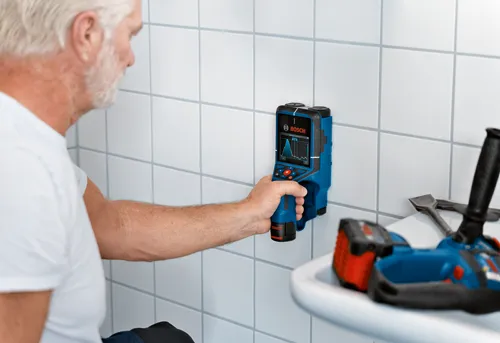
Detection limits to understand before paying more
Bosch warns that moisture, conductive finishes, metallic materials and nearby electromagnetic interference can affect detection. Objects can remain undetected. Consult construction plans and other evidence as well as the scanner; do not treat an empty display as clearance to drill.
Before penetrating a surface, follow Bosch’s instructions to shut off electrical, gas and water supplies and use appropriate independent verification. If the services or construction remain uncertain, stop and arrange qualified help. The official operating and safety manual explains the requirements.
Keep observation and interpretation separate in your notes. “The instrument showed a response here” is an observation. “This is definitely the only pipe in the wall” is a much stronger conclusion. A sound inspection process should record uncertainty rather than hide it behind a confident label.
This distinction also matters when sharing information with someone else. Mark the surface, location and context clearly. A photograph of a screen without a recognizable location can become difficult to interpret after the room changes or another person takes over the project.
If your immediate problem concerns older plaster walls, our guide to finding studs behind plaster provides additional context. Do not assume a method that seemed straightforward on drywall will transfer unchanged to a different assembly.
A repeatable process
Plan an introduction period before relying on a new instrument. Read the instructions, understand the controls and practice on suitable areas where the construction is known. The goal is to learn how to use and document the equipment, not to prove that every uncertain reading must mean the wall is clear.
Useful project records
Decide how records will be named and stored before starting a large project. A simple folder structure with room names, dates and matching site photographs is more useful than a collection of unexplained files. Preserve the original records and distinguish your annotations from the instrument’s output.
A realistic purchase threshold
Set a budget based on expected use rather than a theoretical repair bill. Compare buying, renting where available and hiring qualified help. Include the complete package and the time needed to learn it. Avoid treating an expensive tool as insurance against every possible mistake.
Amazon vs Walmart: compare the exact offer
No live price winner is claimed here. Retailer search results may include accessories, other models, used equipment or marketplace sellers. Open the listing and read the model identifier before comparing checkout totals.
Check these details before ordering
- Exact model: verify D-TECT200C rather than a similarly named scanner or accessory.
- Package contents: check battery, charger, case or pouch and any other included items.
- Seller identity: distinguish the marketplace from the merchant supplying the tool.
- Condition and support: check new, used or refurbished status and regional warranty eligibility.
- Final cost: compare shipping, tax, returns and restocking terms alongside the displayed price.
A lower headline price is only useful when the offers are equivalent. If one package omits equipment you need, add that equipment to the comparison. Keep a record of the listing and order details so you can verify what arrives.
Ready to compare matching offers?
Choose the right model, seller and complete package first. Then compare the final checkout cost and return terms.
Affiliate search links. A matching listing or in-stock offer is not guaranteed at either retailer.
Strengths and trade-offs
Why it makes the shortlist
The documented inspection and recording features make it a candidate for a professional workflow. It is most compelling when you can identify a recurring task that justifies the investment.
Why you might pass
Cost, learning time and the need to interpret uncertain findings can outweigh the benefit for occasional use. Some jobs still require specialist assessment regardless of the scanner you own.
Frequently asked questions
Is the Bosch D-TECT200C worth it for a homeowner?
It depends on the work. For occasional mounting, a simpler tool or qualified help may be better value. Frequent renovation work provides a stronger reason to investigate a premium scanner.
Does its maximum depth apply to every object?
No. Bosch lists different limits for different targets. Check the relevant material and operating conditions rather than applying the maximum metal figure to every task.
Can it guarantee a safe drilling location?
No. Bosch explicitly warns against relying on the detector alone. Follow the manual, verify independently and resolve uncertainty before penetrating a surface.
Which retailer has the lowest price?
We have not verified a current price winner. Compare matching listings, sellers, package contents and final checkout totals using the links above.
Our buying recommendation
Shortlist the D-TECT200C if inspection is a recurring part of your work and you have a clear plan for learning and using it. For a handful of small home projects, establish whether a simpler purchase or professional assistance would answer the need more efficiently.
Either way, treat the tool as one source of information in a careful process. Choose it for a documented fit with your work, then compare complete offers before buying.
Sources and review policy: Bosch’s U.S. product page and operating manual. Buying judgments are editorial analysis, not laboratory findings or a hands-on reliability score. Images: Bosch manufacturer photography.
