
Affiliate disclosure: As an Amazon Associate I earn from qualifying purchases. We may also earn a commission from qualifying Walmart purchases through our links, at no extra cost to you.
Bosch GLM165-22: is it the right step up for your projects?
Understand the measuring workflow, important limitations, and buying checks before ordering.
Updated October 19, 2026 · U.S. buying guide · Research-based review
Quick verdict: is the Bosch GLM165-22 worth buying?
The Bosch GLM165-22 deserves a place on your shortlist if you regularly collect room dimensions and want more than a basic distance reading. Its appeal is the combination of documented measuring functions and a standalone workflow. It is a less convincing purchase if your usual job is marking short boards or checking one small opening with a tape.
Our recommendation is conditional: buy it when you can identify a recurring task that its functions will simplify, and when the actual retail offer fits your budget. Do not pay extra simply because another tool has a shorter range. A useful purchase should make a job easier, not just add capability that remains unused.
This is a research-based review, not a hands-on test. We checked Bosch documentation and assessed how the stated features relate to common homeowner projects. We have not independently measured accuracy, durability, battery life, or visibility. Practical judgments in this article are recommendations based on task fit, rather than claims about personal testing.
What the specifications tell you
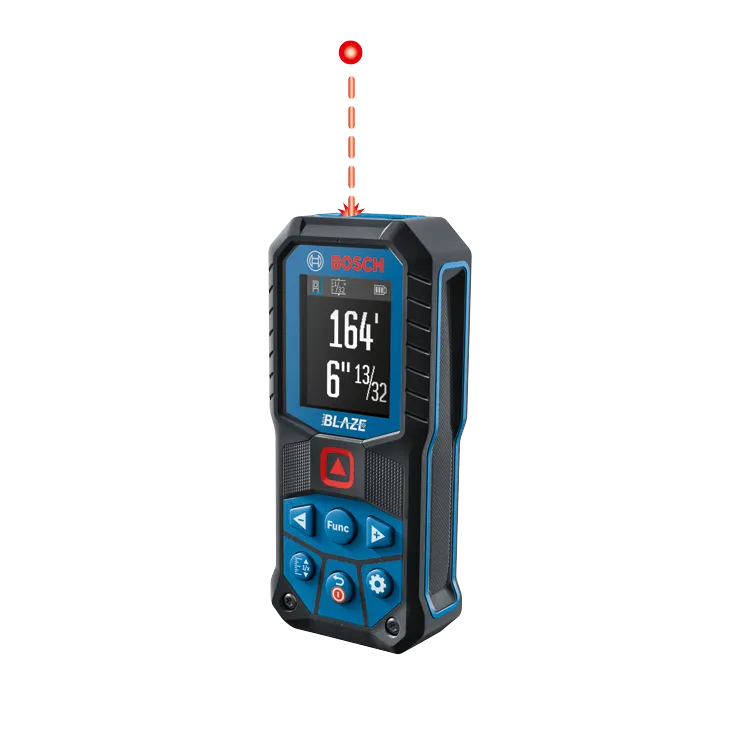
Bosch lists a maximum measuring range of 165 feet, a red beam, a backlit color display, two AA batteries, and IP65 protection. It documents distance, area, volume, indirect, and addition/subtraction functions. The model is listed as unconnected. Bosch’s standard package description includes the tool, batteries, belt clip, and pouch; check the specific retail offer for contents.
The distance accuracy claim is up to ±1/16 inch under the applicable conditions. Importantly, Bosch separately lists stakeout accuracy of ±1/2 inch and warns of a stakeout deviation for certain date codes. Consult current manufacturer information and your supplied manual before using that function for a decision that depends on precision.
These specifications describe intended capabilities. They do not establish that every surface, lighting condition, setup, or measuring mode behaves identically. Read the qualifications before assuming a headline figure applies to your particular project.
| Decision | Our recommendation |
|---|---|
| Frequent indoor room measurements | Shortlist this model |
| Automatic phone transfer required | Choose a connected alternative |
| Direct marking on boards | Keep a tape or suitable marking tool |
| Amazon vs Walmart price winner | Not established; compare checkout totals |
Who should shortlist it?
A homeowner gathering dimensions across several rooms is a plausible buyer. You may be planning furniture, preparing a rough renovation brief, or recording a property layout for your own use. In these situations, collecting clear measurements efficiently can be more useful than having a physical scale stretched across each space.
Someone who frequently works alone may also appreciate a distance-measuring workflow that does not depend on another person holding a tape end. That is a task-based reason to investigate a laser measure. Whether this model provides enough extra value over a simpler device depends on the functions you will use.
Start by listing three recent measuring jobs. Identify what made each difficult: reaching the far wall, doing repeated arithmetic, keeping notes organized, or marking a material. The GLM165-22 should be evaluated against those difficulties. If your problem was mainly making marks on a workpiece, an electronic distance number may not be the solution.
When to keep your money or choose another tool
If you only need a few measurements for one small furniture purchase, an existing reliable tape may already do the job. Buying another instrument is not necessary simply because it is available. Consider borrowing a suitable tool or finishing the preliminary plan with equipment you already understand.
If you need automatic transfer to a phone, this unconnected model does not meet that requirement. Compare an alternative with documented connectivity, and confirm its software supports the workflow you want. Do not infer compatibility from a similar model name or from another product elsewhere in Bosch’s range.
For outdoor targeting, investigate suitability for that environment rather than assuming an indoor recommendation applies. For small-part dimensions, curves, marking, or specialist measurement requirements, choose an instrument suited to the actual job. A laser distance measure belongs in a toolkit because it solves a distance task, not because it replaces all measuring tools.
Area and volume: useful calculations, with limits
A built-in calculation can be convenient when you repeatedly gather dimensions for the same kind of estimate. The practical benefit is reducing the movement between the tool, a separate calculator, and your notes. It does not remove the need to choose the correct dimensions or understand the shape you are describing.
Consider a room with an alcove and a closet opening. Treating it as one rectangle may produce a result that is unsuitable for ordering materials. Draw the room first and divide it into sections when appropriate. Record what each dimension represents, including whether it is taken between finished faces or above an obstruction.
Keep material ordering separate from geometry. Product coverage, installation layout, cuts, wastage, and supplier rules still matter. If you are buying flooring, paint, or a fitted component, ask the relevant supplier or installer how they want the measurements supplied. The tool’s calculation should support that conversation rather than replace it.
A sensible first-use routine
Open the supplied manual before starting a project. Identify the measurement reference, the controls relevant to your task, and the operating limitations. Install the specified batteries and check that the unit you read matches the unit you intend to record. A wrong unit can make an otherwise careful note useless.
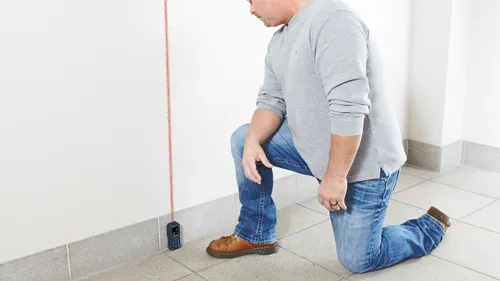
Choose a straightforward indoor span with a stable target. Place the tool consistently according to its instructions and take a reading. Write the unit and reference beside the number. Repeat the reading from the same setup and investigate any difference that could affect your decision.
Compare a convenient span with a reliable tape as a basic setup check. This is not a calibration certificate or a comprehensive accuracy test. It can still reveal an incorrect reference, a unit mix-up, or an aiming mistake before you collect an entire set of room dimensions.
Follow the laser safety instructions in the manual. Avoid eye exposure and account for people who may cross the measuring path. Measuring a wall’s dimensions does not identify hidden wiring or plumbing, so use appropriate checks separately before any drilling or cutting.
How to keep your room notes useful
Give each room a name and draw a small plan before taking readings. Mark doors, windows, recesses, and large fixed obstructions. Then label each recorded distance on the drawing. A number without a location can become ambiguous as soon as you move into the next room.
Keep the original reading instead of immediately rounding it for convenience. You can decide later what level of precision is appropriate for a shopping list or discussion. Retaining the original prevents a rounded planning value from becoming an accidental final fitting dimension.
Check the access route when planning a large furniture purchase. The destination room may have enough space while the doorway, stair turn, or landing does not. Packaging dimensions and required product clearances can also matter. Those are separate questions that a single wall-to-wall reading cannot answer.
When a professional will complete the installation, treat your notes as preliminary information unless they explicitly accept them as final. Let them confirm the dimensions and clearances required for the job. A good measuring workflow includes knowing when someone else must verify the result.
Accuracy and stakeout: the detail buyers should not skip
A measurement is useful only when it answers the right question. Consider the starting reference, target, unit, geometry, and the tolerance your project needs. A precise-looking display does not fix an opening measured at the wrong height or a clearance taken to the wrong face.
The separate stakeout qualification on Bosch’s product page is particularly relevant if that function is part of your buying decision. Read its current notes and confirm the instructions for your unit. Do not substitute the ordinary distance specification for the accuracy stated for another mode.
For repetitive placement or a critical fit, decide how you will verify the result before you begin. A physical reference or another appropriate measuring method may be needed. If you cannot establish that the tool and method meet the task’s requirements, ask the manufacturer or a qualified installer before relying on them.
Our buying verdict does not depend on claiming that the GLM165-22 is universally more accurate than a simpler model. The useful distinction is whether its documented functions and limitations match your work.
Pros, tradeoffs, and ownership questions
The reason to consider this model is a more capable measuring workflow without making a phone part of every task. Buyers who prefer a standalone device may find that appealing. The corresponding tradeoff is that notes and project organization remain your responsibility.
Additional functions also create a learning obligation. Before using an unfamiliar mode on a real project, practice with an uncomplicated example and check the result. A feature is valuable only when you know what inputs it expects and what its output means.
Think about storage and handling as well as the purchase price. Keep the tool protected between jobs, follow the manual’s maintenance guidance, and inspect it if its condition changes. Do not assume a protection rating eliminates the need for reasonable care or makes every type of exposure acceptable.
These are ownership considerations, not reported long-term test results. We have not carried out a drop test or established service life. If durability in a specific environment is essential, check Bosch’s current documentation and warranty terms directly.
Amazon vs Walmart: a fair comparison method
We have not verified current checkout prices at both stores for this review. The buttons open model-specific search results, which can contain multiple sellers, variations, or related products. They are comparison starting points rather than a promise of a particular offer, stock level, or lowest price.
Enter your delivery ZIP code and choose the exact GLM165-22. Compare a new, complete unit with another new, complete unit. If you choose open-box or used equipment, assess that as a different condition and check the return terms carefully. Do not silently compare it with a new retail package.
Look at the final delivered total, not only the search result price. Shipping, tax, membership requirements, and promotions may change the amount you actually pay. Confirm delivery timing if you need the tool for a particular project, and avoid paying for speed you do not need.
Read the seller identity separately from fulfillment information. A familiar marketplace name does not establish that every offer has the same seller, support, or return process. Keep your order receipt and the listing details relevant to your purchase.
A buying checklist before payment
First, confirm the complete model number. Similar-looking Bosch products can have different functions, battery arrangements, or connectivity. A generic title such as “Bosch laser measure” is not enough to prove that two offers are equivalent.
Second, verify package contents and condition. Third, review return information and manufacturer support terms. Fourth, check the total and estimated delivery for your location. Fifth, make sure you know how you will confirm important measurements once the tool arrives.
If a listing contradicts the manufacturer’s documentation, resolve the disagreement before ordering. Ask the seller which exact item they will supply, especially when the difference affects a required function. A confusing offer is not improved by an attractive headline discount.
Do not treat an old deal screenshot as a current price guarantee. Compare the offers available during your own shopping session and make the decision from those terms. This review deliberately leaves the price winner open because we do not have equivalent verified checkout evidence.
GLM165-22 vs GLM100-23: should you upgrade?
The choice depends on whether you need the additional capability. For occasional straightforward indoor distance collection, a simpler model may be sufficient. For repeated measuring tasks that benefit from calculations or a longer stated range, the GLM165-22 becomes more relevant.
Set a personal upgrade budget before looking at promotions. Write down the extra task the more capable model will solve and how often you expect to perform it. Then compare the real delivered price gap. This avoids justifying a purchase with a feature you have no plan to use.
Read our Bosch GLM100-23 vs GLM165-22 comparison for the side-by-side decision. Our GLM100-23 review covers the simpler alternative, while the homeowner laser measure guide helps place both in a broader shortlist.
Final verdict
The Bosch GLM165-22 is worth considering for homeowners and project planners who can use its documented measuring functions and want a standalone tool. Our recommendation is strongest when you have a recurring room-measuring task and understand the operating conditions and separate stakeout qualification.
Keep a tape for direct marking and verification; our laser measure vs tape measure guide explains the distinction. Compare the current Amazon and Walmart offers below, verify the exact model and seller, and choose from the delivered total and terms you can actually obtain.
Frequently asked questions
Does it have Bluetooth?
Bosch lists the GLM165-22 as unconnected. Choose a model with documented connectivity if automatic transfer is essential.
Can I use it for flooring estimates?
It can support preliminary room measurement. Account for the actual shape, layout, coverage, and waste separately, and confirm final quantities with your supplier or installer.
Does IP65 mean I can ignore weather conditions?
No. Follow the model’s operating limits and care instructions. A protection rating does not make every environment or exposure appropriate.
Is the stakeout specification the same as distance accuracy?
No. Bosch gives a separate stakeout qualification. Check the current manufacturer notes and the instructions for your unit.
Which store is cheaper?
No current price winner is verified here. Compare the exact model and condition, seller identity, delivery, tax, and return terms during your shopping session.
