
Laser Distance Measure vs Tape Measure
Compare speed, accuracy, range, one-person use, and real project value before choosing your next measuring tool.
Compare Accurate Measuring Tools
See Laser MeasuresSee Tape Measures
As an Amazon Associate, we may earn from qualifying purchases. Price and availability may change.
Both tools answer the same basic question—how far is it from one point to another—but they do so in very different ways. A tape measure physically spans the distance with a graduated blade. A laser measure calculates distance from the tool’s reference point to the surface hit by its laser. That difference affects speed, setup, visibility, repeatability, and the types of measurements each tool handles best.
This comparison focuses on practical homeowner and DIY use rather than promotional claims. Accuracy depends on the model, the target, technique, temperature, lighting, blade condition, and whether the reference points are understood correctly. Choose according to the job, not simply according to which tool looks more advanced.
Laser Measure vs Tape Measure at a Glance
| Feature | Laser Distance Measure | Tape Measure |
|---|---|---|
| Best task | Rooms, walls, ceilings, long clear distances | Boards, openings, objects, layout and marking |
| Operation | Usually one person | One person for short spans; helper may be needed for long spans |
| Speed | Very fast for repeated dimensions | Fast for short accessible measurements |
| Calculations | Many models calculate area, volume, and indirect height | Manual calculation required |
| Bright outdoors | Laser dot may be difficult to see | Usually dependable when the blade can reach |
| Physical marking | Does not create a physical reference along the material | Blade supports direct pencil marking |
| Power | Requires batteries or charging | No electronic power required |
| Common error | Wrong reference point or reflective target | Blade sag, hook error, angle, or misread scale |
How a Laser Distance Measure Works
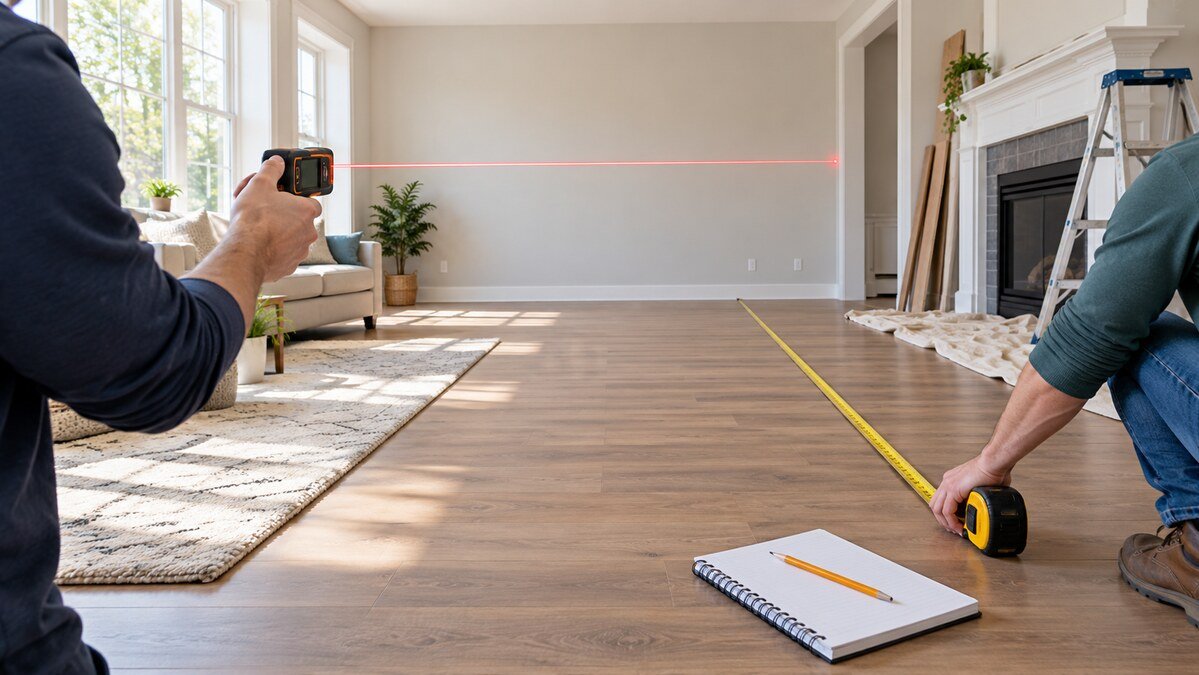
A laser measure emits a visible beam toward a target and uses the reflected signal to calculate distance. The displayed value normally represents the distance from a selected reference point on the tool—often the rear, front, or a fold-out pin—to the surface where the beam lands. The user must confirm that reference setting because a wrong selection can shift every result by the length of the device.
Many models store recent readings and calculate length, area, or volume. More advanced units may offer indirect height calculations, continuous measurement, Bluetooth transfer, a camera or digital viewfinder, and a tripod thread. These functions are valuable when estimating paint, flooring, trim, room volume, or ceiling height, but they do not replace careful identification of the endpoints.
How a Tape Measure Works
A tape measure places a graduated steel, fiberglass, or synthetic blade directly between two points. A retractable pocket tape has a sliding end hook designed to compensate for inside and outside measurements. The hook should move slightly by design; excessive movement, damage, debris, or a bent hook can introduce error.
The tape’s biggest advantage is physical contact. You can hook an edge, extend the blade along material, transfer a mark, compare two pieces, or read an opening even when no reflective target exists. A wide blade and strong standout help on longer unsupported spans, while a compact tape is easier to carry for everyday work.
Best Product Classes for Different Users
Premium Laser
Bosch GLM with camera/viewfinder class
For long ranges, bright jobsites, documentation, and frequent estimates.
DIY Laser
Bosch Blaze GLM165 class
For rooms, flooring, paint estimates, and everyday indoor measurements.
Premium Tape
Wide-blade 25-foot tape class
For construction layout, material cutting, and reliable physical measurements.
Which Tool Is More Accurate?
Either tool can be accurate enough for ordinary home projects when used correctly. The more important question is which error source is easier to control in the situation. A laser avoids blade sag and reading a distant scale, but it needs a clear target and correct reference setting. A tape avoids reflective-surface problems but can bow, twist, angle away from the true line, or move at the hook.
For room dimensions, a laser often produces more repeatable one-person readings because it can sit against one wall and target the opposite wall. For a short board or cabinet opening, a tape provides direct contact and an immediate mark. Our guide to how accurate laser measures are explains the main factors that influence readings.
Speed and One-Person Operation
Laser measures excel when a single person must collect many room dimensions. Place the rear of the tool against a stable surface, aim at the opposite target, and record the result. Measuring several walls, ceiling height, or room area can take seconds without walking the blade across the space.
A tape remains faster for small items already within reach. Pulling a tape across a shelf board is simpler than creating a suitable laser target and checking the device reference. At longer distances, however, the tape may need a helper, a nail, a hook point, or repeated repositioning. Unsupported blades can buckle, and floor obstacles can disturb the path.
Indoor and Outdoor Performance
Indoors, the laser dot is usually easy to see on matte walls and the controlled lighting favors reflected-signal measurement. Outdoors, bright sunlight can make the dot hard to locate long before the electronics reach their advertised range. A target plate, viewfinder, shade, or tripod can help, but these add setup and cost.
A tape measure is unaffected by sunlight and does not require a reflective surface. Wind, mud, uneven ground, and long unsupported spans can still reduce usability. For property lines, large outdoor layouts, or professional surveying, neither a pocket tape nor a basic laser measure substitutes for the correct specialized instrument.
Measuring Rooms, Walls, and Ceilings
For wall-to-wall measurements, a laser has the advantage. It can measure above furniture and across open rooms without a helper. Area and volume functions reduce repetitive arithmetic when estimating flooring, paint, heating capacity, or storage. Verify whether the device adds its own length automatically and whether the target surface is reasonably perpendicular.
A tape is still important for window openings, door frames, trim pieces, cabinet gaps, and any dimension that must be transferred directly to material. Measuring a room exclusively with a tape is possible, but long spans can sag or run around obstacles. Measuring exclusively with a laser can leave you without an easy method to mark the cut.
Construction and Workshop Tasks
A tape measure is the everyday winner at the saw, workbench, and framing layout. It hooks onto edges, shows fractional increments continuously, and supports direct marking. It also gives immediate visual context: you can see whether the blade is aligned and whether the hook is seated.
A laser becomes valuable for checking room diagonals, confirming wall placement, measuring ceiling height, estimating long runs, or documenting as-built dimensions. Contractors often carry both. The laser reduces walking and helper dependence; the tape remains the transfer tool for fabrication and installation.
Common Laser Measure Mistakes
- Using the front reference when the rear of the tool is against a wall.
- Aiming at glass, glossy metal, water, or an angled surface that reflects unpredictably.
- Moving the device before the reading stabilizes.
- Assuming the visible beam is perfectly aligned with the intended endpoint.
- Using indirect measurement without keeping the tool position stable.
- Ignoring weak batteries, temperature limits, or an error code.
Common Tape Measure Mistakes
- Measuring with the blade at an angle instead of along the true shortest line.
- Allowing the blade to sag across a long unsupported span.
- Reading the wrong scale or fraction.
- Starting from a damaged hook without checking it.
- Bending the blade sharply inside a corner and estimating the curve.
- Letting the blade snap back dangerously or damage the hook.
Which Should You Buy First?
Buy a tape measure first if you are building furniture, cutting lumber, hanging shelves, installing trim, or completing ordinary household repairs. It is inexpensive, always ready, and directly supports marking. Choose a durable 25-foot class for general work, a smaller tape for portability, or a longer specialty tape when the project requires it. AccurateGoods already has a detailed guide to the best tape measures for DIY projects.
Buy a laser measure first when your main work involves room dimensions, property inspections, estimates, interior design, flooring, paint, real estate documentation, or long one-person measurements. A straightforward model with a clear display and the functions you actually understand is often more useful than a feature-heavy unit.
Buying Checklist
Laser Distance Measure
- Useful working range for your typical indoor or outdoor job
- Clear reference-point indicator
- Readable backlit display and memory
- Area, volume, continuous, or indirect modes you will use
- Viewfinder or camera if bright outdoor aiming matters
- Protective rating, case, battery type, and tripod support
Tape Measure
- Length appropriate for the work
- Readable markings and preferred fractional scale
- Blade width, coating, and standout
- Reliable hook, belt clip, lock, and comfortable case
- Magnetic hook only when it benefits the intended tasks
- Controlled retraction and replaceability after damage
Frequently Asked Questions
Can a laser measure replace a tape measure?
No. It can replace many room-length measurements, but a tape remains better for direct marking, small objects, edges, curves, and many workshop tasks.
Are laser distance measures accurate outdoors?
They can be, but bright light, target visibility, reflective properties, range, and device stability affect usability. A viewfinder, target plate, or tripod may help.
Why do my laser and tape readings differ?
Check the laser reference setting, target angle, tape alignment, blade sag, hook condition, and whether both tools used exactly the same endpoints.
What size tape measure is best for homeowners?
A 25-foot class is versatile for rooms and building materials, while a compact shorter tape is convenient for furniture and everyday indoor tasks.
Is a green laser measure better than red?
Green may be easier to see in some lighting, but visibility does not by itself determine measurement quality. Compare the complete tool, range, display, and intended environment.
Do I need Bluetooth?
Bluetooth is useful when transferring many measurements to a compatible app or documentation workflow. It adds little value if you normally write down only a few readings.
Practical Project Examples
When estimating flooring, use the laser to collect the room length and width, repeat both dimensions, and calculate area. Then use the tape to measure door recesses, closets, hearths, and narrow offsets that the main rectangle does not capture. This combination is faster than stretching a tape across every clear span and more complete than trusting one simplified laser calculation.
For a gallery wall or shelf installation, the tape is the primary layout tool because it transfers spacing directly to the wall. The laser can confirm the overall wall width and the distance between opposing surfaces. A laser level—not a distance measure—may be the better tool for creating a horizontal alignment line, so do not confuse the two product categories.
During a home inspection or estimate, a laser measure can record room dimensions quickly while one person moves through the property. A tape can verify countertop depth, door width, appliance openings, and other short critical dimensions. Recording which tool produced each measurement makes later verification easier.
Care, Calibration, and Storage
Keep the laser window clean with a method approved by the manufacturer, protect the display, and store the device away from extreme heat, moisture, and impact. Test it periodically over a known indoor distance. If repeated readings change unexpectedly, inspect the target, batteries, reference setting, and tool position before assuming calibration has failed.
Keep a tape blade clean and dry, retract it under control, and inspect the first few inches for bends or worn markings. Check that the hook moves only as designed and that rivets remain secure. A damaged blade can cut skin and compromise measurements; replacement is usually safer than continuing to use a badly kinked tape.
Final Verdict
Choose a laser distance measure for fast one-person room measurements, long clear spans, and automatic calculations. Choose a tape measure for direct contact, material layout, marking, and dependable operation in varied lighting. The best setup for a homeowner, remodeler, or inspector is not one tool replacing the other—it is using each where its error sources are easiest to control.
