
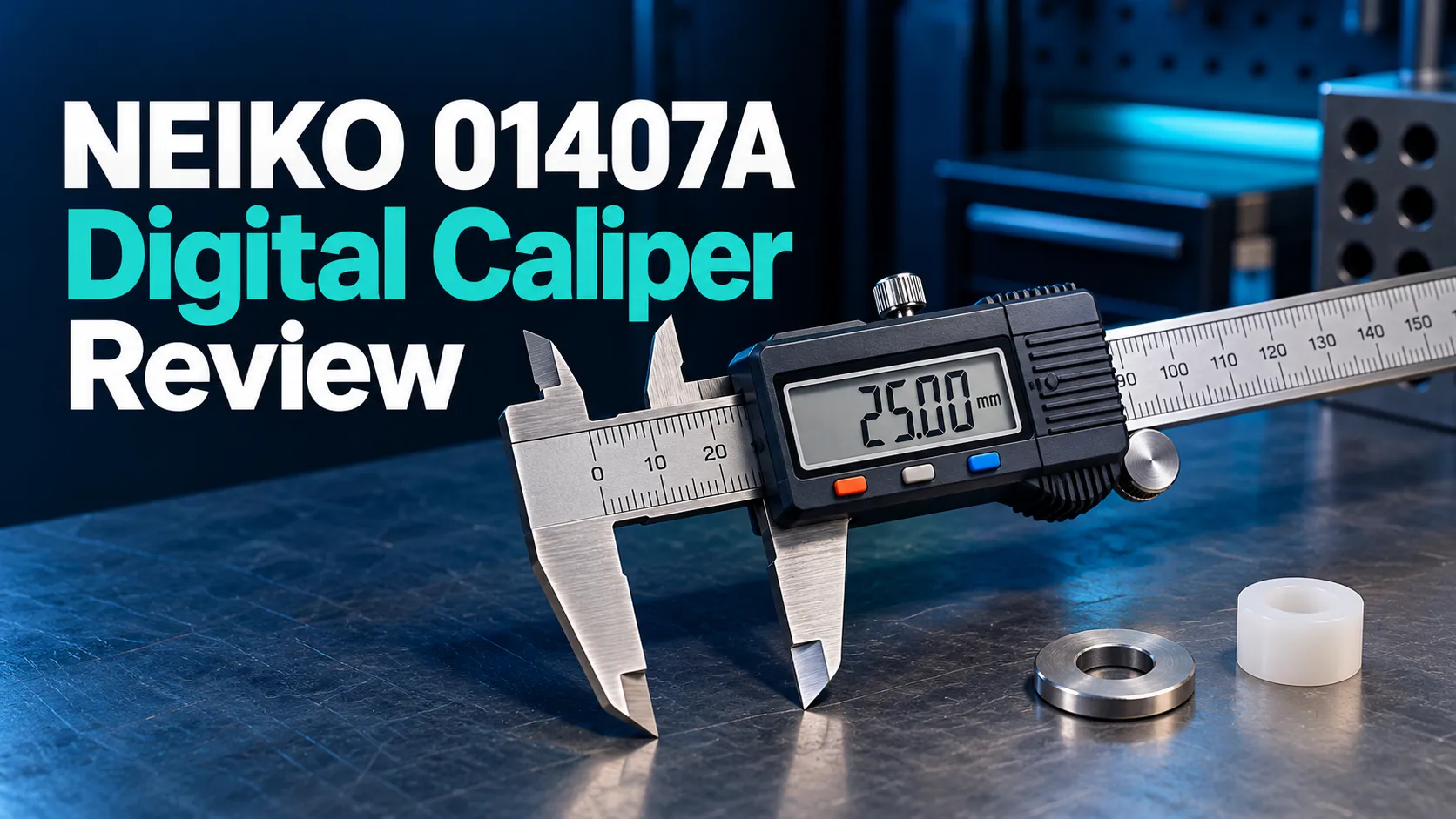
A closer look at a compact measuring tool
Is the NEIKO 01407A right for your workbench?
A digital caliper helps with small parts that are awkward to measure with a ruler. This guide explains where the NEIKO 01407A fits, what to check before ordering, and how to compare its Amazon and Walmart offers fairly.
Affiliate disclosure: As an Amazon Associate I earn from qualifying purchases. We may also earn a commission from qualifying Walmart purchases through our links, at no extra cost to you.
Quick answer
The NEIKO 01407A is a candidate for general hobby and home-workshop measurements when you want a metal caliper with a digital display. Buy only after checking the exact model, seller, return terms, and delivered price. This is a specification-based buying guide; we have not performed a hands-on accuracy or durability test.
Amazon or Walmart? We cannot name a verified price winner. The accessible Walmart page snapshot showed a price and shipping fee, while Amazon did not provide a dependable comparable offer. Use both buttons to check your current checkout totals.
Amazon vs Walmart: NEIKO 01407A price comparison
Comparison researched October 16, 2026. The information below comes from accessible retailer page snapshots, which may lag behind the live store. It is not a real-time quote, a guaranteed offer, or a promise of stock. Your delivery address, selected seller, and shipping option can change the amount you pay.
| Check | Amazon | Walmart |
|---|---|---|
| Exact product | NEIKO 01407A, ASIN B000GSLKIW | NEIKO 01407A, item 124951017 |
| Price evidence | No reliable comparable price available | Snapshot: $25.70 |
| Shipping evidence | Check the selected offer | Snapshot: $4.99 for the displayed location |
| Before-tax total | Not verified | $30.69 using snapshot amounts |
| Seller evidence | Confirm before ordering | Snapshot: Go Industrial Tools |
| Price winner | Undetermined: two comparable current totals are required | |
Do not treat the snapshot total as today’s checkout price. Open both listings, select the same new 6-inch 01407A model, and compare the final amount before placing an order. A store logo does not necessarily identify the marketplace seller.
Check Amazon PriceCheck Walmart Price
What the listed specifications tell you
The retailer descriptions identify a stainless-steel caliper covering 0–6 inches, or 0–150 mm. The display supports inches, millimeters, and fractions. Listed resolution is 0.0005 inch or 0.01 mm; listed accuracy is 0.001 inch or 0.02 mm. The tool has a thumb roller, locking screw, and jaws and probe for several measurement types. These are published specifications, not results independently verified by AccurateGoods.
Think about the parts you measure before focusing on extra digits. If your usual job is identifying a bolt, checking a plastic spacer, or measuring a small wooden component, convenience and repeatability may matter more than a long list of display modes. A tool can be easy to read and still require careful technique.
Who should consider this caliper?
Home DIY and replacement-part checks
A caliper can help you narrow down the diameter or thickness of a replacement component. Start with the old part, identify which surface actually matters, and write the measurement beside a photograph. This is more useful than a note that simply says “small bolt” or “thin washer.” Confirm the nominal part size with the supplier because a measured dimension does not always match the size printed on a package.
3D-printing and craft projects
For hobby projects, measuring an existing part is a sensible starting point for a model. Keep fit allowance separate from the measured size. A printed hole designed to exactly match a measured shaft may need adjustment for your material, printer, orientation, and intended fit. Print a small test piece before committing to a long job. A caliper helps collect dimensions; it does not remove the need to test the finished assembly.
Occasional workshop use
If you use a caliper a few times a month, easy storage and simple controls may be more valuable than features aimed at a production line. Keep the instrument in a clean case where it cannot be knocked onto the floor. Give it a quick inspection before each session. A low purchase price becomes poor value if the tool spends its life loose under heavier tools.
When you should choose a different measuring tool
A caliper is not the best answer for every dimension. A tape measure is more practical for a shelf, a door opening, or a long board. A laser distance measure suits many room-layout tasks. A measuring wheel is useful for longer routes where following the ground is appropriate. Match the measuring method to the scale and shape of the job before comparing brands.
For a tight engineering tolerance, a general-purpose caliper may not be enough. Choose an instrument and verification process suitable for the tolerance you need. A micrometer, a dedicated gauge, or a calibrated inspection service may be appropriate. Do not assume a reading with two decimal places proves the part meets a demanding specification.
For larger jobs, see our laser distance measure vs tape measure guide and measuring wheel vs tape measure comparison.
Resolution, accuracy, and repeatability are different
Resolution is the smallest change shown on the display. It tells you how finely the screen divides a measurement. It does not tell you how close that number is to the true size. More digits can make a display look impressive without improving the quality of a measurement.
Accuracy concerns closeness to the actual dimension under stated conditions. Published figures need context: the condition of the tool, the part, the contact surfaces, and the method all affect the result. The specification is a reason to investigate a tool, not a substitute for checking that the instrument you receive works properly.
Repeatability asks whether you obtain similar readings when you measure the same part again. Take the tool off the part between attempts. If the numbers vary, check your grip, alignment, jaw cleanliness, and contact force before blaming the electronics. A consistent method helps you spot whether the problem follows the user, the part, or the tool.
Four measurements you can make with a caliper
Outside dimensions
Use the larger jaws for the outside of a part. Bring them into light contact rather than squeezing. On a round object, keep the jaws square and check more than one position if roundness matters. Soft plastic, foam, and thin tubing can deform under pressure, producing a number that reflects your grip as much as the original shape.
Inside dimensions
The smaller jaws reach into openings. Place them carefully and avoid reading across a diagonal. A hole with a chamfer, burr, or uneven edge can mislead you if the contact points sit on the wrong surface. Repeat the check at a useful depth and in another orientation when the shape allows it.
Depth
The depth probe can reach into a recess while the end of the caliper rests on the reference surface. Keep that reference flat and stable. Debris at the bottom of a hole changes the result. Do not push the probe into a space you cannot safely access or use it as a lever to move an obstruction.
Step measurements
A step check compares two levels using the appropriate rear contact surfaces. This can be easier than trying to estimate a shallow shoulder with the outside jaws. Make sure the surfaces actually seat against the two levels. Rocking the tool or resting it on an edge gives you a poor reference.
How to compare the retailer offers fairly
- Match the model. Check 01407A on the selected listing rather than relying on the search-result title.
- Match the condition. Compare new with new; an open-box offer needs separate judgment.
- Check the seller. Read the seller name on the offer you are actually buying.
- Include shipping. A lower item price can produce a higher delivered total.
- Check returns. Read the terms attached to that offer, including who handles a problem.
- Compare arrival dates. A small saving may not help when you need the tool for a scheduled project.
Use a simple note with four entries: item price, shipping, tax, and total. Do this for each store at roughly the same time. Treat a coupon as a saving only if you qualify and it appears in your total. Do not add unrelated items just to reach a shipping threshold unless you already intended to buy them.
Also check what comes in the package. A case, spare battery, or accessory can change the value, but only if it is included in the exact offer. Photographs sometimes show several arrangements or related models. The selected variant and written package description should agree before you buy.
Checks to make when the tool arrives
Keep the packaging until you finish an initial inspection. Look for damaged contact edges, loose components, a difficult slider, or display problems. Wipe the measuring surfaces gently and close the jaws without force. Follow the supplied instructions for setting the reference. Open and close the tool several times to see whether it returns consistently.
If you have an appropriate known reference, use it to check the tool at more than one point in its range. An ordinary household object is useful for a repeatability exercise but should not be mistaken for a certified standard. A single zero check does not establish accuracy across the whole measuring range.
If the results look wrong, repeat your method before adjusting anything. Check the battery and the supplied troubleshooting instructions. Contact the seller within the applicable return period if the instrument is defective. Avoid modifying the tool while you are still deciding whether to return it.
Habits that improve everyday results
Clean contact surfaces before measuring. Dust, dried finish, or a metal chip can change a small dimension enough to matter. Keep fingers away from the contact points when that helps the part seat correctly. Let a hot or cold component settle when temperature differences could affect the job. Measure a stable part on a stable surface.
Use light, consistent pressure. Do not twist the tool until the display shows the number you expected. Record the units with every result, especially when switching between inch and metric work. Keep the original measurement in your notes and label any rounded value separately. This prevents a rounded sketch dimension from being mistaken for the raw reading.
Store the caliper dry, protect its jaws, and follow the manufacturer’s battery and care instructions. It is a measuring instrument, so use a separate tool for scraping, marking hard material, prying, or tightening a part. Treating it carefully is usually easier than trying to diagnose damage later.
Pros and limitations to weigh
Reasons to consider it
- A readable digital format can simplify small-part checks.
- Several measurement methods reduce the need to improvise with a ruler.
- Unit switching can help when a project mixes measurement systems.
- The model is listed at both retailers, allowing an offer-by-offer comparison.
Reasons to look more closely
- We have not independently tested the delivered unit.
- Careful alignment and pressure still matter.
- Current retailer totals could not both be verified.
- Demanding tolerances may require a different instrument or calibration process.
Frequently asked questions
Is Walmart cheaper than Amazon for the NEIKO 01407A?
We cannot confirm that. The accessible Walmart snapshot supplied an amount, but a matching dependable Amazon price was unavailable. Compare both current checkout totals for the same model, condition, and delivery destination.
Can I use this for precision machining?
That depends on the tolerance and the quality-control requirements of the job. Choose a suitable instrument and verify its performance. A general shopping guide cannot certify that a particular unit will meet your inspection needs.
Does zeroing the display calibrate the tool?
No. Setting zero establishes a reference at that position. Calibration checks performance against appropriate standards under a defined process. Returning to zero alone does not verify the entire range.
Should I choose a caliper or a tape measure?
Choose a caliper for accessible small dimensions and a tape for larger lengths. Our Amazon vs Walmart measuring-tool buying guide explains additional checks when comparing retailer offers.
Check the right model before you buy
Choose the NEIKO 01407A if its measurement range and controls suit your everyday projects. Compare seller, condition, shipping, and return terms alongside price. We have not identified a verified price winner between these two stores.
Sources and editorial method
This guide uses the Amazon product listing and Walmart product listing for model identification and published specifications. Price evidence is identified as a retailer-page snapshot above. The advice on selecting and using a measuring method is editorial guidance, and no hands-on testing or calibration certification is claimed.
