
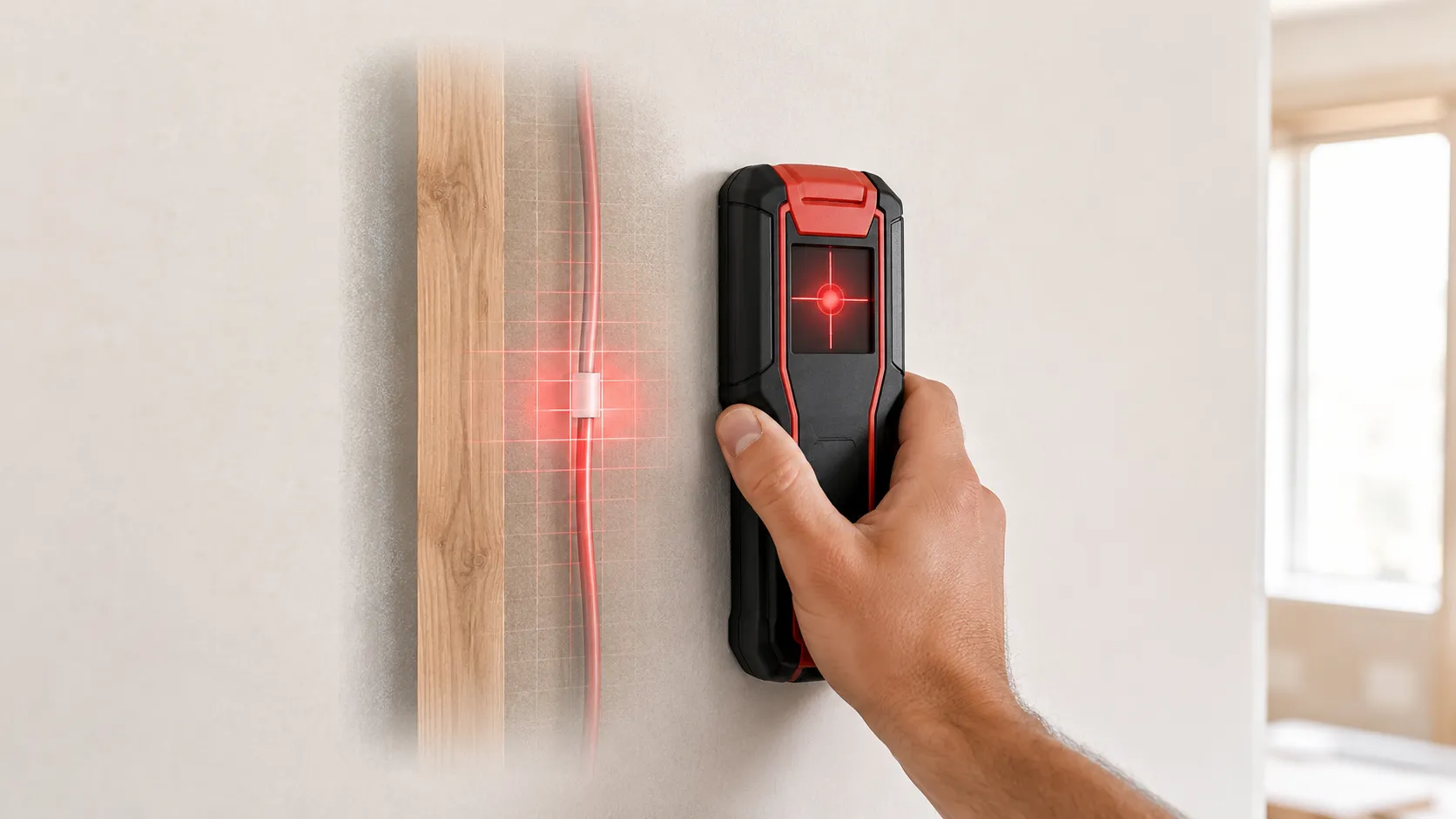
Yes, some Stud Finders For Plaster Walls”>stud finders can detect wires, but only if they are designed for live AC voltage detection and the circuit is powered on. A basic stud finder usually finds wood or metal, not wiring itself. For the safest result, treat a stud finder as a helpful warning tool, not proof that a wall is wire-free.
If you’re planning to drill into a wall, it makes sense to ask whether your stud finder can spot hidden wires first. The short answer is that results depend on the type of stud finder, the wall material, and whether the wiring is live. I’ll walk through what these tools can really do and how to use them more safely.
At AccurateGoods, we like practical answers that help you avoid damage and guesswork. So let’s break down what stud finders detect, where they fall short, and how to reduce the risk of hitting a cable behind drywall or plaster.
Can a Stud Finder Detect Wires? What It Can and Can’t Detect
How stud finders detect wood, metal, and live AC voltage
Most stud finders work by sensing changes in density, capacitance, or magnetism behind the wall. Basic models are made to find the edges of wood studs. Others can detect metal fasteners, pipes, or metal studs. Some advanced models also sense live AC voltage from electrical wiring.
That last part matters. A stud finder that claims wire detection is usually detecting the electrical field around an energized cable, not the wire jacket itself. If the circuit is off, the tool may not notice the wire at all.
Why some models can sense wires while others can’t
Not all stud finders are built the same. Simple edge-finding models are meant for locating framing members, so they often ignore live voltage. Multi-sensor models may include a dedicated live-wire mode, while magnetic models only detect metal screws or nails in studs.
So if someone says, “my stud finder detects wires,” that may be true for one specific model, but not for every stud finder on the shelf. Always check the product features before assuming it can warn you about electrical cables.
The difference between “detecting a wire” and “detecting a live wire”
This is the key distinction. A tool that detects a wire may be sensing metal, but a tool that detects a live wire is sensing voltage or the electromagnetic field created by current flow. Those are not the same thing.
A cable hidden in the wall is not always “visible” to a stud finder. If the wire is dead, damaged, shielded, or too deep, the tool may not alert you at all.
Which Type of Stud Finder Is Best for Detecting Wires?
| Type | What it detects | Wire detection ability | Best for |
|---|---|---|---|
| Edge stud finder | Stud edges, sometimes metal | Usually none | Finding framing for shelves or mounts |
| Center-find stud finder | Stud center, often with deeper scanning | Sometimes, if it includes live-wire mode | Accurate stud placement and general wall scanning |
| Multi-sensor stud finder | Studs, metal, live voltage, sometimes pipe alerts | Best option among stud finders | Safer drilling near outlets and fixtures |
| Magnetic stud finder | Screws, nails, metal fasteners | No | Simple, battery-free stud locating |
Edge stud finders vs. center-find stud finders
Edge finders help you locate one side of a stud, then you move the tool to find the other side. Center-find models aim to show the middle of the stud more directly. Neither type automatically detects wires unless the product specifically includes that feature.
Multi-sensor stud finders with live wire detection
These are the most useful stud finders if your goal is safety around wiring. They usually include a live-wire warning mode and may be more sensitive to changes behind the wall. Even so, they are not perfect. They can miss dead wires or give false alerts near metal.
For a good example of how manufacturers describe these features, it helps to read the product details from brands like Bosch Tools, which often explains sensing modes and limitations clearly.
Magnetic stud finders and why they do not detect wires
Magnetic stud finders work by finding metal fasteners holding drywall to studs. They do not sense electricity, so they cannot detect wires. They can still be useful for finding framing, but they should never be treated as a wire-safety tool.
Best use cases for each type
If you only need to hang a lightweight frame, an edge finder or magnetic finder may be enough. If you are drilling near outlets, light switches, or ceiling fixtures, a multi-sensor model with live-wire detection is the better choice. If safety is the main concern, pair the stud finder with a voltage tester.
How Stud Finders Detect Electrical Wires Behind Walls
Capacitive sensing and live AC voltage detection
Many wire-detecting stud finders use capacitive sensing. In simple terms, the tool reads changes in the electrical field around the wall. When it gets close to a live AC cable, the field changes enough to trigger a warning.
That warning is based on electricity being present, not on the cable’s physical shape. This is why a stud finder may beep near a wire, but it may also beep near other conductive objects or noisy electrical sources.
Depth limits and wall-material limitations
Detection depth matters. A wire buried deep inside thick plaster, masonry, or multiple drywall layers may be outside the tool’s sensing range. Wall texture, moisture, foil-backed insulation, and even paint can affect the reading.
Drywall is usually the easiest surface for these tools. Plaster and lath can be much less predictable. Masonry walls are a different challenge altogether, and many handheld stud finders are not reliable there.
Why wire detection depends on the circuit being energized
Most live-wire detection only works when current is flowing or the circuit is powered. If the breaker is off, the tool may not detect the cable. That means a dead wire can still be dangerous in some situations, but the stud finder may not warn you.
Some electrical safety guidance recommends shutting off power before drilling near known electrical routes. The U.S. Consumer Product Safety Commission offers practical home safety advice on hidden hazards and electrical risks at cpsc.gov.
Common false positives from metal pipes, screws, and foil insulation
False positives are common. Metal corner beads, pipework, drywall screws, wire mesh, and foil-faced insulation can all confuse a scanner. Even a nearby appliance or power cable can create noisy readings in some models.
Do not assume a single beep means “wire found.” A second pass and a second tool are the safest way to confirm what is actually behind the wall.
How to Use a Stud Finder to Check for Wires Safely
If your stud finder uses live-wire detection, the circuit usually needs to be energized for the feature to work. If you can safely leave the circuit on during scanning, do that first.
Place the tool flat against a clear section of wall and follow the manufacturer’s reset or calibration process. A poor calibration can throw off the reading from the start.
Move at a steady pace. Fast movement can make the sensor miss a wire or stud. Slow scanning gives the tool time to respond.
Scan horizontally and vertically if the model allows it. Different angles can help you separate a wire warning from a stud edge or metal object.
Use painter’s tape or a pencil to mark areas where you got alerts. Also mark areas that seemed clear, so you can compare them during the second pass.
Use a non-contact voltage tester or circuit tracer if the area is important or the risk is high. For extra peace of mind, consider a tool from a recognized electrical brand such as Fluke electrical testers.
Signs a Stud Finder Is Detecting Wires vs. Studs or Other Objects
Signal patterns that suggest live wire detection
Wire detection often shows up as a sudden alert, flashing icon, or repeated beep in a narrow area. The signal may appear in a small band rather than the wider shape you’d expect from a stud. Some tools also show a different symbol for live voltage than for wood or metal.
How stud edges can be mistaken for wire locations
Studs can confuse the reading because they often contain nails or screws. If the tool is sensitive, it may react to the fasteners instead of the wire. That is why a narrow alert near a stud is not enough to prove there is a cable there.
When multiple beeps or flashing lights mean interference
Multiple beeps can mean the tool is seeing more than one object, or it may be struggling with interference. Nearby metal, deep wiring, or uneven wall surfaces can all cause erratic behavior. If the pattern changes every time you scan, be cautious.
How drywall thickness affects the reading
Thicker drywall, double layers, or added wallboard can weaken the signal. In those cases, the tool may detect the stud but miss the wire, or it may only alert when it is very close. That is one reason no handheld scanner should be treated as perfect protection.
- Consistent alert in the same spot from multiple passes
- Different warning symbol for live voltage
- Clear separation between stud edge and wire alert
- Random beeps that move around
- Alerts near every screw or metal trim
- One quick scan used as final proof
Pros and Cons of Relying on a Stud Finder for Wire Detection
Advantages of using a stud finder with wire detection
A good multi-sensor stud finder can make wall work safer and less stressful. It can help you avoid obvious danger zones, locate framing, and give you a warning before you drill. For many DIY projects, that extra layer of awareness is useful.
Limitations and risks of false confidence
The biggest risk is trusting the tool too much. A stud finder may miss dead wires, deep wires, shielded cables, or wires hidden in unusual wall assemblies. It can also mistake metal for wiring. That means a “clear” result is helpful, but not absolute proof.
When a stud finder is good enough
For simple wall mounting in low-risk spots, a decent stud finder plus careful scanning may be enough. If you are well away from outlets, switches, and fixtures, and you are only making a shallow hole, the risk is lower.
When you should not rely on it alone
If you are drilling near electrical boxes, running new fixtures, working on older homes, or dealing with unknown wall construction, do not rely on a stud finder by itself. Use a voltage tester, shut off the breaker when possible, and verify the area before you drill.
- Use a stud finder with live-wire detection if safety matters
- Scan the wall more than once
- Confirm alerts with a second tool
- Assume every stud finder can detect wires
- Drill based on one quick scan
- Ignore alerts near outlets or switches
Best Practices to Avoid Hitting Wires When Drilling into Walls
Turn off the breaker before drilling whenever possible
If the job allows it, shut off power to the area before you drill. That reduces the chance of shock if you do hit a cable. It also makes the work area safer while you test and inspect.
Avoid drilling above switches, outlets, and fixtures
Electrical cables often run vertically from outlets and switches, then horizontally across walls and ceilings. That means the space directly above or below these boxes can be a higher-risk area than a random blank section of wall.
Check for horizontal wire runs and cable paths
Many homes have predictable cable routes, but not all of them are obvious. Cables may run horizontally at a consistent height, especially near rows of outlets or lights. Use caution when drilling in those zones.
Use a voltage tester or circuit tracer for added confirmation
A non-contact voltage tester can help confirm whether a wall area is energized. A circuit tracer may help you follow a specific circuit path. These tools do not replace good judgment, but they can improve confidence before you drill.
Drill shallowly and inspect the hole as you go
Start with a shallow pilot hole and stop often. If you hit resistance, stop immediately and investigate. A careful, shallow approach gives you time to react before you reach something hidden.
- Use fresh batteries in the stud finder so the sensor stays stable.
- Mark the wall with painter’s tape instead of writing directly on painted surfaces.
- Scan from both sides of the target area if you can access the opposite wall.
- If the wall has foil insulation or metal mesh, assume readings may be less reliable.
You are unsure about the wall layout, the home is older, or the area is near a main electrical route. In those cases, it is smart to get a qualified electrician involved before drilling.
Can a Stud Finder Detect Wires in Different Wall Types?
| Wall type | Detection reliability | What to expect |
|---|---|---|
| Drywall walls | Best | Most stud finders work well here, and live-wire detection is more likely to be useful. |
| Plaster and lath walls | Mixed | Signals can be less predictable because of thickness, wood strips, and age-related variation. |
| Walls with foil insulation or metal mesh | Poor to mixed | False positives are common, and wire detection may be unreliable. |
Drywall walls
Drywall is the easiest wall type for most stud finders. If the model includes live-wire detection, this is where it is most likely to perform as expected. Even so, you should still verify the result before drilling.
Plaster and lath walls
Plaster and lath can be tricky. The wall surface may be uneven, thicker, or built with materials that confuse the sensor. A stud finder may still help, but its wire detection may be less dependable than on drywall.
Walls with special materials
Walls that include foil insulation, metal mesh, tile backer, or other dense layers can reduce accuracy. In these cases, a stud finder may detect something, but it may not be the thing you think it is. Extra verification is important.
A stud finder can detect wires only if it has live-wire sensing and the conditions are right. It is a useful warning tool, but it should never be your only protection before drilling into a wall.
Common Questions About Stud Finders and Wires
No. Only some stud finders have live-wire detection. Basic stud finders usually locate studs or metal fasteners, not electrical wires.
Usually not. Live-wire detection depends on the circuit being energized, so a powered-off wire may not trigger the sensor.
Sometimes, but not always. Some models use different alerts for wood, metal, and live voltage, yet false positives can still happen.
A non-contact voltage tester or circuit tracer is usually better for checking electrical risk. A stud finder can help, but it should be used alongside other checks.
It may be finding a stud edge, a screw, a pipe, or a live wire. Re-scan from different directions and compare the pattern before deciding what it is.
If possible, yes. Turning off the breaker is a smart safety step when you are drilling near known or possible electrical routes.
- Some stud finders can detect live wires, but many cannot.
- Wire detection usually works only when the circuit is powered.
- False positives can come from metal pipes, screws, and foil insulation.
- A stud finder is helpful, but it should not be your only safety check.
- Use a voltage tester, confirm the area, and drill carefully.