
Affiliate disclosure: Accurate Goods may earn a commission from qualifying Amazon purchases made through links on this page, at no extra cost to you. Our recommendations focus on inspection usefulness, access, image clarity, and buyer fit.
See behind walls, under cabinets, and inside tight cavities without unnecessary demolition
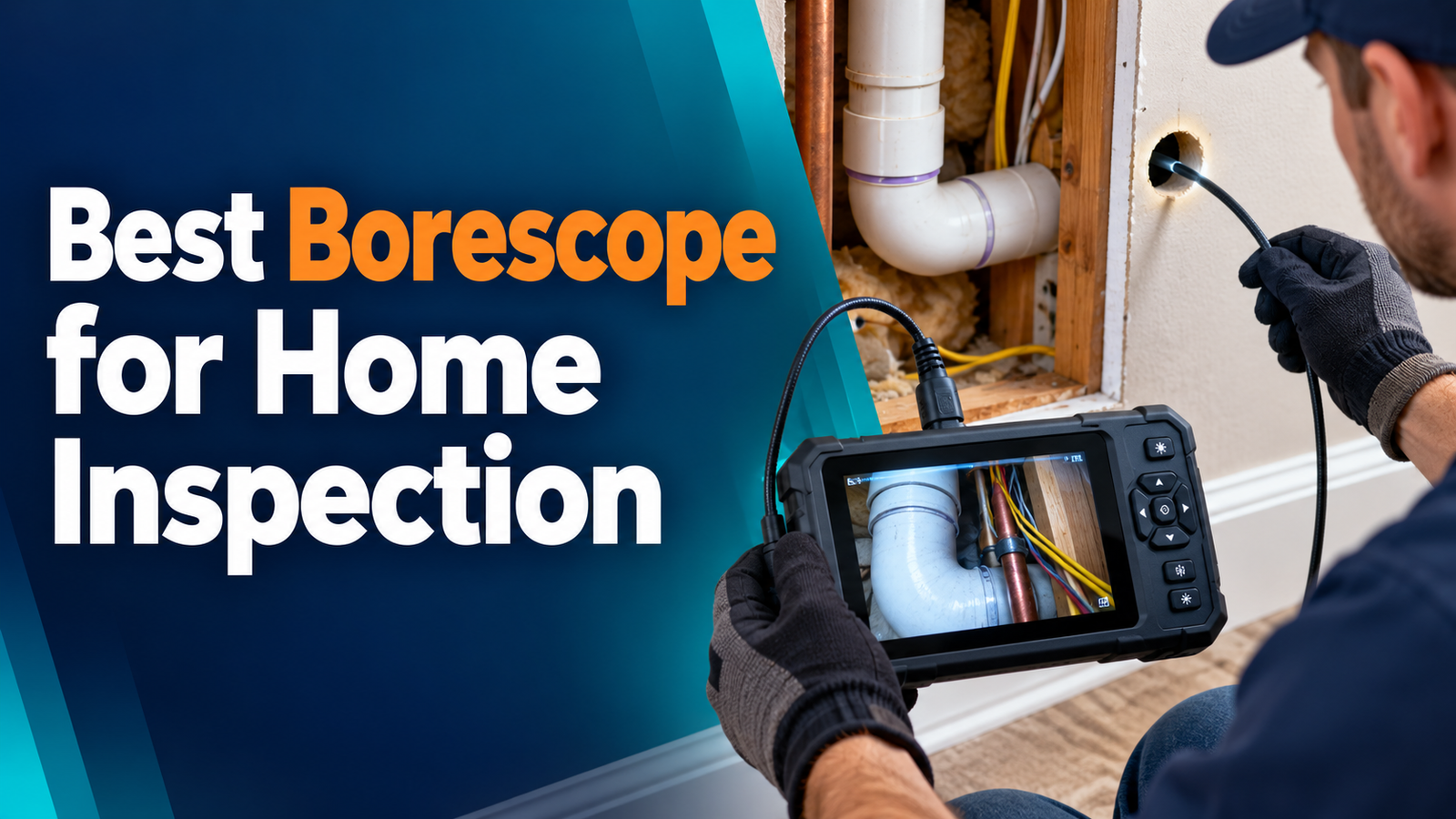
A good borescope helps a homeowner or inspector investigate hidden plumbing, framing, insulation, HVAC components, drains, and mechanical spaces through a small access point. The right model depends on camera-head diameter, cable behavior, display type, image capture, and how often you expect to use it.
Check the current probe size, cable length, included display, and seller package before ordering.
See Borescopes on Amazon →✓ Amazon checkout • Price and availability shown on Amazon
A borescope, inspection camera, or endoscope is not a substitute for professional judgment. It is a visual access tool. It can reveal a stain, disconnected duct, damaged insulation, pest evidence, pipe condition, or misplaced cable, but it cannot prove that a wall is structurally safe or that wiring is de-energized. If the inspection involves suspected gas, live electrical equipment, asbestos, mold, structural movement, or a confined space, stop and use the appropriate qualified professional.
For ordinary homeowner work, the most useful camera is rarely the one with the largest advertised resolution. A clear image depends on working distance, lens cleanliness, LED reflection, camera stability, screen quality, and whether the cable can actually point at the area you need to see. A smaller camera head can enter tighter holes, while a stiffer semi-rigid cable is often easier to steer horizontally through a wall cavity.
Best Borescopes for Home Inspection at a Glance
| Model | Viewing method | Best for | Main trade-off |
|---|---|---|---|
| Milwaukee M12 M-Spector 360 4 ft | Dedicated 4.3-inch display | Frequent professional inspections and documentation | Higher cost and a 10 mm head |
| Milwaukee M-Spector 4 ft | Dedicated 4.3-inch display | Simple standalone wall and drain checks | No video recording on the basic model |
| Klein Tools ET20 | Smartphone display | Compact occasional inspection | Your phone is part of the workflow |
| Teslong NTS300 platform | Dedicated monitor with compatible probes | Users who need probe choices | Exact kit contents vary |
| DEPSTECH DS500 family | Dedicated display | Budget-conscious general inspection | Model and bundle details require careful checking |
1. Milwaukee M12 M-Spector 360 4 ft
The Milwaukee 2323-21 is the strongest choice here for a contractor, serious DIYer, maintenance technician, or home inspector who expects to document repeated inspections. Milwaukee specifies a 4.3-inch LCD, a 720p camera, a 10 mm camera head, a four-foot cable, image and video sharing through an included SD card, three zoom levels, five brightness modes, and 360-degree image rotation.
The rotation system matters more than it may sound. When a probe turns inside a wall cavity, the image can appear sideways or upside down. Being able to correct the view without twisting your wrist repeatedly makes it easier to understand framing, follow a pipe, and show the finding to a client. The four-foot version is practical for most nearby wall, cabinet, appliance, and automotive access points. Milwaukee also offers a longer version for deeper runs, but added length can be harder to control in a compact cavity.
- Dedicated display avoids phone pairing and notification interruptions.
- Photo and video capture support inspection records.
- Image rotation, zoom, and adjustable LEDs improve usability in awkward positions.
- M12 battery compatibility can benefit users already invested in that platform.
- A 10 mm camera head may not fit every tiny access hole.
- It is more tool than an occasional homeowner may need.
- Never push the probe into an energized panel or unknown hazardous space.
Confirm model 2323-21 and the included battery, charger, SD card, and probe length on the listing.
Check Milwaukee M12 M-Spector 360 →✓ Amazon checkout • Verify current package contents
2. Milwaukee M-Spector 4 ft 2319-20
The AA-powered 2319-20 keeps the most useful parts of a dedicated inspection camera while simplifying the package. Milwaukee lists a 4.3-inch LCD, 720p camera, 10 mm head, four-foot cable, three zoom levels, five brightness settings, and digital 180-degree image rotation. It runs on four AA batteries and includes a mirror and plumbing-ball attachment.
This model fits a homeowner who wants a screen that is ready when the tool comes out of the case. There is no app account, Wi-Fi handshake, or concern about exposing a phone to a dusty crawlspace. The balanced cable is intended for both drain-line and behind-wall inspection, making it a practical tool for checking a vanity cavity, looking beside an appliance, or examining a short accessible section of duct.
- Large dedicated screen with no smartphone required.
- Common AA batteries simplify occasional ownership.
- Brightness and image rotation help when the probe changes direction.
- Good match for short wall and plumbing investigations.
- The basic model is not designed around video recording or SD-card documentation.
- The four-foot cable is not intended for a long sewer run.
- Standing water and drain use require careful attention to the manufacturer’s probe rating.
Check that the listing identifies model 2319-20 and not an older discontinued M-Spector.
View Milwaukee 2319-20 Options →✓ Amazon checkout • Listing details may change
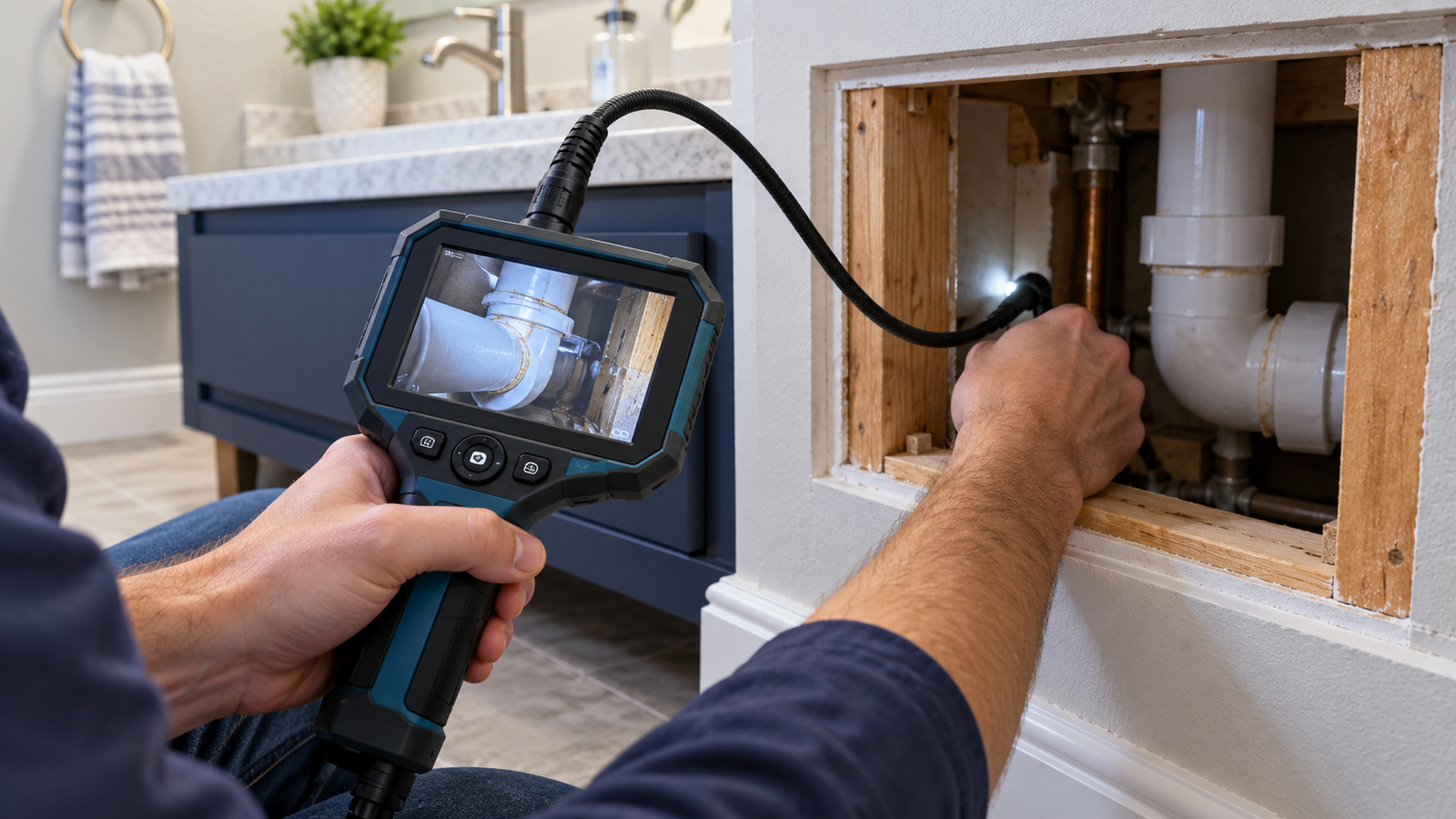
A controllable cable and correctly adjusted LED brightness usually matter more than extreme advertised resolution.
3. Klein Tools ET20 Wi-Fi Borescope
The Klein Tools ET20 is a compact option for users comfortable viewing the image on a compatible phone. Its approximately 9 mm camera head is slimmer than the 10 mm heads on the Milwaukee models above, and the flexible gooseneck-style cable is useful for short access routes. Adjustable LEDs around the camera help illuminate a cavity, while the phone provides a larger familiar screen and an easy way to retain or share images.
A phone-based camera reduces the hardware in the kit, but it introduces workflow trade-offs. You need a charged compatible device, the required connection method, and a protected place to hold the phone. For quick checks behind an appliance, inside a wall, or under a cabinet, that may be completely reasonable. For dirty drain work or daily jobsite documentation, a dedicated display can feel more dependable.
- Relatively compact camera head for tighter openings.
- Lightweight tool body and familiar smartphone display.
- Useful for occasional homeowners who do not need another dedicated screen.
- Klein is a familiar electrical and trade-tool brand.
- Compatibility and app requirements should be confirmed before purchase.
- A phone is exposed to the work area and may occupy one hand.
- Wi-Fi connection does not mean the tool needs internet access, but setup still adds a step.
Confirm ET20 device compatibility, current app support, cable length, and included accessories.
Check Klein Tools ET20 →✓ Amazon checkout • Verify phone compatibility first
4. Teslong NTS300 Platform
Teslong’s NTS300 family is worth considering when the probe matters as much as the monitor. Teslong lists compatible probe options including slim single-lens designs and triple-lens probes. A narrow head can reach through a smaller opening, while a side-view or multi-lens design can reduce the frustration of trying to bend a standard forward-facing camera toward the side of a pipe or cavity.
This flexibility also means buyers must read the exact listing carefully. “NTS300” can describe a monitor platform paired with different probe diameters, directions, and lengths. A kit designed for an engine cylinder is not automatically the best kit for a wall cavity, and a very soft long cable can be difficult to push horizontally. Choose the probe for the path you actually expect to inspect.
- Multiple compatible probe styles support specialized work.
- Slim options can reduce the access-hole size.
- Side-view or multi-lens probes can improve orientation around fittings.
- Dedicated monitor keeps the phone out of the work zone.
- Package names and included probes vary across listings.
- More lens choices do not guarantee better results without good lighting and focus distance.
- Verify whether the specific probe—not merely the monitor—is rated for moisture exposure.
Match the exact camera diameter, lens direction, cable stiffness, and length to your planned inspection.
Compare Teslong NTS300 Kits →✓ Amazon checkout • Confirm the included probe
5. DEPSTECH DS500 Family
DEPSTECH’s DS500-branded inspection cameras appear in several packages and are commonly considered by buyers who want a dedicated screen without moving to a professional tool-system price tier. Depending on the current version, listings may emphasize dual-view capability, a semi-rigid cable, adjustable lights, and a rechargeable display. These are useful features for household inspection, especially when a side view can help examine a joint or the edge of a framing member.
The important caution is model consistency. Marketplace titles, probe lengths, and included accessories can change. Treat “DS500” as a family name and verify the model photo, head diameter, focal range, waterproof rating, memory support, and warranty shown by the current seller. A lower-cost borescope can be an excellent occasional tool when its physical dimensions match the job.
- Dedicated display at a more accessible price position.
- Dual-view variants can reduce probe repositioning.
- Semi-rigid cables are useful for common wall and appliance checks.
- Exact versions and specifications differ by listing.
- Do not select by advertised megapixels alone.
- Support and accessory availability may not match established trade-tool systems.
How to Choose a Borescope for Home Inspection
Start With Camera-Head Diameter
The camera must physically fit through the route. A 10 mm head needs an opening slightly larger than 10 mm once the protective rim and cable are considered. A 5.5 mm or 3.9 mm probe can enter a smaller hole, but a smaller lens may collect less light and can cost more. Measure the planned access point instead of assuming that “small camera” means the same thing across brands.
Choose Cable Length and Stiffness Together
A long cable is not automatically more useful. A four-foot semi-rigid cable is often easier to steer through a nearby stud bay than a very long soft cable. Long drain cameras use push rods and guides designed for that task. For ordinary wall inspection, choose enough length to reach the target plus a comfortable working margin. Too much loose cable can make orientation difficult.
Dedicated Screen or Smartphone?
A dedicated display creates a repeatable grab-and-go tool. It is easier to use with gloves and keeps a personal phone away from dirt and moisture. A phone-based camera can be lighter and less expensive while making photos simple to share. Decide whether convenience means fewer components or fewer connection steps.
Focus Distance Beats Marketing Resolution
Every fixed-focus camera has a range where the image is sharp. If the lens is pressed against a pipe, even a high-resolution sensor will produce a blur. Check the specified focal range, keep the lens clean, and withdraw the probe slightly when the image loses detail. Adjustable lighting is equally important because shiny pipes can reflect the LEDs directly into the lens.
Water Resistance Has Limits
A waterproof camera head does not necessarily make the connector, cable control, or display waterproof. Read the manual for immersion depth and duration. Do not use a general-purpose borescope as a sewer camera unless it is designed for that environment. Never place the probe in a toilet trap, contaminated drain, fuel tank, or chemical area without an appropriate tool and cleaning procedure.
Home-Inspection Jobs a Borescope Can Handle
- Wall cavities: look for pipe routes, insulation gaps, staining, pests, or obstructions before making a larger opening.
- Under cabinets: examine the back of supply valves, drain fittings, and appliance connections.
- HVAC spaces: inspect a short accessible duct section or look around an air-handler cabinet without reaching into moving equipment.
- Appliances: check behind a washer, dishwasher, refrigerator, or dryer after disconnecting power and following manufacturer instructions.
- Attics and crawlspaces: view a narrow bay that cannot be safely reached by hand.
- Vehicle and workshop tasks: inspect engine spaces or machinery only with the equipment off, cool, and secured.
For a practical workflow, first map likely pipes and wires, choose the least destructive access point, verify power is off where appropriate, drill only when you understand the surface, and insert the camera slowly. Our guide on how to use an inspection camera inside walls covers the step-by-step process. If moisture is the concern, combine visual evidence with a moisture-meter check on drywall rather than relying on a picture alone.
A borescope also complements other inspection tools. A thermal camera may help locate a suspicious temperature pattern, while the borescope can visually inspect an accessible cavity near that pattern. For safety-specific monitoring, see our guides to home gas leak detectors and Home Assistant presence sensors. Each instrument answers a different question.
How to Get a Clearer Borescope Image
- Clean the camera lens with the method recommended by the manufacturer.
- Begin with medium LED brightness; maximum light can create glare on metal or white PVC.
- Keep the subject inside the specified focus range.
- Rotate the image or screen before deciding that the object itself is upside down.
- Advance in small increments and pause so the cable stops moving.
- Use a hook, magnet, or mirror only when the accessory is securely attached and appropriate for the cavity.
- Capture a wide contextual image before moving close to the suspected defect.
- Record the access location and direction so another person can interpret the photo later.
Frequently Asked Questions
What is the best borescope diameter for walls?
A camera around 8 to 10 mm works for many household access holes, while a 5.5 mm or slimmer probe helps when minimizing the hole is critical. The best size is the smallest head that still provides adequate light, image quality, and a controllable cable for your route.
Is a dual-lens borescope better?
A side-view or dual-lens model can be easier for examining a pipe wall, joint, or adjacent framing without sharply bending the cable. It is not automatically clearer. Lens quality, focus range, lighting, and screen processing still determine the useful image.
Can I use a borescope inside a drain?
Only when the specific probe and cable are rated for the exposure and the drain is suitable for the tool. A short household borescope is not a replacement for a professional sewer camera, and the handheld display or connector may not be waterproof.
Can a borescope find mold behind a wall?
It can show suspicious discoloration or growth, but a photo alone cannot identify the material or determine the full moisture source. Use moisture measurement and professional assessment when health, contamination, or hidden damage is a concern.
Can I inspect electrical wiring with a borescope?
You can visually inspect a de-energized and verified-safe cavity, but the camera does not detect voltage. Do not insert a conductive accessory near live parts. Use a properly rated electrical tester and a qualified electrician when the condition is uncertain.
Final Verdict
The Milwaukee M12 M-Spector 360 4 ft is the best overall professional option for buyers who value a dedicated display, saved documentation, image rotation, and a durable tool platform. The Milwaukee M-Spector 2319-20 is the simpler standalone value choice. Choose the Klein ET20 when a compact phone-based workflow fits your needs, or a Teslong NTS300-compatible system when probe diameter and viewing direction are the deciding factors. Whatever you buy, prioritize access, focus distance, lighting control, and cable behavior over an impressive resolution number.
Compare the exact head diameter, cable length, display type, and included accessories before checkout.
Compare Current Borescope Options →✓ Amazon checkout • No fixed price or rating claims
