
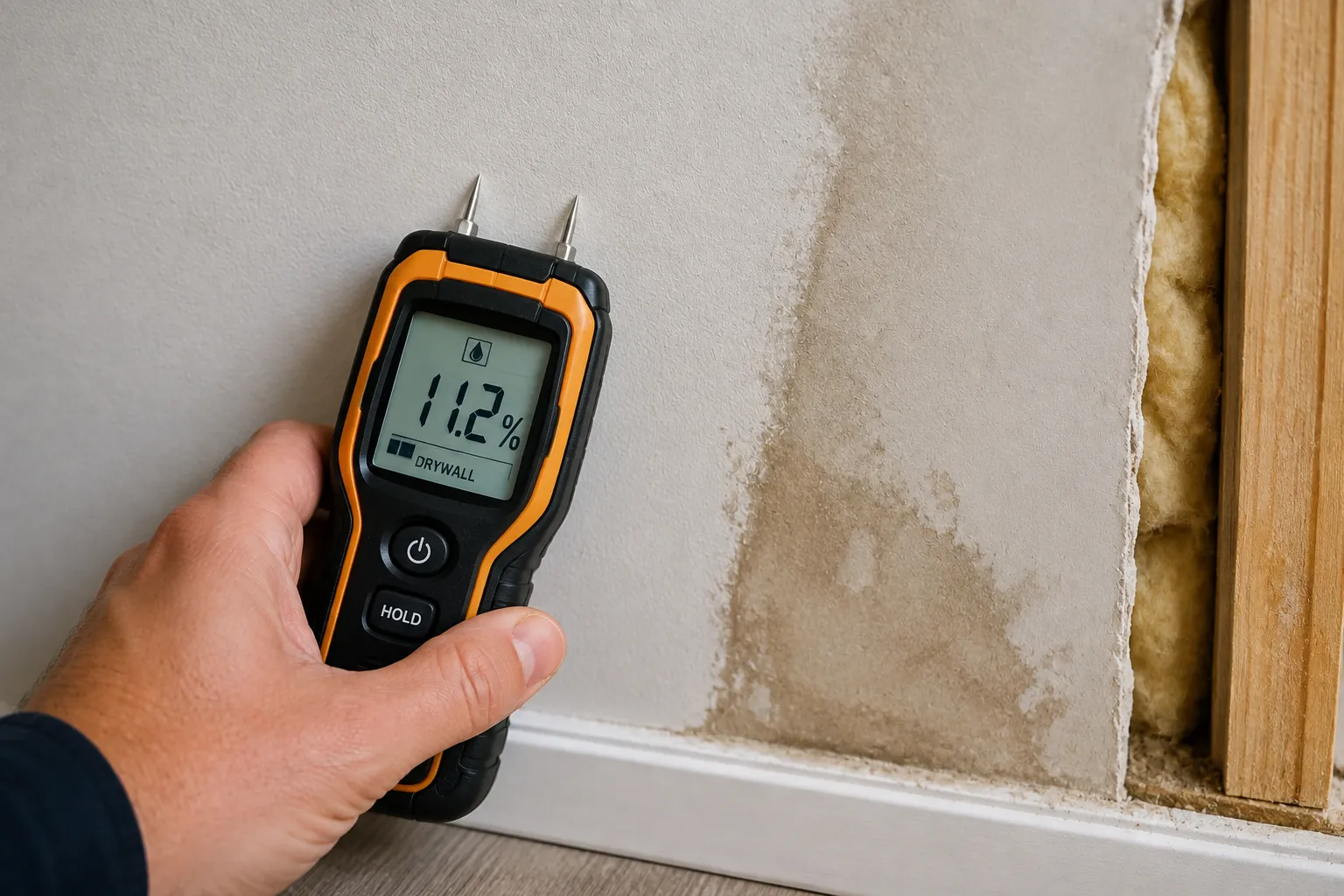
A moisture meter cannot detect mold itself. It only measures moisture in a material, which can help you find places where mold is likely to grow. If a meter shows repeated damp readings, that area deserves a closer look for leaks, hidden damage, or visible mold.
If you have ever wondered whether a moisture meter can detect mold, the short answer is no, not directly. What it can do is point you toward wet or damp materials that create the right conditions for mold. That makes it a useful first check for homeowners, renters, and DIYers.
In this article, we explain what a moisture meter really measures, how to use one to find mold risk areas, and where its limits are. We also cover the signs that suggest mold may be present, even when the meter reading has already dropped.
Can a Moisture Meter Detect Mold, or Only Moisture?
| What it measures | What it can tell you | What it cannot tell you |
|---|---|---|
| Moisture in materials | Whether drywall, wood, or another surface is damp | Whether mold is actually present |
| Relative wetness across areas | Which spots are more likely to have a leak or hidden water issue | Mold species, spores, or toxicity |
| Change over time | Whether a problem is getting better or worse | The exact cause without inspection |
What a moisture meter actually measures
A moisture meter measures the moisture content in a material or the relative moisture near a surface, depending on the type. Pin meters test resistance between two probes. Pinless meters scan a wider area without poking holes. Either way, the reading is about moisture, not mold.
That is why a meter is best seen as a clue finder. It helps you spot conditions that mold likes, such as a damp wall cavity, a wet subfloor, or a leaking window frame.
Mold needs moisture to grow, but moisture alone does not prove mold is there. A room can be damp because of a plumbing leak, a roof issue, condensation, or a recent spill. Mold may follow if the area stays wet long enough, but the meter will not tell you when that has happened.
For a reliable mold response, it helps to understand the moisture source first. The U.S. Environmental Protection Agency has clear guidance on mold and moisture control at EPA mold and moisture guidance.
The short answer homeowners need to know
So, can a moisture meter detect mold? No. Can it help you find the conditions where mold is likely to grow? Yes. That is why it is such a practical tool for early checks after leaks, water stains, or musty smells.
If you already see visible mold, you do not need a moisture meter to confirm that something is wrong. The meter is more useful for finding hidden dampness and checking whether the area is still wet.
How a Moisture Meter Can Help You Find Mold Risk Areas
When a meter shows higher moisture in drywall, wood, or trim, that area may be at risk. Mold often starts in places that stay damp after a leak or condensation issue.
Moisture meters can help you notice patterns that suggest water is trapped behind a surface. A wet reading near a bathroom wall, ceiling stain, or warped floor may point to a hidden leak.
One reading by itself is not always helpful. Comparing several spots in the same room, or across different rooms, makes it easier to see which area is abnormal.
Spotting damp materials where mold is likely to grow
Some materials hold water longer than others. Drywall, wood framing, carpet backing, and insulation can stay damp after a leak, which gives mold time to develop. A moisture meter helps you find those wet spots before the damage spreads.
Hidden leaks are one of the most common reasons people use moisture meters. You may not see water, but you might notice a soft wall, peeling paint, or a ceiling stain. A meter can confirm that the material is still damp and worth investigating.
Comparing readings across rooms to find problem zones
When you compare readings, you get context. A basement wall that reads much higher than the rest of the house may be affected by seepage or poor drainage. A bathroom wall that is consistently damp may point to a plumbing or ventilation issue.
Take readings in a dry room first so you have a comparison point. That makes it easier to spot a suspiciously high number in a different area.
Types of Moisture Meters and Which Ones Work Best for Mold Checks
| Type | Best for | Main advantage | Main limitation |
|---|---|---|---|
| Pin moisture meter | Drywall, wood, framing | More direct material reading | Leaves tiny holes |
| Pinless moisture meter | Quick scans of larger areas | Non-invasive | Less precise on some surfaces |
| Thermal camera | Finding temperature patterns linked to moisture | Useful for spotting suspicious zones | Does not measure moisture directly |
| Hygrometer | Room humidity checks | Shows indoor air conditions | Does not show moisture inside materials |
Pin moisture meters for drywall, wood, and framing
For a practical walkthrough, see how to use a moisture meter on drywall. Pin meters are common for checking building materials. They work well when you want a more direct reading in wood studs, baseboards, or drywall. Because they use probes, they can be a little more invasive, but they are often helpful when you want a closer look at a specific spot.
Pinless moisture meters for non-invasive scanning
Pinless meters are a good choice when you want to scan a wall or floor without making holes. They are handy for quick checks across larger areas. Just remember that they usually give relative readings, so they are best for comparisons rather than exact moisture content.
Thermal cameras vs. moisture meters for suspected mold
Thermal cameras can show cool areas that may suggest moisture, but they do not confirm water by themselves. A moisture meter helps verify whether the surface or material is actually damp. Used together, they can make inspection faster and more focused.
When a hygrometer is useful alongside a moisture meter
A hygrometer measures indoor humidity, which matters because high humidity can support mold growth even if a wall is not visibly wet. If a room feels damp, stuffy, or condensation-prone, a hygrometer can help you see whether the air itself is part of the problem.
Signs a Moisture Meter Reading May Point to Mold Growth
Mold can keep growing after a leak has been fixed if the material stayed wet long enough. A lower moisture reading does not always mean the area is safe.
Repeated high readings in the same area
If one spot keeps reading higher than nearby areas, that is a red flag. Repeated damp readings often mean there is a source of moisture that has not been solved yet.
Water stains, musty odors, and soft or warped materials
Meters are most useful when paired with your senses. A stain on the wall, a musty smell, soft drywall, or warped baseboards can all support what the meter is telling you. These signs together are more meaningful than any single reading.
Cool surfaces and condensation-prone spaces
Bathrooms, laundry rooms, basements, and exterior walls can stay cooler and collect condensation. Those areas often show moisture problems first, especially if ventilation is poor.
When visible mold is present but moisture is no longer high
Sometimes the leak has stopped, the surface has dried, and mold is still visible. That can happen because mold may remain after the moisture source is gone. In that case, the meter helps you confirm drying, but it does not erase the mold problem.
Do not assume a dry reading means the area is safe if you already see mold, smell mold, or know there was a major water event. Hidden mold can still be present in damaged materials.
How to Use a Moisture Meter to Check for Hidden Mold Conditions
Begin near sinks, tubs, toilets, windows, exterior walls, basements, and any place that has had a leak or spill. These are the most likely places to show moisture problems.
Do not test only one point. Check several nearby spots so you can see whether the moisture is isolated or spread out. A pattern is more useful than a single number.
These are common trouble spots. Water often shows up first at the bottom of walls, around window edges, or inside cabinets where leaks can stay hidden for a while.
Write down the date, room, spot, and reading. If moisture levels rise or stay high, that tells you the problem is ongoing and needs attention.
There is no single universal number for every meter and every material. In general, a reading that is much higher than nearby dry areas is the one to worry about. Always use the meter’s material settings and compare against a known dry spot.
For guidance on safe moisture control and drying after water damage, the Centers for Disease Control and Prevention offers practical advice at CDC mold cleanup and prevention guidance.
Moisture Meter Pros and Cons for Detecting Mold
- Fast way to check damp areas
- Useful for early leak detection
- Can help you compare rooms and materials
- Non-destructive options are available
- Helpful before mold damage gets worse
- Cannot confirm mold by itself
- Does not identify mold species
- Can be fooled by normal humidity or wet cleaning
- Can miss mold in dry materials
- Does not measure airborne spores
Pros: fast, affordable, non-destructive, useful for early detection
For many homeowners, the biggest advantage is speed. A moisture meter gives you a quick way to check problem spots without tearing anything apart. That makes it a smart first step when you suspect a leak or hidden dampness.
Cons: cannot identify mold species or confirm spores
A meter cannot tell you whether the moisture has led to mold growth. It also cannot tell you what kind of mold it is. If you need that level of detail, you need a visual inspection or professional testing.
Cons: false positives from normal humidity or wet cleaning
Fresh mopping, steam, shower use, or high indoor humidity can all raise readings. That does not always mean there is a hidden mold problem. It may simply mean the area is wet for a normal reason.
Cons: false negatives when mold is present but materials are dry
Dry material does not always mean no mold. If the leak happened in the past, the material may have dried while mold remained behind. That is why a meter is only one part of the picture.
- Use the same meter setting on similar materials so your comparisons stay consistent.
- Test a known dry area first, then compare suspicious spots against it.
- Check after a leak, after drying, and again a few days later to see if moisture returns.
- Pay extra attention to corners, seams, and edges where water can hide.
You have a large affected area, repeated water intrusion, health concerns, or visible mold that keeps returning. In those cases, a qualified mold inspector or remediation professional can help you assess the problem more fully.
What a Moisture Meter Cannot Tell You About Mold
Because the meter only measures moisture. Mold is a biological growth issue, not a moisture reading. You can have a wet area with no mold yet, or dry materials that still contain mold from an earlier leak.
A moisture meter does not sample air. It cannot count spores, and it cannot tell you whether mold is toxic. Those questions require other forms of inspection or testing.
If the damage is widespread, the source is unclear, or health symptoms are a concern, professional help may be worth it. A trained inspector can combine moisture findings with visual checks and other tools.
If you see a small, obvious patch of mold from a known minor leak, a visual inspection may be enough to decide your next step. If the problem is hidden, recurring, or spread through walls or flooring, a visual check alone is usually not enough.
What to Do If Your Moisture Meter Suggests Mold Risk
Repair the leak, improve ventilation, stop condensation, or address drainage problems. If the moisture source stays active, mold risk stays active too.
Use fans, dehumidifiers, and ventilation where appropriate. Check the meter again over the next few days to make sure the material is drying instead of staying damp.
For limited surface growth on hard materials, careful cleaning may be enough. Use proper protection and avoid spreading dust or spores to other areas of the home.
Call for help if the area is large, the mold keeps coming back, the source is hidden, or the damage involves HVAC, insulation, or inside wall cavities.
Porous materials can be hard to clean once they are heavily affected. If drywall, insulation, or carpet padding has been soaked or moldy for a while, replacement is often the safer choice.
A moisture meter does not detect mold directly, but it is one of the best tools for finding the wet conditions that let mold grow. Use it to spot problem areas early, then confirm the cause with a visual check and, when needed, professional help.
Frequently Asked Questions About Whether a Moisture Meter Can Detect Mold
No. It can detect moisture in the wall, which may suggest a leak or a mold-friendly environment, but it cannot confirm mold inside the wall.
There is no single reading that means mold is present. The important clue is a reading that is higher than nearby dry areas or stays high over time.
It can help you find hidden damp areas that may support mold growth, but it cannot find mold itself. It is best used as a screening tool.
If you want a simple way to check for damp spots after leaks or around problem areas, yes, it can be useful. Just remember it is a moisture tool, not a mold detector.
It can show whether the material is still wet, but not whether mold has been fully removed. Mold can remain even after the area dries.
Check areas after leaks, compare readings with dry parts of the home, and watch for changes over time. That helps you catch moisture problems before mold has a chance to spread.
- A moisture meter measures moisture, not mold.
- High readings can point to leak-prone or mold-prone areas.
- Pin and pinless meters both have useful roles for home checks.
- Mold can still be present even when the material has dried.
- Use meter readings with visual clues, smell, and professional help when needed.
