
The best torpedo levels for electricians are compact, magnetic, easy to read in dim spaces, and accurate enough for daily conduit, box, and panel work. In most cases, a good 9-inch magnetic torpedo level with bright vials and a rigid frame is the safest all-around choice.
Here are the main types I’d look at first:
- Magnetic aluminum torpedo level for everyday carry
- Compact level for panel and outlet box work
- Heavy-duty box-beam level for rough jobsites
- Vial-only level for simple, fast checks
- Digital torpedo level for angle-heavy layout work
- Budget level for apprentices and light use
When I look for the best torpedo levels for electricians, I focus on real jobsite use, not just the label on the package. The right level should fit in a tool pouch, stick to steel when I need both hands free, and stay readable in a dark panel or basement.
In this guide, I’ll break down what makes an electrician’s torpedo level different, which features matter most, and how to choose the right one for your kind of work.
What Makes the Best Torpedo Levels for Electricians Different from Standard Levels?
A torpedo level is usually shorter than a standard spirit level, which makes it easier to use in crowded electrical spaces like panelboards, boxes, and strut runs.
Compact size for panel work, conduit, and tight spaces
Electricians often work where a long level just gets in the way. A torpedo level is small enough to sit on top of an outlet box, rest on conduit, or slip into a pocket without feeling bulky.
That compact shape matters when you are working inside a closet panel, above a ceiling grid, or beside a crowded service area. You want a tool that helps, not one that blocks your view.
Strong magnetic edge for hands-free use on EMT and steel boxes
One of the biggest advantages for electricians is magnet strength. A good magnetic edge can hold onto EMT, steel boxes, strut, and panel surfaces while you adjust the run or line up a fitting.
This is one reason many electricians prefer a magnetic model over a standard non-magnetic level. It gives you a free hand when you need it most.
Vials and angle readings electricians actually rely on
Most electricians do not need a complicated layout tool for every task. They need clear 0°, 45°, and sometimes plumb readings that are easy to trust at a glance.
Some torpedo levels also include slope or angle markings. That can help when you are setting conduit, checking fixture pitch, or matching an existing run.
Durability for jobsite drops, dust, and daily belt carry
A torpedo level lives a hard life. It gets tossed in a pouch, dropped on concrete, and exposed to dust, grime, and metal shavings. The best models are built with a rigid frame, protected vials, and a finish that can handle daily use.
If you want to see how level design and accuracy are described by a major manufacturer, Stanley Tools is a useful place to compare product features and construction details.
Key Features to Compare in the Best Torpedo Levels for Electricians
| Feature | What to look for | Why it matters for electricians |
|---|---|---|
| Length and profile | Usually 6 to 10 inches, slim enough for a pouch | Fits tight spaces and stays easy to carry |
| Magnet placement | Strong edge magnets or rare-earth magnets | Helps on EMT, strut, and steel boxes |
| Vial visibility | Bright, high-contrast vials with clear markings | Easy to read in basements, attics, and panels |
| Accuracy | Tight tolerance and consistent readings | Better confidence when leveling boxes and runs |
| Frame material | Rigid aluminum or reinforced body | Helps the level stay true after bumps and drops |
| Conduit details | V-groove and ruler markings | Makes conduit alignment faster and cleaner |
Length, width, and pocket-friendly profile
For electricians, a torpedo level should be compact without feeling cramped. Most people are comfortable with something in the 6- to 10-inch range, depending on how much extra surface contact they want.
A slimmer profile is easier to carry all day. A wider body may feel steadier, but it can be harder to fit into a tool pouch or use in a crowded box area.
Magnetic strength and magnet placement
Magnet strength is not just about “strong” or “weak.” Placement matters too. A well-designed magnetic edge should hold securely without spinning or sliding on round EMT.
Some levels use one long magnetic strip. Others use multiple magnets. I like a design that grips steel well but still releases cleanly when I need to reposition it.
Vial visibility, brightness, and readability in dim areas
Electric work often happens in low light. That means the vial windows need to stand out fast. Bright, easy-to-read vials save time and reduce second-guessing.
Tip: If you often work in dark panels or crawlspaces, look for vials with a high-contrast background and large viewing windows.
Accuracy tolerance and calibration quality
Accuracy is one of the most important things to compare. A level can feel solid in the hand and still give poor readings if the vial setup is off.
Look for a published accuracy spec from the maker. If the brand does not list it clearly, I treat that as a warning sign. For product safety and general tool standards, the U.S. Consumer Product Safety Commission is a useful reference point for consumer product guidance: U.S. Consumer Product Safety Commission.
Materials, shock resistance, and frame rigidity
Aluminum is common because it is light and durable enough for daily carry. Some models use reinforced ends or thicker walls to handle drops better.
Rigid frame design matters because flex can throw off readings. If the body twists easily, the level may not stay reliable over time.
V-groove, ruler markings, and conduit-friendly details
A V-groove is one of those small features that makes a big difference. It helps the level sit more securely on pipe and conduit.
Ruler markings can also be handy for quick layout checks. They are not a replacement for a tape measure, but they can speed up small tasks.
Price range versus build quality
You do not have to buy the most expensive torpedo level to get good performance. But very cheap models often cut corners on magnet strength, vial clarity, or frame quality.
I think of it this way: if you use a level every day, paying a little more for better accuracy and durability usually makes sense.
Best Torpedo Levels for Electricians by Use Case
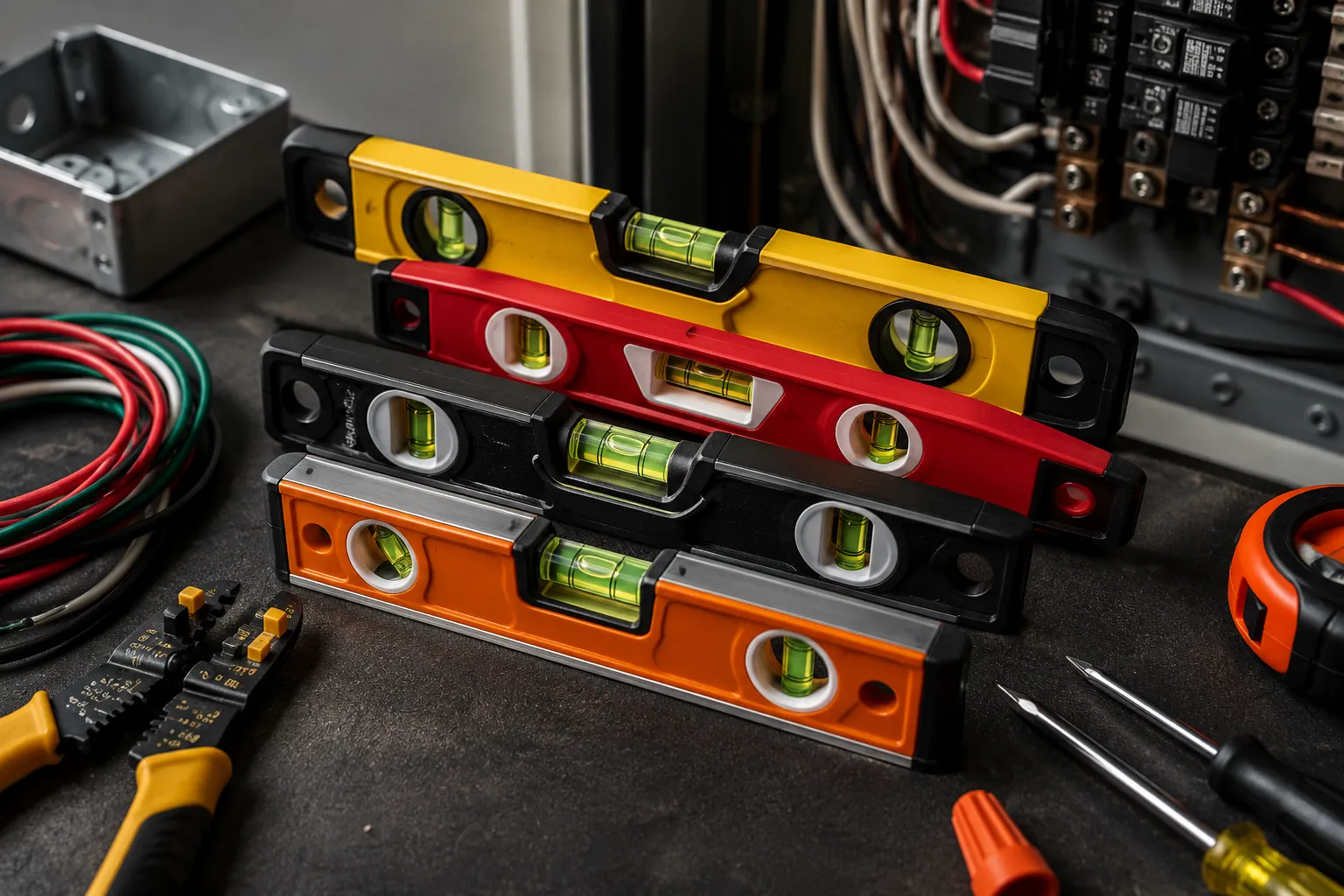
| Use case | Best level style | What matters most |
|---|---|---|
| Everyday electrical work | Magnetic aluminum torpedo | Balance of size, grip, and durability |
| EMT and strut | Strong magnetic torpedo | Hands-free holding and pipe stability |
| Panel and outlet boxes | Compact torpedo | Small profile and easy visibility |
| Rough jobsite conditions | Heavy-duty box-beam level | Rigidity and drop resistance |
| Apprentice or occasional use | Budget torpedo level | Basic accuracy and low cost |
Best overall torpedo level for everyday electrical work
The best all-around choice is usually a magnetic aluminum torpedo level with bright vials, a V-groove, and a slim body. That gives you enough strength for metal work without making the tool too heavy.
This is the kind of level I would want on my belt if I were moving between boxes, conduit, and fixture installs all day.
Best magnetic torpedo level for EMT and strut
If you spend a lot of time on EMT or strut, magnet quality should move to the top of your list. A strong magnetic edge helps hold the level in place while you line up fittings or check a run.
Note: A very strong magnet is useful, but it should not be so aggressive that it makes the level hard to remove or reposition.
Best compact torpedo level for panel and outlet box installs
For panel work and outlet box installs, smaller is often better. A compact level can fit where a longer one cannot, and it is easier to keep aligned in tight spots.
Look for a model with clear vial windows and a flat, stable base so it sits well on box edges.
Best heavy-duty torpedo level for rough jobsite conditions
If your tools get tossed around a lot, choose a rigid frame with protected ends and strong body construction. Box-beam style levels often feel more solid and can hold accuracy better under daily abuse.
They may be a little bulkier, but they can be worth it if durability is your top concern.
Best budget torpedo level for apprentices and occasional use
A budget level can be fine for lighter use, especially for apprentices who are still building a kit. The key is not to go so cheap that the vials are hard to read or the magnet barely works.
If you are buying on a tight budget, I would still spend a little extra for a brand that publishes accuracy specs and has decent reviews from tradespeople.
Pros and Cons of Popular Torpedo Level Styles Electricians Use
- Clear vials with strong contrast
- Magnetic edge that grips steel well
- Rigid body that resists flex
- Compact shape for tool pouch carry
- Weak magnet that slips on EMT
- Cloudy vials that are hard to read
- Body flex that affects accuracy
- Large size that feels awkward in tight spaces
Aluminum torpedo levels: lightweight but less impact-resistant
Aluminum levels are popular because they are light and easy to carry. That matters when you are climbing ladders, moving between rooms, or keeping your pouch weight down.
The tradeoff is that some aluminum models can dent more easily than heavier-duty designs.
Box-beam torpedo levels: rigid and accurate but bulkier
Box-beam styles usually feel more solid in the hand. The rigid frame can help keep the level accurate, especially if you use it often and expect a lot of wear.
The downside is size. They can take up more room in a pouch and may feel less nimble in tight electrical spaces.
Magnetic torpedo levels: convenient on metal surfaces but can snag
Magnetic levels are a favorite for electricians because they let you work hands-free on steel surfaces. That convenience is hard to beat when you are holding wire, fittings, or fasteners.
Still, magnets can snag on other tools in your bag or grab metal dust and shavings over time.
Vial-only versus laser-enhanced or digital torpedo levels
Vial-only levels are simple, reliable, and usually the easiest to grab for everyday use. That is why they remain the standard choice for many electricians.
Laser-enhanced or digital models can be useful for specific tasks, but they usually cost more and may need batteries. For many jobs, a good vial level is all you need.
How Electricians Choose the Right Torpedo Level for the Job
Start with the kind of work you do most. If you spend more time on conduit, magnet strength matters more. If you work in boxes and panels, compact size and readability matter more.
Think about whether you want light holding power or a stronger grip for hands-free work. Too little magnet strength is frustrating, but too much can make repositioning awkward.
Look for a clear accuracy claim from the maker. If the brand does not publish one, I would keep shopping.
Imagine using the level in a dim panel room or attic. If the vial windows are hard to read in your head, they will be hard to read on the job too.
If the level will live in your pouch every day, choose a model with a solid frame and a warranty that gives you some peace of mind.
Step 1 — Match the level to conduit, boxes, or fixture work
Your main task should guide your choice. A level that is great for conduit may not be the best for switch boxes, and a tiny pocket model may not feel stable enough for some layout work.
Step 2 — Decide how much magnet strength you need
If you work mostly on metal surfaces, stronger magnets are worth it. If you move between metal and non-metal surfaces all day, a balanced magnet may be more practical.
Step 3 — Check accuracy specs before buying
Accuracy specs help you separate a serious tool from a cheap one. Even a small error can matter when you are lining up multiple boxes or a visible conduit run.
Step 4 — Test visibility in low-light conditions
Good visibility is not a luxury. It saves time and reduces mistakes. I like levels with large vial windows and clear bubble contrast.
Step 5 — Compare durability and warranty for daily carry
For a tool that gets used every day, durability matters as much as features. A decent warranty can also be a sign that the maker stands behind the product.
Common Tasks Where the Best Torpedo Levels for Electricians Matter Most
When I am choosing a torpedo level for electrical work, I test it on a piece of EMT and on a flat surface. That quick check tells me a lot about magnet grip and vial readability.
Leveling outlet boxes and switch boxes
Box alignment is one of the most common places a torpedo level earns its keep. A quick check helps make the finished install look clean and professional.
Aligning conduit runs and bends
Conduit work often benefits from a level that can sit securely on round pipe. A V-groove and strong magnet can make this much easier.
Setting panels, disconnects, and junction boxes
When you are mounting panels or disconnects, the level needs to be compact enough to fit the space but accurate enough to trust. This is where a good torpedo level really shines.
Mounting light fixtures, raceway, and strut
Overhead work can be awkward, so a hands-free magnetic hold is a big help. It lets you focus on placement instead of fighting the tool.
Checking appliance connections and equipment platforms
For appliances and equipment pads, a torpedo level is often enough for quick verification. It is fast, portable, and easy to keep nearby.
A level only helps if it is accurate. If you drop it hard, notice a damaged vial, or get repeated odd readings, stop trusting it until you verify it against a known flat surface or replace it.
Price Ranges and What You Get at Each Level
Budget torpedo levels: what to expect
Budget levels are fine for light use, but they often have weaker magnets, simpler construction, and less refined vial visibility. They can still work well for apprentices or backup tools.
Mid-range torpedo levels: the sweet spot for most electricians
Mid-range models usually give you the best balance of price and performance. You often get stronger magnets, better accuracy, and a more durable frame without paying premium pricing.
Premium torpedo levels: when the extra cost makes sense
Premium levels make sense if you use one every day and want better durability, clearer vials, and a stronger overall feel. If a tool saves time and frustration on every job, the higher price can be easier to justify.
- Keep one torpedo level in your pouch and one in the truck as backup.
- Wipe magnets clean so metal dust does not reduce grip.
- Check the level against a known flat surface after any hard drop.
- Choose a model with large vial windows if you work in dark spaces often.
- For conduit, prioritize magnet strength and V-groove design together.
You should recheck your level if it starts giving inconsistent readings, the vial looks damaged, or the body bends, twists, or dents after a fall. For critical installs, trust a level only after it has been verified.
The best torpedo levels for electricians are compact, magnetic, readable, and tough enough for daily carry. If you choose a model with solid accuracy, strong magnet placement, and good vial visibility, you will have a tool that works well on panels, conduit, boxes, and general jobsite tasks.
FAQ
Most electricians do well with a 6- to 10-inch torpedo level. That size is small enough for tight spaces but still stable enough for everyday work.
Not always, but many electricians prefer one. A magnetic edge is very helpful on EMT, steel boxes, strut, and other metal surfaces where hands-free support saves time.
Not necessarily. Digital levels can be useful for special layout work, but a good vial level is simpler, faster, and usually enough for most electrical tasks.
Look for a clear published accuracy spec from the manufacturer. Tighter accuracy is better, especially if you use the level for visible conduit runs or repeated box alignment.
The V-groove helps the level sit more securely on round conduit and pipe. That makes alignment easier and reduces slipping during setup.
Check it on a known flat surface, then flip it end for end and compare the readings. If it disagrees with itself, it may need replacement.
- Electricians need compact, durable, easy-to-read torpedo levels.
- Magnet strength matters most for EMT, strut, and steel boxes.
- Bright vials and clear accuracy specs are worth paying for.
- V-groove and ruler markings add real jobsite value.
- Mid-range models are often the best balance for most users.