
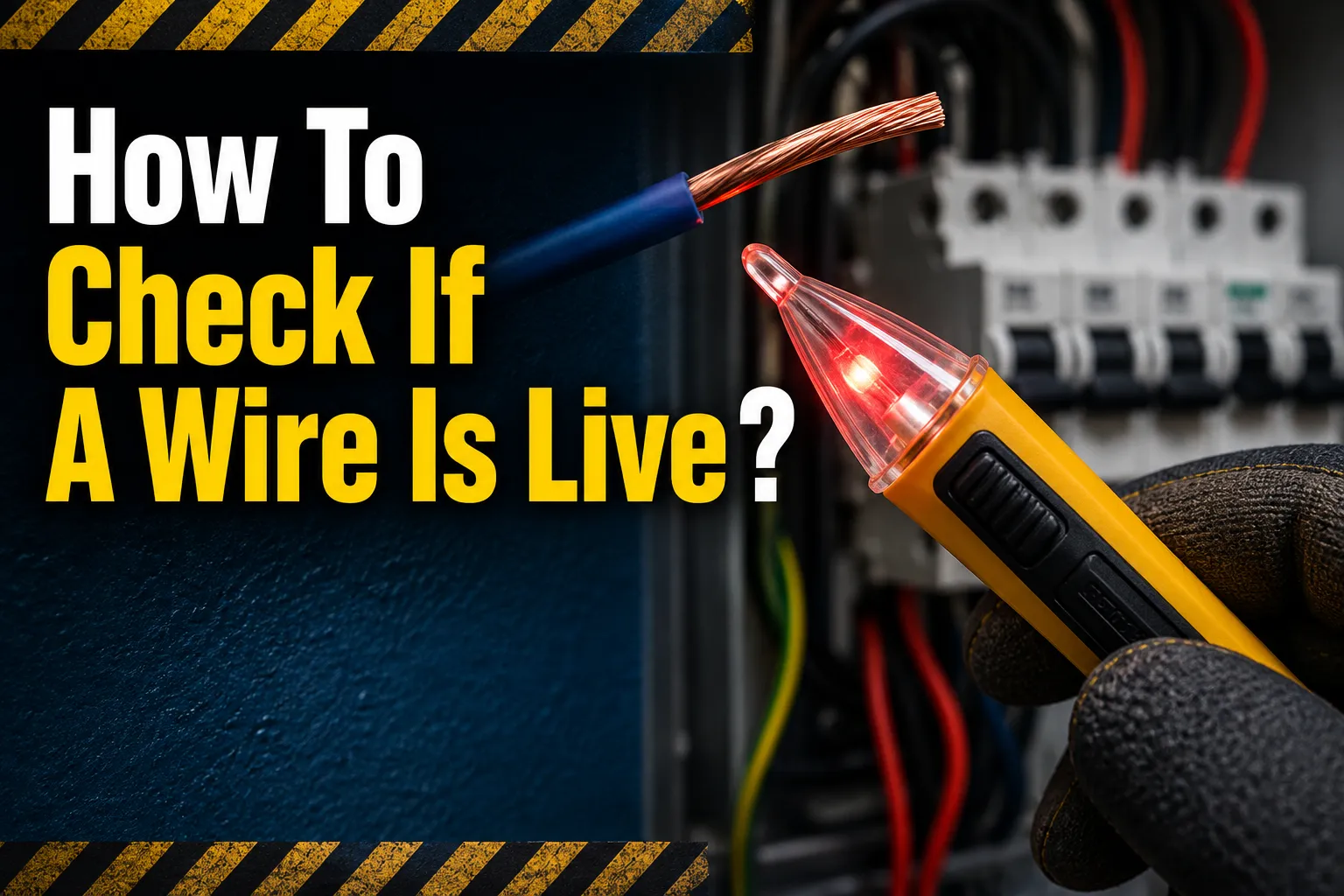
The safest way to check if a wire is live is to use a properly rated tester, prove it works on a known live source first, then test the wire without touching bare metal. A non-contact voltage tester is great for a quick check, while a multimeter gives a more reliable confirmation.
If you are working on a light, outlet, switch, or appliance, knowing whether a wire is live can keep you from getting shocked. We’ll show you the simple tools to use, the safest testing steps, and the common mistakes that can lead to a wrong reading.
- Verify your tester on a known live source first.
- Turn off power only if you are isolating a circuit.
- Test the wire with a non-contact voltage tester.
- Confirm the result with a multimeter when possible.
- Re-test the tester after you finish checking.
- Watch for bundled wires, boxes, and hidden conductors.
- Stop and call an electrician if anything seems unclear.
What It Means for a Wire to Be Live and Why It Matters
Hot, neutral, and ground wires in simple terms
A live wire is usually the hot wire. It carries voltage from the power source to the device or fixture. The neutral wire returns power, and the ground wire is a safety path that helps protect you if something goes wrong.
In many homes, hot wires are black or red, neutral wires are white, and ground wires are bare copper or green. But wire colors are not a guarantee. Someone may have changed the wiring, or you may be looking at an older system.
Why a wire can still be dangerous even if the switch is off
A switch only controls part of a circuit in many cases. The wire ahead of the switch may still be energized. That means a light may be off, but the wiring in the box can still carry dangerous voltage.
Some wires also hold a small induced voltage from nearby energized cables. That can confuse some testers. For that reason, a quick beep or glow is not always the full story.
Common situations where homeowners need to check a wire
You may need to check a wire when changing a light fixture, replacing a switch, removing an outlet, or troubleshooting a dead circuit. It also helps when you are sorting out old wiring in a junction box or tracing which cable feeds a device.
We also see this question come up when people are working near ceiling fans, garbage disposals, outdoor outlets, and appliance cords. In all of these cases, confirming power before you touch anything is a smart habit.
Some testers can detect voltage through insulation, but that does not always mean the wire is safe to handle. A second check is often worth the extra minute.
Tools You Can Use to Check If a Wire Is Live
Non-contact voltage tester
A non-contact voltage tester is the easiest tool for a quick check. You bring the tip close to the wire, and the tester alerts you if it senses AC voltage. It is handy because you do not need to touch bare conductors.
These testers are common for homeowners because they are simple and fast. Still, they are best used as a first check, not the only one.
Multimeter
A multimeter measures voltage more directly. When used correctly, it can tell you whether there is voltage between hot and neutral or hot and ground. That makes it a better choice when you want confirmation.
If you use a multimeter, make sure it is rated for the type of work you are doing. For household wiring, a meter with the right AC voltage range is usually what you need.
For a general safety reference on electrical hazards and home wiring, we also like the guidance from the U.S. Consumer Product Safety Commission electrical safety page.
Plug-in circuit tester
A plug-in circuit tester is useful for outlets. You plug it into the receptacle, and the lights on the tester show wiring conditions. It does not help much with loose wires, but it is great for checking whether an outlet is wired and powered correctly.
We like this tool for quick outlet checks after repairs or when a receptacle seems dead. It is not a substitute for testing exposed conductors, though.
Voltage tester pen limitations and when not to rely on it
A voltage tester pen is often another name for a non-contact tester. It can be helpful, but it has limits. Thick insulation, cable placement, low voltage, weak batteries, or nearby energized wires can all affect the result.
Do not rely on it alone when the job involves important safety decisions. If the reading matters, confirm with a multimeter or call an electrician.
How to Check If a Wire Is Live Safely Step by Step
Turn off power only if you are isolating a circuit first
If you are working on a circuit, you should usually turn it off at the breaker before touching the wire. But if your goal is to find out whether a wire is live, you may need the circuit energized long enough to test it safely. The key is to know what you are trying to prove before you start.
When in doubt, shut off the circuit, label it, and test carefully. Never assume a breaker label is correct without checking.
Verify your tester on a known live source before testing
Before you test the wire, prove your tester works. Check it against a known live outlet, fixture, or conductor that you already know is energized. If the tester does not respond there, do not trust it on the wire you want to check.
This one step prevents a lot of false confidence. A dead battery or faulty tester can make a dangerous wire seem safe.
Test the wire using a non-contact voltage tester
Bring the tester close to the insulated part of the wire or the exposed conductor, following the tool’s instructions. Move slowly and test more than one spot if needed. If the tester signals voltage, treat the wire as live until you confirm otherwise.
Keep your fingers behind the grip line on the tester. Do not let your hand touch bare copper, terminal screws, or nearby metal parts.
Confirm with a multimeter for a more reliable reading
If the wire is accessible and you know how to use the meter, set it to the correct AC voltage range. Measure between hot and neutral, then hot and ground. A standard North American branch circuit often reads around 120 volts, while many larger appliances use about 240 volts.
Voltage can vary a little, so do not expect an exact number every time. What matters is whether the reading is clearly present or clearly absent.
Re-test the tester after checking the wire
After you finish, test your non-contact tester on the known live source again. If it no longer works, you know the result from the wire may not have been reliable. This habit also tells you whether the tester stayed functional during the job.
What to do if the wire is inside a box or bundled with other wires
Wires inside a box can be harder to test because nearby live conductors may influence the reading. Separate wires carefully only if the circuit is de-energized and you know what you are doing. If not, keep your hands clear and use the meter on accessible test points.
⚠️ Warning
Do not poke around in a crowded electrical box with bare hands or loose tools. If the wiring is tight, unclear, or damaged, stop and get help.
We suggest taking a photo of the wiring before you disconnect anything. It can save a lot of time when you put it back together.
How to Check If a Wire Is Live with a Non-Contact Voltage Tester
How to position the tester near the wire
Hold the tester close to the insulated wire or exposed conductor, then move it slowly along the length of the cable. Some testers work best when the sensing tip is near the side of the wire, not pressed hard against it. Follow the maker’s instructions for the tool you own.
Signs the tester is detecting voltage
Most testers beep, flash, or vibrate when they sense voltage. Some use a light bar or a combination of signals. If the response is weak or inconsistent, repeat the test and compare it with a known live source.
False positives and false negatives to watch for
False positives can happen when the tester picks up voltage from nearby wires. False negatives can happen if the battery is weak, the insulation is thick, or the wire is not positioned well for the sensor. That is why we do not treat a single result as final.
Best uses for this tool around the home
This tool is best for quick checks at switches, outlets, light fixtures, appliance cords, and breaker panels where you need a fast warning. It is also useful for tracing which conductor is energized before you move to a more exact test.
How to Check If a Wire Is Live with a Multimeter
Setting the meter to the correct voltage mode
Set the meter to AC voltage, not resistance or continuity. If your meter has ranges, choose one above the voltage you expect to see. For household wiring, that usually means a range that covers 120 volts or 240 volts.
Measuring between hot and neutral
Place one probe on the hot conductor and the other on the neutral. If the circuit is live, the meter should show the expected voltage for that circuit. Keep your fingers on the insulated parts of the probes only.
Measuring between hot and ground
You can also measure between hot and ground. On a properly wired circuit, this should be close to the hot-to-neutral reading. If the readings are very different, that may point to a wiring issue.
For more on safe meter use and electrical testing basics, the Fluke guide to using a multimeter is a solid reference from a well-known test equipment manufacturer.
Reading the display and understanding voltage ranges
A clear voltage reading means the wire is energized. A very low or zero reading usually means the wire is not live, but you should still confirm the setup. If the meter shows a strange or unstable number, check your probe placement and test again.
Small variations are normal. What you want to avoid is guessing from a number you do not understand.
Common multimeter mistakes that lead to wrong results
Common mistakes include using the wrong mode, touching the wrong points, using damaged leads, or trying to test through insulation. Another issue is forgetting to verify the meter on a known live source first.
If you are not comfortable using a multimeter, use a non-contact tester for the first pass and leave the more detailed work to someone experienced.
Safety Tips Before and During Testing
Wear insulated gloves and use dry hands
Dry hands lower your risk, and insulated gloves add another layer of protection. They do not make electrical work safe by themselves, but they can help reduce risk during basic testing.
Keep exposed metal away from terminals
Use only the insulated part of your tools. Keep rings, watches, and loose jewelry away from the work area. Even small slips can create a shock path.
Stand on a dry surface and avoid damp areas
Water and electricity do not mix. Stand on a dry floor or mat, and avoid testing in wet basements, puddles, or damp outdoor spaces unless the situation is fully controlled and safe.
Use only properly rated testers and leads
Your tester should be rated for household electrical work and in good condition. Cracked housings, worn probe insulation, or damaged leads are reasons to replace the tool before using it again.
When to stop and call a licensed electrician
If the wiring is scorched, the breaker keeps tripping, you smell burning, or the test results do not make sense, stop. A licensed electrician can find the fault safely and fix it properly.
You see damaged insulation, melted plastic, buzzing, repeated tripping, or any sign of overheating. Those are not normal DIY situations.
Pros and Cons of Each Method for Checking a Live Wire
Non-contact voltage tester pros and cons
| Method | Pros | Cons |
|---|---|---|
| Non-contact voltage tester | Fast, simple, no bare-metal contact needed | Can miss voltage or give false alarms |
Multimeter pros and cons
| Method | Pros | Cons |
|---|---|---|
| Multimeter | More accurate, gives actual voltage readings | Needs correct setup and careful probe use |
Plug-in tester pros and cons
| Method | Pros | Cons |
|---|---|---|
| Plug-in circuit tester | Great for outlets, easy to read | Only works on receptacles, not loose wires |
Which method is best for quick checks vs accurate confirmation
For quick checks, we prefer a non-contact voltage tester. For accurate confirmation, a multimeter is the better choice. For outlet troubleshooting, a plug-in tester is often the fastest option.
- Tester works on a known live source
- Voltage shows clearly on the meter
- Readings match between hot-neutral and hot-ground
- Tester gives inconsistent results
- Meter readings jump around
- Wires are damaged, wet, or crowded together
Common Mistakes People Make When Checking a Wire for Power
Assuming a switch means the wire is dead
A switch only controls the device it is wired to. The wire may still be live upstream, so never trust the switch alone.
Testing without proving the tester works first
If the tester is broken or the battery is weak, you may get a false sense of safety. Always check the tester first and last.
Touching insulation instead of the exposed test point
Some tools can sense through insulation, but not every setup is the same. When you need a real reading, use the proper exposed test point and the correct method.
Confusing induced voltage with true live power
A tester may react to nearby energized wires even when the conductor itself is not carrying useful power. That is why a multimeter check matters when the result affects your next step.
Checking the wrong wire in a multi-wire cable
In a cable with several conductors, it is easy to mistake the feed wire for the switch leg or neutral. Trace carefully and label wires if needed before disconnecting anything.
- Keep a fresh battery in your non-contact tester.
- Use one hand when possible to reduce shock risk.
- Take photos before disconnecting wires.
- Test more than once if the reading seems odd.
If you want to know how to check if a wire is live, start with a trusted tester, prove it works, and confirm the result when you can. A non-contact tester is great for speed, but a multimeter gives you the stronger answer when safety depends on it.
Frequently Asked Questions About How to
Yes. The switch may only control part of the circuit, so the wire can still carry voltage even when the light or device is off.
It is useful for a quick check, but it is not the most reliable final answer. We recommend confirming with a multimeter when possible.
Many homes in North America use about 120 volts for standard circuits and about 240 volts for some larger appliances. The exact value can vary a bit.
Yes, that is what a non-contact voltage tester is for. It senses AC voltage near the wire without direct contact with bare metal.
It may be picking up induced voltage, nearby live wires, or a weak battery issue. Try a second method before you trust the result.
Call a licensed electrician if the wiring is damaged, wet, burned, confusing, or if your test results do not make sense. Safety comes first.
- Use a tester that is rated for household electrical work.
- Prove the tester works on a known live source first.
- Non-contact testers are fast, but multimeters are more reliable.
- Switches do not always make a wire safe to touch.
- Stop if the wiring looks damaged, wet, or unclear.