
Best Laser Distance Measures for Homeowners
A good laser measure turns awkward room dimensions, ceiling heights, flooring estimates, and renovation planning into fast one-person jobs. These three picks cover everyday indoor projects, premium documentation, and long outdoor measurements without forcing every homeowner into the same tool.
Affiliate disclosure: As an Amazon Associate, AccurateGoods earns from qualifying purchases. Product availability and prices can change. We recommend comparing the current listing details before ordering.
Our Top Three Picks at a Glance
| Product | Best for | Official headline capability | Why it stands out |
|---|---|---|---|
| Bosch GLM400C | Premium indoor/outdoor projects | Up to 400 ft; camera viewfinder; connected workflow | Helps locate the laser point outdoors and supports detailed project documentation. |
| Leica DISTO D2 | Precise indoor renovation planning | Up to 330 ft / 100 m; Bluetooth; intelligent endpiece | Compact premium design with useful corner and edge measuring options. |
| Klein Tools 93LDM200 | Best value for most homes | Up to 200 ft; length, area, volume, and indirect functions | A straightforward range and feature set for common remodeling estimates. |
Bosch GLM400C
Choose it for large properties, exterior estimates, high ceilings, and projects where a standard red dot becomes difficult to see at a distance.
- Camera viewfinder with zoom
- Bluetooth project transfer
- Area, volume, indirect, and real-time modes
Leica DISTO D2
Choose it for kitchens, flooring, built-ins, and detailed interior documentation where compact handling and flexible reference points help.
- Intelligent endpiece
- Bluetooth Smart
- Multiple measurement modes
Klein Tools 93LDM200
Choose it for routine room measurements, material estimates, and homeowners who want capable functions without paying for a camera system.
- 200-foot class range
- Area and volume calculations
- Job-focused interface
How We Chose These Laser Measures
Homeowners rarely need the same laser measure as a survey crew, but the cheapest single-button model can become frustrating as soon as a project expands beyond one wall. We prioritized tools that solve realistic household problems: measuring rooms alone, calculating flooring and paint areas, checking ceiling heights, estimating exterior spans, documenting dimensions, and measuring from corners.
We compared manufacturer-stated range, accuracy, visibility aids, calculation modes, durability, reference-point options, connectivity, and ease of carrying. We did not rank products by invented hands-on testing, changing retailer ratings, or temporary sale prices. The result is a short list organized by use case rather than a long catalog of near-identical devices.
Remember that maximum range is normally measured under favorable conditions. Bright sunlight, dark or reflective surfaces, shaky aim, and the absence of a clear target can shorten practical working distance. For a deeper explanation of where a laser tool wins—and when a physical blade remains smarter—read our laser distance measure vs tape measure comparison.
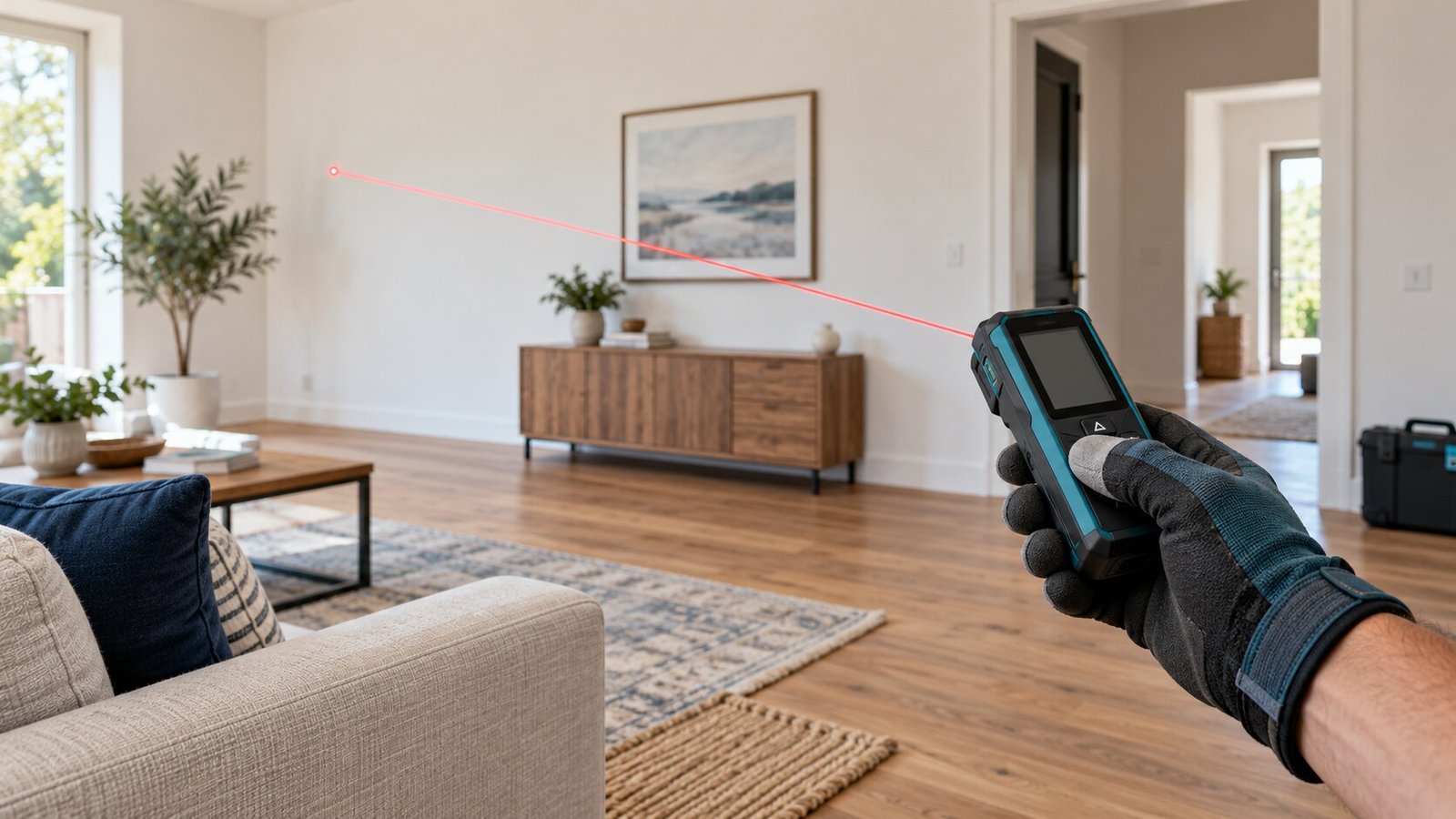
1. Bosch GLM400C: Best Premium Laser Measure
The Bosch GLM400C is the most capable choice here for homeowners managing larger or more demanding projects. Its defining feature is the built-in camera viewfinder. Instead of depending entirely on your eyes to find a small laser dot across a bright yard or long space, the screen helps you aim at the intended target. That makes this model especially relevant for exterior remodeling plans, deck estimates, fence layouts, detached garages, and tall interior spaces.
Bosch lists a measuring range of up to 400 feet and typical accuracy of plus or minus 1/16 inch. It also provides the functions expected from a higher-tier instrument: length, area, volume, indirect measurements, addition and subtraction, a 360-degree inclinometer, and real-time measuring. Memory for recent measurements reduces repeated note-taking when you are moving through several rooms.
Bluetooth connectivity works with the Bosch MeasureOn ecosystem, allowing measurements to be associated with project notes, photos, and floor-plan documentation. That is more valuable than a huge maximum range for many serious renovators. If you routinely prepare estimates, plan material orders, or communicate dimensions to contractors, a connected record can reduce transcription mistakes.
Who should buy it?
Buy the GLM400C if you will use the viewfinder or documentation tools. It is also the sensible choice when outdoor measurement is a regular need. For occasional furniture placement in small rooms, it is more tool than necessary, and a lower-priced model will feel faster and simpler.
2. Leica DISTO D2: Best for Indoor Precision
The Leica DISTO D2 occupies a useful premium middle ground. It is compact enough for a pocket yet offers a wider set of functions than basic homeowner models. Leica lists a range of up to 100 meters, or 330 feet, with typical accuracy of plus or minus 1.5 millimeters. For kitchens, bathrooms, flooring, cabinetry, and room documentation, that balance of size and capability is appealing.
Its intelligent endpiece is one of the most practical reasons to choose it. Fold the piece out when you need to measure from a corner or edge; the instrument adjusts its reference accordingly. That can make diagonal room dimensions and measurements from awkward recesses less clumsy than trying to hold a flat-backed unit in position.
The D2 can calculate area and volume, add or subtract measurements, and perform indirect height calculations. Bluetooth Smart connectivity supports transferring readings to compatible apps, which is useful when creating a floor plan or capturing dimensions for a contractor. The interface has more depth than a one-button device, so expect to spend a little time learning its modes.
Who should buy it?
Choose the DISTO D2 when most of your work is indoors and you appreciate a small, established measuring platform with flexible reference options. It is well suited to renovation planning, real-estate documentation, custom storage, and finish carpentry preparation. Our guide to laser measure accuracy explains why technique and target conditions still matter even with a premium tool.
3. Klein Tools 93LDM200: Best Value for Homeowners
The Klein Tools 93LDM200 is the practical selection for buyers who want more reach and calculation capability than a tiny entry-level model but do not need a camera viewfinder or elaborate app workflow. Klein specifies measurements from two inches to 200 feet, with accuracy varying by distance. Always check the current manufacturer and retailer specifications if a tight tolerance is critical to your project.
It handles the functions homeowners use most: single and continuous distance, area, volume, and indirect measurements. Those tools are enough to estimate flooring, wall covering, paint, room volume, ceiling height, and spans that would be awkward for one person with a tape. The 200-foot class range also leaves comfortable headroom for common residential spaces.
Klein is a familiar name in trade tools, and this model follows a conventional jobsite-oriented approach. It is a better value when you want competent core measurement without paying for features you may never configure. It is not our first recommendation for long outdoor shots in bright sun because it lacks the camera-assisted aiming advantage of the Bosch.
Who should buy it?
Choose the 93LDM200 for general remodeling, property walk-throughs, material estimates, and frequent indoor DIY. If your work is mostly quick shelf and furniture measurements, an even simpler model could be enough. If you expect outdoor landscaping or construction planning, step up to a viewfinder-equipped tool.
What to Look for Before Buying
Practical range, not just advertised maximum
A 65- to 100-foot tool is enough for many rooms, but range becomes important in open-plan homes, high stairwells, long basements, yards, and exterior work. Do not buy solely for the largest number. Bright conditions and poor targets can make a long specification difficult to reproduce. A viewfinder or green laser may contribute more than raw range when visibility is the limiting factor.
Measurement functions
Length is the minimum. Area multiplies length by width for flooring or paint estimates, while volume adds height for room capacity. Continuous mode updates as you move, which is helpful when locating a precise setback. Indirect or Pythagorean modes estimate inaccessible heights, but they require steady positioning and careful geometry. Direct measurement is preferable whenever it is possible.
Reference points and endpieces
Most devices can measure from the front or rear of the housing. Premium models may add a tripod reference or folding endpiece. The correct reference setting matters: measuring from the wrong end introduces an error approximately equal to the length of the device. Look for a clear on-screen reference icon and confirm it before recording dimensions.
Screen and visibility
A backlit display with large digits is easier to read in unfinished rooms and dim basements. A color screen can make modes and prompts clearer, but screen design matters more than color alone. For exterior work, the ability to aim through a camera viewfinder can be a decisive upgrade.
Connectivity and records
Bluetooth is worth paying for if you create floor plans or collect many measurements per job. It is less important when you need only one or two dimensions. Check app compatibility with your phone and workflow before making connectivity the deciding feature.
Durability and power
Rubber overmolding and published dust or water protection help in garages and renovation zones. Replaceable alkaline batteries are easy to swap, while rechargeable packs reduce disposable battery use. Neither approach is universally better; choose based on how and where you work.
How to Get More Accurate Results
- Confirm the reference edge. Check whether the tool is measuring from its front, rear, tripod point, or unfolded endpiece.
- Use a solid target. Transparent glass, glossy surfaces, very dark walls, and irregular textures may produce unreliable returns. Use a suitable target plate when needed.
- Keep the device square. Angling across a room creates a longer diagonal instead of the perpendicular distance you intended.
- Stabilize long shots. Brace the tool against a solid surface or use compatible support when a small movement can shift the laser far from the target.
- Repeat critical readings. Take two or three measurements and investigate any mismatch before cutting or ordering materials.
- Verify with a tape when practical. A laser and tape complement each other. Use a tape for short edges, object dimensions, and confirmation before irreversible work.
Laser Safety for Home Use
These tools use a visible laser for aiming. Never stare into the beam, aim it at another person or animal, or direct it toward vehicles and aircraft. Do not view the beam through magnifying optics. Keep children from treating the device like a pointer, and store it with the laser switched off. Follow the specific safety instructions supplied with your model.
Also remember that a distance meter does not detect wiring, pipes, or structural hazards. Before drilling or cutting, use the appropriate inspection method. Measurement accuracy does not make a proposed hole safe.
Which One Should You Buy?
For the broadest capability, the Bosch GLM400C earns our premium recommendation. The camera viewfinder is a meaningful improvement for long and bright measurements, and the connected workflow suits larger projects. The Leica DISTO D2 is our preferred indoor premium model because its compact body, endpiece, and measurement functions fit renovation planning particularly well. The Klein Tools 93LDM200 offers the best balance for many homeowners who need core calculations and generous residential range without paying for a camera.
Choose according to the hardest task you expect to perform regularly—not the most impressive specification. A reliable, understandable tool that fits your usual projects will deliver more value than an advanced model whose features stay unused.
Frequently Asked Questions
Are laser distance measures accurate enough for home renovation?
Yes, quality models are generally suitable for room dimensions, material estimates, layouts, and planning when used correctly. For cuts or installations with very tight tolerances, verify critical dimensions with a suitable physical measuring tool and follow the product’s stated accuracy limits.
Do laser measures work outside?
They can, but bright sunlight may make the dot difficult to see and reduce practical performance. A camera viewfinder, visible green beam, target plate, and stable support can help. Never aim toward roads, vehicles, or aircraft.
Is a green laser better than a red laser?
Green light is often easier for the human eye to see, but visibility also depends on ambient light, surface, distance, and device power. A camera viewfinder can be more useful than beam color for very long outdoor aiming.
Can a laser measure replace a tape measure?
Not completely. Laser tools excel across rooms and awkward spans, while tapes remain convenient for short objects, edges, curved surfaces, and direct confirmation. Many homeowners benefit from carrying both.
What range is enough for a homeowner?
For typical indoor rooms, 100 feet is often ample. Larger homes, exterior work, high ceilings, and long property features can justify 165 to 400 feet, especially when paired with better aiming aids.
Do I need Bluetooth?
Bluetooth is useful when recording many dimensions, adding measurements to photos, or building floor plans. For occasional one-off measurements, it is optional and should not outweigh basic usability.
Ready to Measure Faster?
Compare the current listings, included accessories, warranty information, and delivery options before choosing.
