

Water leak detectors help people spot leaks early, protect homes from water damage, and cut down on costly repairs. These small devices range from simple sensors that beep when they get wet to smart models that send alerts to a phone and integrate with a home network. They sit near appliances, under sinks, or in basements and work 24/7 so users can act fast when a leak starts.
Buyers should focus on detection type, alert method, battery life, and coverage area. Wired sensors offer constant power but require installation, while wireless models are easy to place and often pair with hubs for remote alerts. The most important thing is reliable notification — choose a detector that fits the home’s layout and will alert someone quickly, whether by sound, phone push, or smart home integration. This guide evaluates top models and buying factors to help readers pick the best detector for their needs.
9 Best Water Leak Detectors
Below is a carefully chosen list of the best water leak detectors for home use. It includes reliable options for basements, bathrooms, kitchens, and appliances to help people catch leaks early and avoid costly damage.
GoveeLife Smart Water Leak Detector 5‑Pack

It is a strong choice for large homes that need long-range wireless coverage and multiple alert methods.
Pros
- Very long wireless range for reaching detached areas.
- Multiple alerts: app push, SMS, email, and a loud local alarm.
- Long advertised battery life reduces maintenance.
Cons
- Gateway only works on 2.4 GHz Wi‑Fi.
- Multiple batteries required for the kit.
- App and cloud features depend on the gateway.
The long-range Sub-1G radio aims to keep sensors connected across big properties, so it suits basements, garages, and outbuildings. It pairs sensors with a gateway that handles notifications to phones and emails.
It offers a loud 105 dB alarm and app controls like one-tap silence and a “find device” beep. Users can set volume levels and add extra email recipients to share alerts with family.
The sensors carry an IP67 rating, so they tolerate spills and brief submersion after drying. The kit claims up to five years of battery life, which lowers the need for frequent changes.
Potential buyers should note the gateway needs a 2.4 GHz network and the system will need several alkaline batteries. Those limits matter for some Wi‑Fi setups and for people who prefer battery-free devices.
GoveeLife Premium Water Leak Kit (1 gateway + 6 sensors)

This kit is a strong choice for someone who wants long-range, phone alerts, and many sensors to cover basements, laundry rooms, and sheds.
Pros
- Very long wireless range so remote sensors stay connected.
- Sends phone SMS, app push, and email alerts for fast notice.
- Long battery life and IP66 rating for damp places.
Cons
- Gateway only works on 2.4 GHz Wi‑Fi.
- Setup instructions can be confusing for some users.
- Uses many AAA batteries across the kit.
The sensors link to a gateway that pushes SMS, app, and email alerts when water appears. They use LoRa for a long receiving range, which helps sensors in outbuildings and basements stay connected.
Each sensor has multiple probes and a loud alarm so it detects small drips as well as floods. The IP66 build suits wet spots near water heaters, sinks, and sump pumps.
Users should note the gateway needs 2.4 GHz Wi‑Fi and the kit relies on several AAA batteries, so plan for replacements down the line. The app supports Alexa and voice reminders for simple hands-free alerts.
Topvico 120dB Water Leak Detector — 5 Pack

This is a good budget choice for people who want loud, simple leak alerts without Wi‑Fi or apps.
Pros
- Very loud 120dB alarm that’s hard to miss.
- Long 37.8″ cable lets the sensor sit where water collects.
- Low-power design claims long standby on a single 9V battery.
Cons
- No low‑battery alert, so batteries must be checked manually.
- Basic build quality; feels lightweight and simple.
- Requires a 9V battery (not included) and manual replacement.
The alarm uses a contact sensor on a plated detection board that reacts to water and sounds an immediate siren. Buyers like that the sensor and alarm separate, so the loud unit can sit where it’s easy to reach while the probe sits by the water source.
Installation relies on double‑sided adhesive or mounting, and the cable can be extended if needed. The design avoids Wi‑Fi, so it will still alarm during network outages but won’t send remote notifications.
This kit suits basements, laundry rooms, under sinks, RVs, and near water heaters where a simple, loud warning is enough to prompt a quick check.
Read more and buy on Amazon: Topvico Water Leak Detector, 120dB Loud Siren, Powered by 9V Battery (not Include), Sensor Alarm for RV Kitchen Basement Water Heater, 5 Pack
GoveeLife 5-Pack Water Leak Detectors
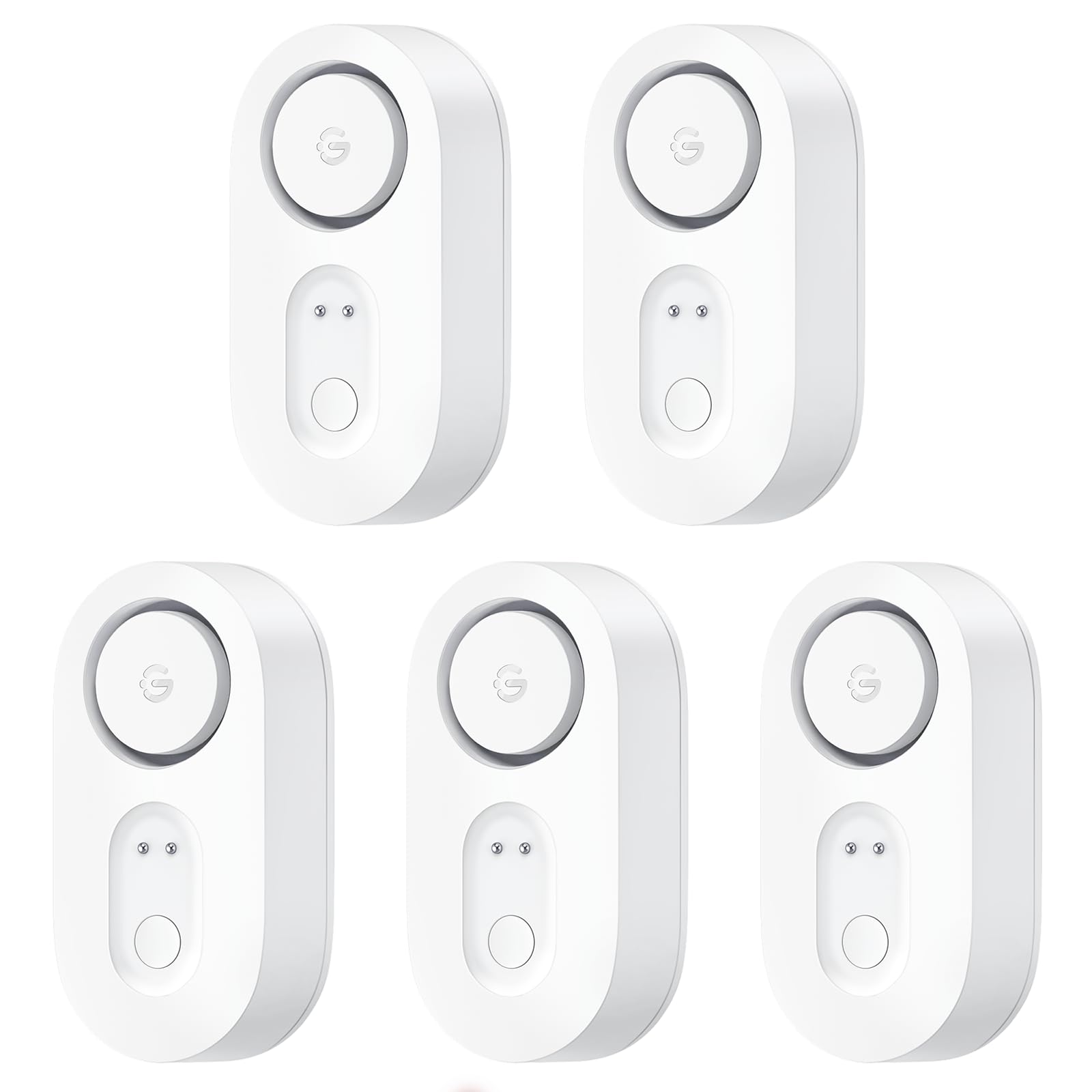
It is a good buy for people who want long-lasting, loud local alerts and multi-point protection but don’t need direct Wi‑Fi connectivity.
Pros
- Long battery life that can last up to five years.
- Very loud, adjustable 105 dB alarm that is easy to hear.
- Two probe sets improve early detection around appliances and sinks.
Cons
- Requires a specific GoveeLife gateway to use remote app features.
- App setup can be fiddly and may not work with all routers.
- Not directly Wi‑Fi capable — no cloud features without the gateway.
The detectors give strong local protection. They sit near potential leak points and trigger a loud alarm quickly when they sense water. Their IP67 build means they tolerate damp spots well.
These sensors work in small clusters, so placing them under sinks, by water heaters, and near washing machines helps cover common leak sites. Dual probes boost sensitivity for thin or early leaks.
Remote phone alerts only work with the compatible GoveeLife gateway, which the pack does not include. Buyers who want cloud alerts must add that gateway.
Geevon Water Leak Detector 2-Pack

It is a simple, battery-powered alarm that warns quickly of standing water and is a good value for basic leak detection.
Pros
- Very loud 100 dB alarm that wakes attention.
- Small, portable design fits under sinks or near appliances.
- Comes with batteries and two sensors for wider coverage.
Cons
- Alarm volume may be weaker one floor up for some homes.
- Plastic case screws can wear with frequent battery changes.
- No smart alerts or remote notifications.
The detector uses three metal prongs to sense water and sounds an audible alarm when liquid makes contact. It runs on a 9V battery, so it works during power outages and needs no wiring.
Placement is simple: set it on a flat surface where leaks start, like under sinks, near water heaters, or in basements. The unit is light and small, so users can move it as needed to test different spots.
This kit includes two sensors and two batteries, and the maker offers a 30-day return and a 12-month warranty. For someone wanting a low-cost, loud alarm that needs no app or hub, this offers straightforward protection.
Buy link: Geevon Water Leak Detector 2-Pack
METAK 5-Pack Water Leak Detectors

It is a good buy for someone who wants simple, battery-powered leak alerts placed around a home to catch drips and small floods early.
Pros
- Very loud 100 dB alarm that is easy to hear.
- Multiple probes give top and rear sensing for different leak types.
- Small, wireless units are easy to place where needed.
Cons
- Not smart-home compatible and offers no remote alerts.
- Instructions and indicator details may be unclear.
- A few users reported occasional defective units out of the pack.
The METAK kit includes five compact, battery-powered detectors that sit on floors or under appliances. They use metal probes to detect contact with water and trigger a loud alarm. The units are IP66-rated so the sensing parts resist rust and moisture.
Each detector runs on two AAA batteries and aims for long standby life with a low-battery flash alert. Buyers who want a simple, low-cost safeguard for basements, laundry rooms, under sinks, or an RV will find these easy to deploy without wiring or hubs.
This model does not send notifications to a phone and lacks smart features, so someone away from home must rely on local alarms or a third-party monitoring setup. Still, for direct, audible warning of leaks near the sensors, it offers clear detection at an affordable price.
YoLink Water Leak Detector

It is a strong choice for properties that need long-range, low-power leak sensing and don’t want to rely on home Wi‑Fi.
Pros
- Very long radio range that reaches outbuildings and basements.
- Works without using home Wi‑Fi or the internet for core functions.
- Long battery life with included batteries.
Cons
- Requires a YoLink hub for app features and full control.
- Not plug-and-play with Wi‑Fi-only smart home setups.
- Some users report regional setup or hub pairing steps can be tricky.
The YoLink sensor uses LoRa radio to send alerts across long distances and through obstructions. This makes it useful for garages, basements, and remote sheds where Wi‑Fi is weak.
It operates on batteries that last years and can pair device-to-device so basic alerts keep working if the internet or power fails. The hub unlocks app alerts, battery status, and integrations like Alexa and IFTTT.
Buyers should plan to add a YoLink hub if they want smartphone control and full functionality; the sensor alone gives local leak detection but limited remote features. Overall, it fits users who value range and reliability over Wi‑Fi dependence.
RUIKORING 5-Pack Water Leak Alarm

It is a solid choice for buyers who want simple, loud, battery-powered leak alarms to catch drips and floods early.
Pros
- Very sensitive to small drips and pooling.
- Uses included batteries for long standby life.
- Fully waterproof and built for damp spots.
Cons
- No smart alerts — only a loud siren.
- Can false-trigger in very humid places.
- Alarm can be uncomfortably loud for close testing.
This pack gives five compact, contact-style sensors designed for floor placement in basements, under sinks, and near appliances. It detects water quickly and sounds a clear alarm so someone nearby can act.
The unit runs on included batteries and shows a low-battery flash. That means users do not need to wire anything but should still check batteries periodically for steady protection.
It fits cluttered or tight areas and resists dust and water with an IP66 rating. Users should wipe probes in very humid rooms to cut down on false alarms.
Basement Watchdog BW-WA360

This is a solid battery alarm that many buyers choose for loud, simple early leak alerts.
Pros
- Very loud alarm that is hard to miss
- 360° sensing design detects water from any side
- Small size fits tight spots
Cons
- No Wi‑Fi or app notifications
- Requires a 9V battery (not included)
- Some users question the exact loudness rating
The unit uses a patented 360° contact sensor that senses small amounts of water and triggers a piercing alarm. Its compact shape lets it sit beside water heaters, under sinks, or near sump pits without taking up space.
It runs on a single 9‑volt battery and conserves power by only drawing energy while the alarm sounds. That keeps maintenance simple but means it won’t send remote alerts or integrate with smart home systems.
Buyers who want a basic, very audible alarm for basements or laundry rooms will like its straightforward approach. Those wanting remote alerts or home automation should look at smart models instead.
Buying Guide
Choosing the right water leak detector starts with where it will be used. They should pick units made for basements, bathrooms, kitchens, or outdoors depending on risk. Consider sensor type: spot sensors detect leaks at one point, while cable or mat sensors cover larger areas.
They should check how the detector alerts them. Look for loud local alarms plus remote alerts via apps, text, or email. Battery life matters; longer battery life reduces maintenance. Some units use plug-in power with battery backup for reliability.
Connectivity is important for remote monitoring. Wi‑Fi allows instant alerts but needs a stable connection. Simple radio or hub systems work well in homes without strong Wi‑Fi. Verify app quality and update support before buying.
Installation and placement affect performance. Battery models are easy to move and place near appliances. Hardwired or plug‑in models suit fixed spots like sump pumps. Ensure sensors sit at floor level and in any drip points.
Durability and water resistance determine lifespan. Look for corrosion‑resistant probes and sealed electronics for damp areas. For crawl spaces and outdoor use, verify weatherproof ratings.
Additional features can add value. Automatic shutoff valves prevent damage. Temperature and humidity sensing help detect freezing risks. Multiple sensor expansion is useful for larger homes.
Use the table below to compare key features at a glance.
| Feature | Why it matters |
|---|---|
| Sensor type | Coverage area and placement options |
| Alerts | Local and remote notification methods |
| Power | Battery life, plug‑in, and backups |
| Connectivity | Wi‑Fi, hub, or local only |
| Durability | Resistance to moisture and corrosion |
| Extra features | Shutoff valves, temp/humidity, expandability |
Editor’s Choice
The Editor’s Choice pick is the unit that best balances reliability, ease of use, and value for most homes. It offers fast leak alerts, battery life that lasts, and simple setup without extra gadgets.
| Feature | Why it stands out |
|---|---|
| Detection speed | Sends alerts within seconds of sensing water |
| Battery life | Months to years on a single battery, depending on use |
| Setup | App-guided setup with clear instructions |
| Alerts | Push, email, and optional SMS notifications |
| Price | Mid-range cost with strong performance |
It works well for basements, laundry rooms, and under sinks. They rate sensors as accurate in tests and note minimal false alarms.
The unit pairs with existing smart home systems and also functions solo. That gives flexibility for users who want a simple device or a fully integrated setup.
Accessories like extra probes and water sensors add coverage. Users can place them in high-risk spots and monitor remotely through the app.
Where to Buy – Best Amazon Deals
They can find most top water leak detectors on Amazon, where selection and fast shipping make shopping simple. Prices often drop during sales like Prime Day, Black Friday, and holiday deals.
Buyers should check these features on each Amazon listing:
- Price history: Look for recent price drops or coupons.
- Bundle options: Some kits include extra sensors or a hub at a lower combined price.
- Warranty and returns: Confirm the seller’s return policy and manufacturer warranty.
Amazon listing details matter. Read verified customer reviews to spot real-world issues like false alarms or short battery life. Pay attention to Q&A and customer images for extra insight.
Use Amazon filters to compare models by brand, rating, and price. Sort by “Price: Low to High” to find cheap options, or “Avg. Customer Review” for higher-rated picks. Subscribe & Save may lower costs on models with replaceable batteries.
Look for sold-by-Amazon or fulfilled-by-Amazon sellers for easier returns. Prime members often get free two-day shipping, which helps when a quick replacement is needed.
Conclusion
They should pick a leak detector that fits their home, budget, and tech comfort. Basic sensors work well under sinks and near appliances, while smart, Wi‑Fi models add remote alerts and integrations.
Battery life, app reliability, and sensor placement matter most. Wired systems offer constant power but cost more to install.
A few well-placed sensors can prevent big repairs. Local shutoff features and automatic alerts reduce water damage quickly.
For renters, stick to plug‑and‑play or battery models. Homeowners with high value items or basements may prefer whole‑home systems.
Bold choices: prioritize alarms with proven app reliability and long battery life. Consider models with temperature sensing if freezing pipes are a risk.
They can use a short checklist to decide:
- Location needs (appliance, basement, attic)
- Power type (battery, plug, wired)
- App and alert reliability
- Budget and installation plans
Choosing the right detector reduces stress and potential costs. Regular testing and battery checks keep the system working when it matters.
FAQs
What does a water leak detector do?
It senses water or moisture and alerts users to possible leaks. Many models send sounds, lights, or smartphone notifications.
Where should detectors be placed?
They work best near water sources: under sinks, behind toilets, near water heaters, and by washing machines. Place one in basements and any low spots where water can collect.
How often should batteries be changed?
Check battery life in the product manual. Many devices last 1–3 years on a single battery. Smart models may show low-battery alerts.
Are smart detectors worth it?
Smart detectors send remote alerts and can connect to home systems. They cost more but help catch leaks when no one is home.
Can detectors prevent major damage?
They alert to leaks early, which reduces damage risk. They do not stop water flow by themselves unless paired with an automatic shutoff valve.
Do detectors need Wi‑Fi?
Not all do. Basic models use local alarms only. Smart models use Wi‑Fi or hubs to send remote alerts.
How many detectors are needed?
Number depends on the home’s layout. Use one at each major water source and in basements or crawl spaces.
What maintenance is required?
Test alarms monthly and replace batteries as recommended. Keep sensors clean and free of debris for accurate detection.