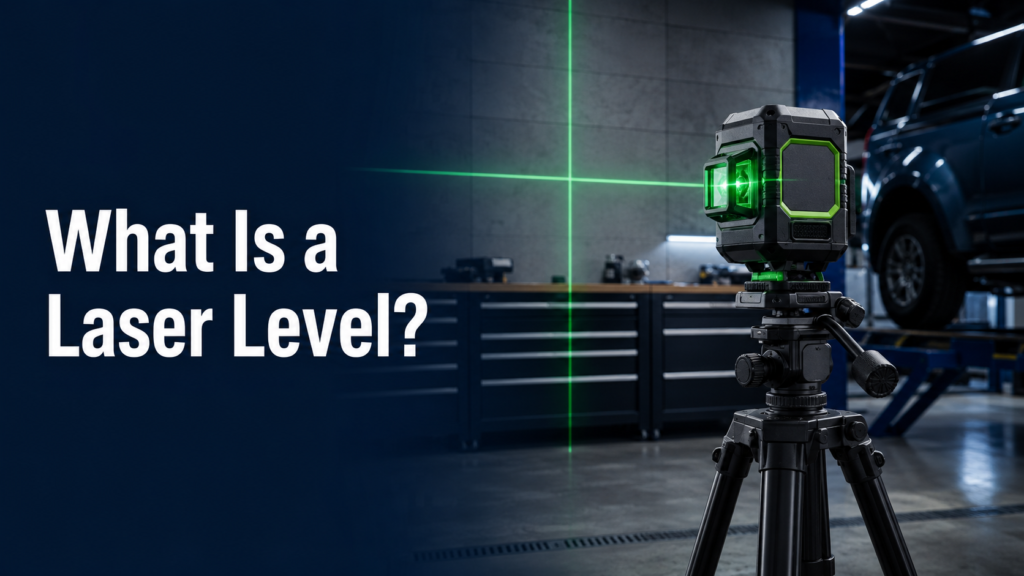
Quick answer: A laser level is a measuring and alignment tool that projects a visible laser point, line, cross-line, or rotating reference plane. It helps you establish level, plumb, square, or aligned reference points across a work area without repeatedly moving a traditional spirit level.
Laser levels are useful for jobs where a straight reference needs to continue across a wall, floor, ceiling, or larger workspace. Common examples include hanging shelves, installing cabinets, laying tile, aligning electrical boxes, framing walls, setting posts, and checking elevations.
What Is a Laser Level?
A laser level combines a leveling mechanism with a laser emitter. Once the tool is positioned correctly, it projects a reference that you can follow while marking, fastening, cutting, or installing materials.
The important distinction is that the laser beam itself does not physically measure whether an object is level. The tool first establishes a level or plumb reference using its internal leveling system, then projects that reference so you can see it over a useful distance.
How Does a Laser Level Work?
Most modern jobsite laser levels use either a pendulum-based self-leveling mechanism or an electronic leveling system. A self-leveling unit corrects small setup errors within its specified leveling range. Some rotary models use electronic sensors and servomotors rather than a simple gravity pendulum.
If the tool is tilted beyond its self-leveling range, many models warn you by blinking, beeping, or stopping the beam. That warning matters because a visible line is not automatically an accurate level line when the tool is outside its operating range.
Main Types of Laser Levels
Line Laser Levels
A line laser projects a horizontal or vertical line. It is a practical choice for shelves, cabinets, trim, pictures, electrical work, and other indoor alignment jobs.
Cross-Line Laser Levels
A cross-line model projects horizontal and vertical lines at the same time. The crossing lines make it easier to establish both level and plumb references from one setup.
360-Degree Laser Levels
A 360-degree laser projects a continuous reference around much or all of a room. This can reduce repositioning when installing cabinets, tile, drop ceilings, outlets, or fixtures at a consistent height.
Rotary Laser Levels
A rotary laser creates a level reference by rotating a laser beam. These tools are commonly chosen for larger indoor spaces and outdoor elevation work. Outdoor use often involves a compatible laser receiver because the beam can be difficult to see in bright daylight.
Dot and Plumb Lasers
Dot lasers project reference points rather than full lines. They can be useful for transferring points from floor to ceiling, plumbing walls, or positioning fixtures.
What Is a Laser Level Used For?
A laser level is useful whenever consistent alignment matters across more distance than a short spirit level can conveniently cover. Typical applications include:
- hanging pictures, mirrors, shelves, and curtain hardware;
- installing kitchen cabinets and countertops;
- laying wall or floor tile;
- aligning outlets, switches, and electrical boxes;
- installing trim, chair rails, and wall panels;
- checking framing and partition-wall layout;
- transferring plumb points between floor and ceiling;
- setting consistent elevations for outdoor construction or landscaping when the laser is designed for that work.
Laser Level vs Traditional Spirit Level
A spirit level is simple, durable, and excellent for checking an individual object or short surface. A laser level becomes more useful when the reference must extend across a room or remain visible while you work with both hands.
They are complementary tools rather than perfect substitutes. A small spirit or torpedo level is often faster for a single shelf bracket or short pipe, while a laser is more efficient for aligning several objects to one reference.
How Accurate Are Laser Levels?
Accuracy varies by model and is normally specified as a tolerance at a stated distance, such as a fraction of an inch over a number of feet or millimeters over meters. Do not assume two laser levels have the same tolerance simply because both are self-leveling.
Accuracy can also be affected by impact damage, unstable mounting, temperature changes, incorrect setup, dirty optics, or using the unit outside its self-leveling range.
For a practical check, see our guide to testing laser level accuracy. That supporting article covers the actual test procedure, so this pillar guide does not duplicate it.
Red vs Green Laser Levels
Green beams are often easier for the human eye to see under the same general viewing conditions, which can help in bright indoor spaces. Red-beam models can still be perfectly suitable for many indoor jobs and may offer a simpler or more economical setup.
Beam color should not be treated as a direct measure of accuracy. Check the manufacturer’s stated accuracy, working range, receiver compatibility, runtime, and intended environment.
Self-Leveling vs Manual Laser Levels
A self-leveling laser automatically compensates for small setup errors within its rated range. This saves time and reduces the chance of projecting a tilted reference after a rough setup.
A manual-leveling model requires the user to level the tool before relying on the beam. Manual mode on some self-leveling lasers can also intentionally lock the pendulum so you can project a sloped line, but a sloped line should not be mistaken for a level reference.
If you’re shopping for this feature, see our best self-leveling laser levels guide.
Indoor vs Outdoor Use
Indoors, the projected line is usually easier to see because ambient light is controlled. Outdoors, direct sunlight can wash out a visible beam quickly. For longer outdoor distances, a rotary laser or compatible line laser used with a receiver is often more practical than relying on eyesight alone.
Also check the tool’s environmental rating before exposing it to dust, rain, or jobsite debris. Not every laser level is designed for the same conditions.
How to Choose the Right Laser Level
Start with the work rather than the longest feature list. For basic home alignment, a cross-line self-leveling laser may be enough. For room-wide installations, a 360-degree model can reduce repositioning. For grading and larger outdoor jobs, a rotary laser with receiver support is usually the more appropriate class of tool.
Compare the manufacturer’s stated accuracy, usable range, self-leveling range, mounting options, battery system, beam visibility, receiver compatibility, durability rating, and warranty. Paying for a much longer range or more laser planes than your projects require may add cost without improving the result.
Laser Level Safety
Never intentionally stare into a laser beam or aim it at another person’s eyes. Check the warning label and laser classification on your specific tool, because precautions depend on the class and output. OSHA guidance notes that Class 2 visible lasers rely on the normal aversion response for brief accidental viewing, but direct eye exposure should still be avoided.
Keep the beam path controlled, especially around reflective surfaces, children, coworkers, traffic, and public areas. Follow the manufacturer’s safety instructions and applicable workplace requirements.
Common Laser Level Mistakes
- Using the beam before the unit has finished self-leveling.
- Ignoring a blinking or warning indication.
- Setting the tool on a vibrating or unstable surface.
- Assuming a brighter beam means a more accurate tool.
- Using an indoor-only setup for long outdoor work without a receiver.
- Failing to recheck accuracy after a hard drop or impact.
- Looking directly into the beam.
Is a Laser Level Worth It?
For occasional one-point checks, a traditional level may be all you need. A laser level becomes especially useful when you repeatedly align several items, work across long walls, transfer heights around a room, or need a reference that stays visible while you work.
The best choice is not automatically the model with the most lines or longest advertised range. Choose the laser type that matches your normal projects and verify the accuracy specification before buying.
Frequently Asked Questions
Does a laser level measure distance?
Usually, no. A standard laser level projects an alignment reference. A laser distance meter is a different tool designed to calculate distance, although some products combine multiple functions.
Can a laser level be used outside?
Yes, if the model is suitable for outdoor conditions. Beam visibility can be poor in sunlight, so longer-distance work often requires a compatible receiver.
Do laser levels work on uneven floors?
Yes. The mounting surface does not itself need to be level if a self-leveling unit is securely positioned within its specified leveling range. The projected reference is established by the tool’s leveling mechanism.
Are green laser levels more accurate than red ones?
Not necessarily. Green can be easier to see, but accuracy depends on the instrument’s design, calibration, setup, and stated tolerance—not beam color alone.
How often should you check laser level accuracy?
Check it when the tool is new, after a significant drop or impact, whenever results look suspicious, and periodically when accuracy is important to your work.
Bottom Line
A laser level turns an internal level or plumb reference into a visible point, line, or plane that can span a workspace. The right type can make alignment faster and more repeatable, but accuracy still depends on correct setup, calibration, mounting stability, and using the tool within its specifications.
For your next step, compare self-leveling laser levels or learn how to test a laser level for accuracy.