
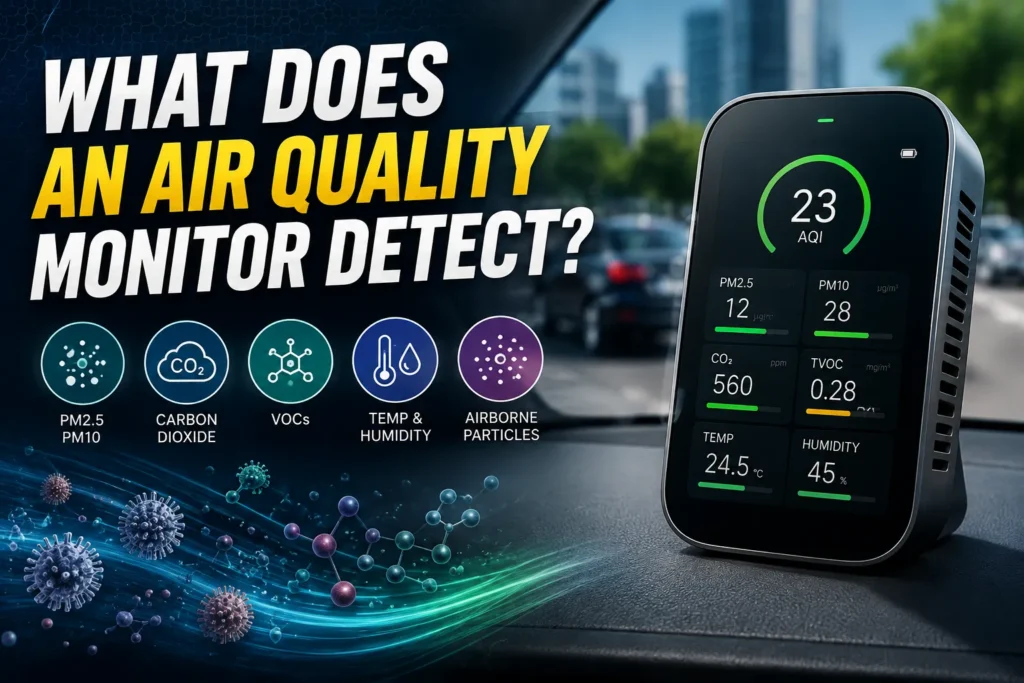
An air quality monitor detects pollutants and conditions in the air around you, such as fine particles, carbon dioxide, carbon monoxide, volatile organic compounds, temperature, and humidity. Some models also track smoke, pollen, and other gases, but they do not identify every pollutant or tell you the exact source without extra investigation.
If you have ever wondered why a room feels stuffy, smoky, or just “off,” an air quality monitor can help you see what is going on. We use these devices to make indoor air easier to understand, not to replace common sense or professional testing when the problem is serious.
In this guide, we explain what an air quality monitor can detect, what it cannot detect well, and how to read the numbers without getting lost in the jargon.
What an Air Quality Monitor Detects in Your Home and Why It Matters
Indoor air can change fast. Cooking, cleaning, showering, burning candles, or opening windows can all shift readings in just a few minutes.
Indoor vs. outdoor air quality monitoring
Indoor and outdoor monitors look for some of the same pollutants, but they are used for different jobs. Outdoor monitors help track pollution from traffic, wildfire smoke, and weather conditions. Indoor monitors focus on the air inside your home, where things like cooking fumes, cleaning products, and poor ventilation often matter more.
For indoor use, the goal is usually practical: find out when air needs freshening, when a purifier should run, or when a room may be too humid for comfort.
Why “air quality” is more than just smells or dust
Bad smells are only one clue. Air can look clear and still contain fine particles or gases that affect comfort and health. Dust on a shelf also does not tell the whole story, because the smallest particles are often the ones you cannot see.
That is why a monitor can be useful. It gives numbers for things your senses may miss.
The Main Pollutants and Conditions an Air Quality Monitor Can Detect
| What it detects | What it means | Why it matters |
|---|---|---|
| PM2.5 and PM10 | Fine and larger airborne particles | Often linked to smoke, dust, cooking, and outdoor pollution |
| CO2 | How stale or well-ventilated a space is | Helps show when air may need freshening |
| CO | Carbon monoxide from incomplete combustion | A serious safety concern |
| VOCs | Gases from cleaners, paints, furniture, and more | Can signal off-gassing or indoor chemical buildup |
| Temperature and humidity | Comfort and moisture levels | Helps manage mold risk and indoor comfort |
Particulate matter: PM2.5 and PM10
Particulate matter means tiny bits floating in the air. PM2.5 refers to particles smaller than 2.5 microns, and PM10 covers larger particles up to 10 microns. PM2.5 is usually the bigger concern indoors because it can come from smoke, cooking, candles, and outdoor pollution that gets inside.
Many consumer monitors are strongest at detecting changes in particle levels, so you may notice a spike when frying food or vacuuming.
Carbon dioxide (CO2)
CO2 is not the same as carbon monoxide. In a home monitor, CO2 is often used as a sign of ventilation quality. When levels rise, it usually means people are breathing in a closed room and fresh air is not moving in fast enough.
That does not mean CO2 itself is the main danger at typical indoor levels. It is more of a clue that the room may need airflow.
Carbon monoxide (CO)
Carbon monoxide is a dangerous gas that can come from fuel-burning appliances, fireplaces, generators, or attached garages. A monitor that detects CO can provide an important warning, but it should never replace approved CO alarms.
For safety guidance on carbon monoxide, we recommend checking the U.S. Environmental Protection Agency’s carbon monoxide and indoor air quality resource.
Volatile organic compounds (VOCs)
VOCs are gases released by many household products. Common sources include cleaners, air fresheners, paints, adhesives, new flooring, and some furniture. A monitor may show a rise in VOCs after you paint a room or use strong cleaning sprays.
VOCs are a broad group, so the reading is usually a combined signal rather than a breakdown of each chemical.
Formaldehyde and other chemical off-gassing
Some monitors can estimate formaldehyde or related gases, but this depends on the sensor and the model. Formaldehyde can come from pressed-wood products, certain glues, textiles, and other materials that slowly release gases over time.
Because “off-gassing” can involve many compounds, a basic consumer monitor may only give you a general warning, not a full chemical report.
Temperature and humidity
These are not pollutants, but they matter a lot. High humidity can support mold growth, while very dry air can feel uncomfortable and irritate your nose and throat. Temperature also affects how a room feels and can influence how you interpret other readings.
For many homes, humidity is one of the easiest things to track and improve.
Smoke, pollen, and other airborne irritants
Smoke often shows up as a particle spike, especially PM2.5. Pollen can also affect particle readings, though not every monitor will separate pollen from other dust in the air. That means a monitor can show that the air is loaded with particles, but it may not tell you whether the cause is pollen, cooking, or dust.
Radon and other less common gases
Some devices or add-on systems can detect radon, but many standard air quality monitors do not. Radon is usually measured with a dedicated test or long-term detector, because it is not something most basic consumer monitors handle well.
For radon guidance and testing information, the U.S. EPA has a helpful radon information page.
How Air Quality Monitors Detect These Pollutants
Sensor types used in consumer monitors
Most home monitors use a mix of sensors. Particle sensors usually use light to spot airborne particles. Gas sensors may use metal-oxide, electrochemical, or infrared technology. Temperature and humidity sensors are usually separate and simpler.
The sensor mix matters because no single sensor can accurately measure everything in the air.
How particle sensors measure dust and smoke
Many particle sensors shine a light into a chamber and look for how airborne particles scatter that light. More particles usually mean more scattering, which the monitor turns into a reading. This is why a candle, frying pan, or sweeping session can make the numbers jump.
Particle sensors are often useful for spotting changes quickly, even if the exact particle type is unknown.
How gas sensors detect VOCs and CO2
Gas sensors work differently. Some respond to chemical reactions, while others measure how a gas absorbs infrared light. CO2 sensors in better monitors often use non-dispersive infrared, or NDIR, technology. VOC sensors are usually more general and can react to many different gases.
That broad response is helpful, but it is also why VOC readings should be treated as an estimate, not a full lab result.
What built-in temperature and humidity sensors tell you
These sensors are simple but useful. They help you see whether a room is too damp, too dry, or too warm. They also give context to the rest of the data, since air that feels stuffy is often tied to poor airflow, high humidity, or both.
Consumer monitors are best at showing patterns and changes. They are less reliable when you expect them to name every pollutant with lab-level precision.
What an Air Quality Monitor Cannot Detect Reliably
Germs, viruses, and bacteria
Most home air quality monitors do not directly detect germs, viruses, or bacteria. They may show particle levels or ventilation changes, but that is not the same as identifying infectious material in the air.
Every individual chemical in a mixed indoor environment
Indoor air can contain a mix of gases from many sources at once. A basic monitor usually gives you a combined VOC reading, not a list of each chemical. If you need exact chemical identification, you usually need professional testing.
Exact source of a pollutant without investigation
A reading can tell you that something is in the air, but it cannot always tell you where it came from. A spike might be from cooking, a scented product, a nearby garage, or outdoor smoke. You often have to match the reading with what was happening in the room.
Long-term exposure risk without context
A single reading is only a snapshot. To judge risk, you need to know how long the level stayed high, how often it happens, and who is in the room. That is why trends matter more than one dramatic spike.
If a monitor shows carbon monoxide, treat it as a safety issue right away. Leave the area if needed and follow the instructions for your CO alarm or local emergency guidance.
How to Read Air Quality Monitor Results Correctly
Understanding AQI, ppm, ppb, and µg/m³
Air quality data can look confusing at first. AQI means Air Quality Index, which is a simple scale used for some outdoor pollution reports. ppm means parts per million, ppb means parts per billion, and µg/m³ means micrograms per cubic meter.
Different sensors use different units, so it helps to know what each one measures before comparing readings.
What “good,” “moderate,” and “poor” readings usually mean
These labels are often based on the manufacturer’s own ranges or common indoor air guidance. “Good” usually means low pollution and decent comfort. “Moderate” may mean the room is okay but could use better airflow. “Poor” often means the level is high enough to take action, such as ventilating the room or removing the source.
Why readings change by room, time, and activity
Kitchen air is not the same as bedroom air. A monitor near a stove will often show more particles than one in a hallway. Readings can also change after showering, cleaning, opening windows, or running the HVAC system.
That is normal. Air quality is dynamic, not fixed.
Common mistakes that lead to misreading the data
One common mistake is reacting to every short spike. Another is placing the monitor too close to a window, vent, or appliance. People also sometimes assume a high VOC reading means danger from one specific chemical, when it may just reflect a broad mix of household gases.
- Look for patterns over time
- Compare readings before and after activities
- Place the monitor where you spend time
- Judge air quality from one reading alone
- Put the monitor right next to a vent or window
- Assume every spike means a major hazard
Benefits and Limits of Using an Air Quality Monitor
- Early warning when particle levels rise
- Better ventilation decisions
- Helpful feedback after cooking or cleaning
- Useful humidity tracking
- False alarms from poor placement
- Sensor drift over time
- Limited accuracy in low-cost models
- Confusing readings without context
Pros: early warnings, better ventilation decisions, and healthier habits
A monitor can help you notice problems early. If the air gets stale, smoky, or too humid, you can act before the room feels unpleasant. It can also help you see which habits create the biggest air quality changes, like pan-frying without the hood fan on.
Cons: false alarms, sensor drift, and limited accuracy in cheap models
Lower-cost monitors may be less consistent. Sensors can drift over time, and some devices react too broadly to common household products. That does not make them useless, but it does mean you should treat the numbers as guidance, not absolute truth.
When a consumer monitor is enough
For most homes, a consumer monitor is enough if you want to improve comfort, watch for smoke or cooking pollution, and keep an eye on humidity or ventilation. It is especially useful when you want practical feedback rather than lab-grade analysis.
When to call a professional or use lab testing
If you suspect a serious gas leak, recurring carbon monoxide, radon, mold, or a chemical exposure that keeps coming back, professional help is the safer choice. Lab testing can also help when you need to identify a specific contaminant or prove a problem for remediation.
- Place the monitor at breathing height, not on the floor or right under a vent.
- Watch trends for a few days before making big changes.
- Use the monitor during cooking, cleaning, and sleeping to learn your home’s patterns.
- Pair the readings with simple actions like opening windows or turning on exhaust fans.
You see repeated carbon monoxide warnings, persistent high humidity with visible mold, or strange readings that do not match normal household activity. In those cases, it is smart to verify the issue with a professional or a dedicated test.
How to Use Air Quality Monitor Readings to Improve Indoor Air
Improving ventilation and airflow
Fresh air is one of the simplest fixes. Open windows when outdoor conditions allow, run exhaust fans, and use bathroom and kitchen ventilation during moisture or smoke-producing activities. Better airflow often brings readings down quickly.
Reducing dust, smoke, and cooking pollution
Vacuum with a good filter, dust with damp cloths, and use your range hood when cooking. If smoke is the issue, step one is always source control. The less smoke you create, the less your monitor has to detect.
Lowering VOCs from cleaners, paints, and furniture
Choose low-odor or low-VOC products when possible, and store chemicals tightly sealed. New furniture or paint may off-gas for a while, so extra ventilation can help during that period.
Managing humidity to reduce mold risk
Try to keep humidity in a comfortable middle range. If it stays high, use a dehumidifier or improve ventilation. If it is too dry, a humidifier may help, but use it carefully and keep it clean.
Using air purifiers and HVAC filters effectively
Air purifiers can help reduce particles like dust, smoke, and pollen. HVAC filters also matter, especially if your system runs often. A monitor can show whether those tools are making a real difference in the room.
For product guidance, it can also help to review the manufacturer’s specs and support pages. For example, Airthings’ indoor air monitoring resources explain the kinds of sensors found in many consumer devices.
What to Look for When Buying an Air Quality Monitor
Sensors that match your biggest concern
If smoke is your main issue, focus on particle detection. If stale air is the problem, look for CO2. If you worry about fumes from paints or cleaners, VOC sensing may be more useful. There is no need to buy every sensor if you only need one or two.
Accuracy, calibration, and response time
Check whether the monitor can be calibrated and how often the manufacturer recommends it. Fast response time is helpful if you want to see changes during cooking or cleaning. If a device is slow, it may miss short spikes.
App alerts, data logging, and display quality
Some monitors give clear on-device readings, while others rely on an app. If you like tracking trends, data logging is useful. Alerts can also help if you want to know when a room needs attention without staring at the screen all day.
Battery life, portability, and placement options
A portable monitor is handy if you want to test several rooms. Battery life matters if you plan to move it around or use it during travel. Good placement options also make it easier to get readings that reflect the room, not the corner where the device was squeezed in.
Indoor-only vs. indoor/outdoor models
Indoor-only models are usually simpler and better suited to home use. Indoor/outdoor models can be useful if you want to compare inside air with outside conditions, especially during wildfire smoke or seasonal pollution.
An air quality monitor gives you a practical view of what is in your air, but it works best as a guide, not a lab report. It can show particles, gases, humidity, and ventilation patterns, which helps you make smarter choices about airflow, cleaning, cooking, and comfort.
FAQ
Most home monitors commonly detect particles like PM2.5, along with gases such as CO2, VOCs, and sometimes carbon monoxide. Many also track temperature and humidity.
Not directly in most cases. Some monitors can show high humidity or particle changes that may point to a mold risk, but they usually cannot confirm mold on their own.
Not usually at the levels shown by consumer monitors. In homes, CO2 is mainly used as a sign that ventilation may be poor and the room may need more fresh air.
Usually no. A basic monitor often gives a broad VOC reading, not a full chemical breakdown. Exact identification usually needs professional testing.
Place it in the room you want to study, at about breathing height, and away from direct vents, windows, or appliances. That gives a more realistic reading of the space.
Yes. A dedicated carbon monoxide alarm is still the right safety device for CO protection. A general air quality monitor should not replace it.
- Air quality monitors detect particles, gases, and indoor conditions like humidity.
- Common readings include PM2.5, PM10, CO2, CO, VOCs, temperature, and humidity.
- They can show patterns and changes, but not every chemical or exact pollutant source.
- Readings make the most sense when you compare trends, not single spikes.
- Use the data to improve ventilation, reduce pollution sources, and manage moisture.