
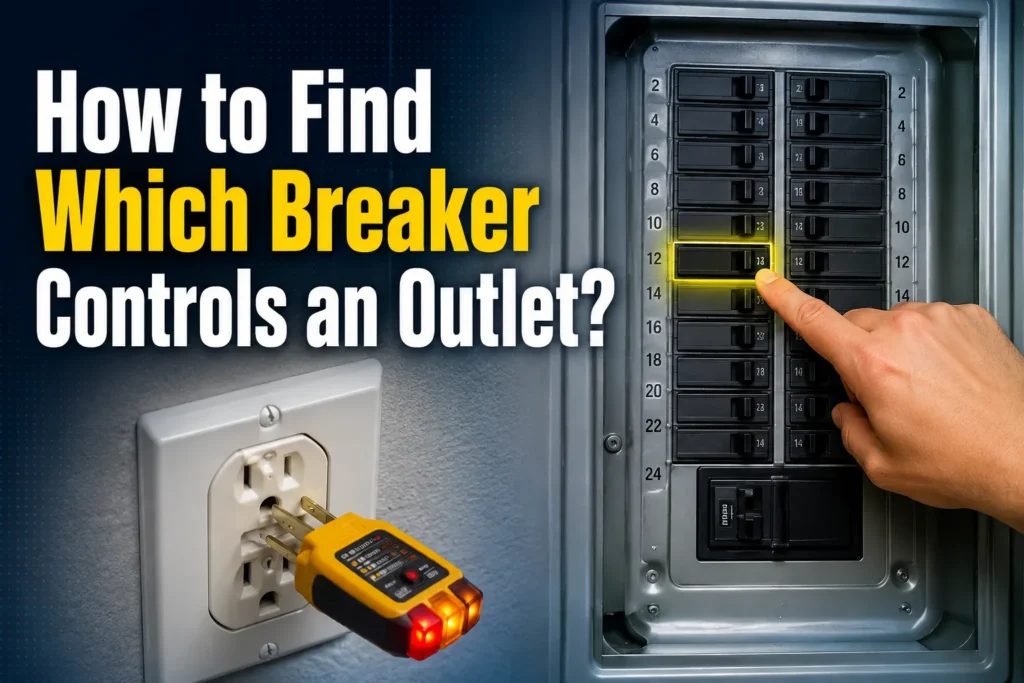
To find which breaker controls an outlet, plug in a lamp or outlet tester, turn it on, then switch breakers off one at a time until the power goes out. Once you find the right breaker, test the outlet again and label the panel so you do not have to guess next time.
If you have ever stared at a dead outlet and a crowded breaker panel, you are not alone. I wrote this guide to make the process simple, safe, and easy to repeat, even if your panel labels are messy or outdated.
We will walk through the basic steps, some faster ways to narrow things down, and the common mistakes that can throw you off.
- Plug in a lamp or outlet tester and turn it on.
- Go to the breaker panel and find the circuit breakers.
- Turn off one breaker at a time.
- Check whether the outlet lost power.
- Repeat until you find the correct breaker.
- Verify the result by testing the outlet again.
- Label the breaker clearly for future use.
Why You Need to Know Which Breaker Controls an Outlet
Many homes have more than one outlet on the same circuit. That means one breaker can shut off several receptacles, lights, or even a mix of both.
Safety reasons before unplugging or repairing anything
Knowing the right breaker helps reduce the chance of electric shock while you replace an outlet, fix a switch, or inspect a loose connection. It is a simple step, but it matters.
If you are unsure about wiring damage, burning smells, repeated tripping, or warm outlets, stop and get help from a qualified electrician. The U.S. Consumer Product Safety Commission has useful home electrical safety guidance at CPSC electrical safety resources.
How identifying the right breaker saves time during outages and upgrades
When an outlet stops working, you do not want to shut off half the house just to find the problem. Finding the correct breaker lets you isolate one circuit fast, which is helpful during repairs, remodeling, and troubleshooting.
It also makes future work easier. Once the panel is labeled well, you can turn off power with confidence instead of testing by guesswork.
Common situations where homeowners need this information
This comes up more often than people expect. You may need it when installing a new light fixture, replacing a worn receptacle, resetting a tripped circuit, or checking why a room lost power.
It is also useful after a move, because older panel labels are often incomplete or wrong.
What to Gather Before You Start Tracing the Outlet
Flashlight for dark panel areas
Breaker panels are often in garages, basements, closets, or utility rooms with weak lighting. A flashlight helps you read breaker positions and labels without straining your eyes.
Outlet tester or lamp to confirm power loss
A small lamp or plug-in outlet tester gives you a clear yes-or-no answer when you switch breakers off. If the lamp goes dark, you are on the right track.
Label maker, masking tape, and pen for temporary marking
If you are not ready to make permanent labels right away, use masking tape and a pen. That way you can mark your findings as you go and tidy them up later.
Smartphone or notebook for documenting breaker results
It is easy to forget which breaker you already tested, especially when a panel has many circuits. Write down each result or take photos of the panel before and after you test.
Safety gear and a helper for faster identification
Closed-toe shoes and dry hands are a good idea when working near electrical equipment. A helper can save time by watching the outlet while you move back and forth to the panel.
If the outlet is in a bathroom, kitchen, garage, basement, or outdoors, it may be protected by a GFCI outlet or breaker. That can affect where the power is interrupted.
How to Find Which Breaker Controls an Outlet — Step by Step
Choose a lamp you can see from across the room, or use a plug-in tester. Make sure the outlet is live before you start flipping breakers.
Open the panel door and look for the breakers that match the area you are testing. If the labels are vague, that is fine. You are going to verify them yourself.
Switch off a single breaker, then pause. Do not turn off several at once, or you may lose track of which one affected the outlet.
Return to the outlet and see whether the lamp went out or the tester changed. If the outlet is still live, go back and try the next breaker.
Keep testing one breaker at a time until the outlet shuts off. Be patient. Some panels have closely grouped circuits that are easy to mix up.
After you think you found the right breaker, switch it off and on again to confirm the outlet responds the same way each time.
Write the room, outlet location, or appliance it controls. Good labels save time later and help anyone else working in the home.
If you see scorch marks, hear buzzing, smell burning, or notice a breaker that will not stay reset, stop using that circuit and call a licensed electrician.
Faster Ways to Identify the Right Breaker Without Guessing
Use a circuit breaker finder tool for quicker tracing
A circuit breaker finder can speed things up by helping you match an outlet to a breaker with less walking back and forth. These tools are common in home tool kits and can be very helpful in larger houses.
For a product overview from a well-known manufacturer, I like the practical guidance from Klein Tools, which makes circuit tracing tools for electricians and DIY users.
Work with a second person to reduce back-and-forth trips
One person can stay at the outlet while the other works the panel. That makes the process faster and helps confirm the exact moment power drops.
Test nearby outlets and lights to map the same circuit
If one outlet goes dead, nearby outlets or lights may also turn off. Testing a few nearby points can help you map the whole circuit, not just one receptacle.
Start with breakers that seem likely based on room layout
Sometimes the panel gives you clues. A breaker labeled “bedroom,” “hall,” or “living room” is a better place to start than a random circuit across the house.
Trace GFCI outlets if the outlet is part of a protected circuit
Some outlets are fed through a GFCI outlet elsewhere. If the outlet you are testing stays live even after you flip nearby breakers, check for a tripped GFCI in bathrooms, kitchens, garages, laundry rooms, or outdoor areas.
How to Confirm You Chose the Correct Breaker and Not a Nearby One
Check multiple outlets on the same wall or room
Do not stop after one outlet goes off. Test other outlets nearby to make sure they are on the same circuit and not on a different breaker.
Some circuits feed outlets and lights together. A lamp may go out, but a ceiling light or fan could still be on another circuit. Checking a few loads gives you a better picture.
Look for split circuits, multi-wire setups, or mislabeled panels
Older homes sometimes have split circuits or panels with labels that never got updated. That is one reason why a breaker map made by testing is more reliable than a panel legend alone.
Recheck after restoring power to make sure the outlet comes back on
Turn the breaker back on and confirm the outlet works again. If it does not, the problem may be more than just breaker location, and the outlet itself may need inspection.
| Method | Speed | Accuracy | Best For |
|---|---|---|---|
| Trial-and-error at the panel | Moderate | High when done carefully | Most homeowners |
| Breaker finder tool | Fast | High | Larger homes or many circuits |
| Panel label only | Fast | Often low if labels are old | Only when labels are verified |
| Helper at outlet and panel | Fast | High | Any home with two people available |
Mistakes That Make It Harder to Find the Outlet’s Breaker
Relying on old or inaccurate breaker labels
Panel labels are often outdated after renovations, appliance changes, or quick repairs. Use them as a guess, not as proof.
Testing only one outlet when several are on the same circuit
One dead outlet does not always tell the whole story. Test a few points in the room so you can identify the full circuit.
Forgetting that a tripped GFCI can kill power downstream
A tripped GFCI outlet can make other outlets seem dead even when the breaker is fine. Reset any nearby GFCIs before you keep hunting.
Turning off multiple breakers at once and losing track
This is one of the easiest ways to confuse yourself. One breaker at a time keeps the process clear and prevents mistakes.
Assuming the breaker panel map is already correct
Even neat labels can be wrong. I always recommend verifying the label before you trust it with a repair.
Some circuits are wired in ways that are not obvious from the panel. If your testing gives odd results, the wiring may be more complex than a simple one-breaker-one-outlet setup.
Pros and Cons of the Main Methods for Finding the Correct Breaker
Method 1 — Trial-and-error switching at the panel
- No special tool needed
- Works in almost any home
- Easy to understand
- Takes more time in larger panels
- Can be annoying if labels are poor
- Easy to lose track if you rush
Method 2 — Using a breaker finder tool
- Faster in many cases
- Helpful for tracing multiple circuits
- Reduces guesswork
- Costs more than trial-and-error
- Requires learning how the tool works
- Can still need a verification test
Method 3 — Checking labels only
- Very quick when labels are accurate
- No extra work if the panel is well marked
- Often wrong in older homes
- Not safe to trust without testing
- Can lead to the wrong breaker being shut off
- Take a photo of the panel before you start so you can track breaker positions.
- Label circuits by room and by what they power, such as “office outlets” or “bedroom lamps.”
- Test the outlet again after a few minutes to make sure the breaker did not trip back on its own.
- If a breaker controls more than one room, note that on the panel for future repairs.
You find repeated breaker trips, buzzing sounds, heat at the panel, discoloration on outlets, or power loss that does not match a simple breaker issue. Those signs can point to a wiring problem that needs professional attention.
The safest and simplest way to find which breaker controls an outlet is to test one breaker at a time while watching a lamp or outlet tester. Once you confirm the right circuit, label it clearly so the next repair, outage, or upgrade is much easier.
FAQ
Plug in a lamp or outlet tester, then switch breakers off one at a time until the power goes out. A helper or a breaker finder tool can make it faster.
Try the next breaker. The outlet may be on a different circuit, or it may be fed through a GFCI outlet somewhere else in the home.
Yes. In many homes, one breaker controls several outlets, and sometimes lights too. That is why checking only one receptacle can be misleading.
Labels often get outdated after remodeling, repairs, or changes in how rooms are used. It is common to find labels that are close, but not exact.
No, but it can save time. Most homeowners can find the right breaker with trial and error, a lamp, and a careful method.
Check for tripped GFCI outlets, test nearby outlets and lights, and look for panel labels that may point to the right area. If the problem still does not make sense, an electrician can trace the circuit safely.
- Use a lamp or outlet tester to spot when power drops.
- Turn off one breaker at a time and verify the result.
- Check nearby outlets and GFCIs so you do not miss shared circuits.
- Label the breaker clearly once you confirm it.
- Call a licensed electrician if you see signs of damage or repeated tripping.