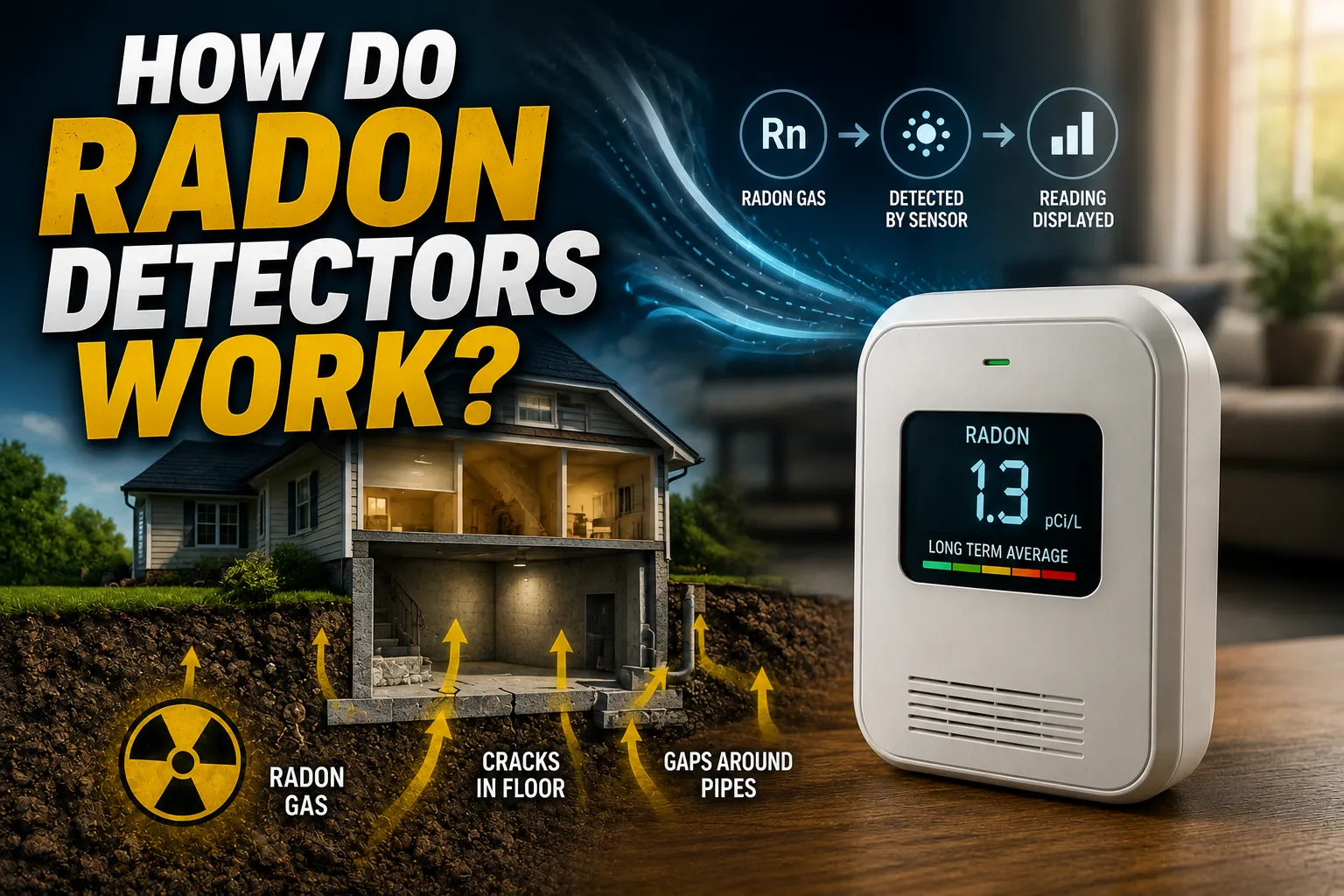
Radon detectors work by measuring radioactive particles or electrical changes caused by radon gas and its decay products in air. Some devices passively collect evidence over time, while others use a pump and electronic sensor to give near real-time readings.
Radon is invisible, odorless, and easy to miss without a detector. If you’re trying to understand what the numbers on a test mean, the key is knowing what the device is actually sensing and why the reading changes from room to room.
In this guide, we at AccurateGoods Editorial Team explain the science in plain language, compare the main detector types, and show you how to get results you can trust.
What a Radon Detector Is Measuring in Your Home
| What the detector is looking for | What it means | Why it matters |
|---|---|---|
| Radon gas | Radioactive gas that enters from soil and rock | It is the source of the exposure |
| Decay products | Short-lived radioactive particles created as radon breaks down | Many detectors measure these more directly than the gas itself |
| Alpha particles | Radiation released during decay | Used by many detectors as the signal to count |
| Ions or electrical changes | Air changes caused by radiation | Used in electronic and electret-style detectors |
Radon gas, decay products, and why the detector targets radiation
Radon itself is a gas, so a detector does not usually “see” it the way your eyes would see dust or smoke. Instead, the detector looks for the radiation released as radon breaks down into smaller particles, called decay products or daughters.
Those decay products are important because they can attach to dust and move through the air. When they keep breaking down, they release alpha particles. Many radon detectors are designed to count those alpha particles or the electrical changes they cause.
Radon is part of the natural uranium decay chain in soil and rock. That is why basement and ground-floor air often need the most attention.
Why radon levels fluctuate by room, season, and airflow
Radon levels are not always steady. They can change with soil conditions, weather, ventilation, and even how your home is being used that day.
Rooms close to the ground often show higher levels because radon enters through cracks, gaps, drains, and openings in the foundation. In many homes, winter readings can run higher because windows stay closed and the stack effect can pull more soil gas indoors. Air movement from fans, HVAC systems, and open windows can dilute radon and lower the reading.
How Radon Detectors Work Step by Step
Passive detectors let air move in naturally. Active monitors use a small fan or pump to pull air into the sensing chamber more consistently.
Some devices trap decay particles on a film, sensor, or filter. Others collect ionized air in a chamber and watch how the air changes.
Different detector designs use different signals. The goal is the same: turn invisible radiation activity into something measurable.
The detector’s electronics or lab analysis estimate how much radon was present in the air sample over the test period.
Most results are reported as picocuries per liter (pCi/L) in the U.S. or becquerels per cubic meter (Bq/m3) in many other countries. The number is usually an average, not a moment-by-moment snapshot.
Step 1 — Radon enters the device through passive diffusion or a pump
Passive detectors rely on natural air movement. Radon gas drifts into the chamber on its own. Active detectors use a fan or pump to draw air in more quickly and evenly.
Step 2 — The detector captures radon or its decay particles
Once inside, the detector needs a way to hold onto the evidence. A charcoal canister may adsorb radon. A track detector may expose a plastic film to decay particles. A digital monitor may keep the air in a chamber long enough for the sensor to respond.
Step 3 — The sensor counts alpha particles, tracks, ions, or electrical changes
This is the core of the measurement. Alpha particles can leave tiny marks in a film, create electrical signals, or change the ion balance in air. The device counts those changes and uses them as a proxy for radon exposure.
Step 4 — The device converts those signals into a radon concentration reading
Raw sensor data is not very useful on its own. The detector or lab software converts it into a concentration estimate based on the test method, chamber size, exposure time, and calibration data.
Step 5 — The result is averaged over time to show pCi/L or Bq/m3
Because radon changes through the day, the reading is usually averaged over the test period. That is why a detector can show a stable result even if the level moved up and down during the test.
The Main Types of Radon Detectors and How Each One Works
| Detector type | How it works | Best for |
|---|---|---|
| Charcoal test kit | Adsorbs radon on charcoal, then lab analysis estimates exposure | Low-cost short-term screening |
| Alpha track detector | Alpha particles leave tracks on a plastic film | Long-term average testing |
| Continuous radon monitor | Electronic sensor gives time-based readings | Real-time tracking and troubleshooting |
| Electret ion chamber | Ionized air changes the charge on an electret | Short- to medium-term home testing |
Charcoal test kits — adsorption and lab analysis
Charcoal kits use activated charcoal to adsorb radon from the air. After the test, the kit is sealed and sent to a lab. The lab measures the radiation from the collected material and estimates the radon level.
This is a simple and affordable way to screen a home, but timing matters. Since the test is passive, you need to follow the instructions carefully for the result to mean much.
Alpha track detectors — particle tracks on a film or plastic
Alpha track detectors use a plastic surface that gets tiny damage marks from alpha particles. After the exposure period, the lab etches and counts those tracks under a microscope.
Because they stay in place for months, they are useful for seeing a home’s long-term average rather than a short spike.
Continuous radon monitors — real-time electronic sensing
Continuous radon monitors use electronics to watch changes in air or radiation over time. Many have a display that updates every hour or even more often, which can help you spot patterns.
If you want to understand how ventilation or weather affects your home, this type gives the clearest timeline. For background on device testing and consumer guidance, the U.S. EPA radon information page is a solid place to start.
Electret ion chambers — voltage drop from ionized air
An electret ion chamber contains a charged material called an electret. When radon and its decay products ionize the air, the ions reduce the electret’s charge over time. The amount of voltage drop helps estimate the radon level.
These detectors are passive, but they still depend on proper setup and the right exposure time.
Active vs. passive detectors — power, airflow, and measurement differences
Passive detectors do not need power. They are easier to use and often cheaper, but they give you less immediate feedback. Active detectors need electricity or batteries, but they can monitor changes in real time and often give more information during troubleshooting.
Different detector types can all be valid. The right choice depends on whether you want a quick screen, a long-term average, or a live reading while you diagnose a problem.
Why Radon Detector Readings Need Time to Stabilize
Short-term vs. long-term tests and what each can tell you
Short-term tests usually run for a few days. They are useful when you want a fast answer. Long-term tests run for months and give a better picture of your home’s average exposure.
A short test can be a good first step, but it should not always be treated as the final word. Radon levels move around, so a longer test often gives a more dependable home average.
Why 24-hour spikes can mislead homeowners
A single day can be unusual. A storm, a windy day, a closed-up house, or a change in heating use can push the number up or down. That is why one high reading does not always mean your home stays at that level all the time.
Do not make a big decision from one very short reading unless the test instructions say that is appropriate. Radon should be judged by the method and the test duration, not by one passing spike.
How weather, HVAC use, and ventilation affect readings
Cold weather can increase the pressure difference between indoors and outdoors, which may pull more soil gas into the home. Heating systems, exhaust fans, and open windows can also change air pressure and airflow.
That is why test conditions matter. A detector is measuring air in a real home, not a sealed lab chamber.
How Accurate Radon Detectors Are and What Can Affect Results
- Detector was placed correctly
- Test lasted the full recommended time
- Results came from a calibrated device or lab
- Home conditions followed the instructions
- Detector sat near a draft, window, or vent
- Test was cut short
- Humidity or heat affected the device
- Reading changed wildly without a clear reason
Accuracy strengths of lab-based and digital detectors
Lab-based detectors can be very useful because the analysis is done under controlled conditions. Digital monitors are helpful because they show patterns over time and can reveal whether the reading is steady or bouncing around.
Both can be accurate when used the right way. The main difference is how much information you get during the test.
Common causes of false highs or false lows
False highs can happen if the detector is placed in a damp, hot, or poorly ventilated spot. False lows can happen if the detector is in a draft, near an open window, or in a room that is not representative of the home’s lowest lived-in space.
Some detectors can also be affected by rough handling, expired test kits, or a missing lab return window.
When a detector needs calibration, replacement, or retesting
Electronic monitors should be calibrated according to the manufacturer schedule. Passive kits are usually single-use, so replacement is normal after each test. If a result seems odd or the instructions were not followed, a retest is often the smartest next step.
For long-term guidance and mitigation standards, the CDC radon safety information is also helpful.
How to Use a Radon Detector Correctly for Reliable Results
Put the detector in the lowest level that people actually use, such as a basement family room or lower-floor bedroom.
Keep the detector away from windows, vents, bathrooms, kitchens, and hot sunny spots so the air sample stays representative.
Most tests ask you to keep conditions as stable as possible. That helps the detector measure your normal indoor air instead of a short burst of fresh air.
Start and stop the test on time, seal the kit when required, and send it back promptly. Small mistakes can change the result more than many people expect.
If you are testing with a digital monitor, write down when you opened windows, ran the HVAC, or used exhaust fans. That makes the trend data much easier to understand later.
Pros and Cons of Different Radon Detector Types
| Detector type | Pros | Cons |
|---|---|---|
| Passive detectors | Low cost, simple to use, no power needed | Slower results, less feedback during testing |
| Electronic monitors | Instant readings, trend data, easy troubleshooting | Higher cost, may need calibration or batteries |
| Lab-analyzed kits | Good for screening and long-term averages | Results are not immediate |
Passive detectors: low cost, simple use, slower results
Passive detectors are a good fit if you want a straightforward test and do not need live readings. They are often the easiest way for a homeowner to start.
Electronic monitors: instant readings, higher cost, maintenance needs
Electronic monitors are useful when you want to watch changes over time or check whether mitigation is working. They cost more, and they may need setup or calibration, but they offer more day-to-day insight.
When a homeowner should choose one type over another
If you only need a basic check, a passive test kit is often enough. If you are tracking a known problem, testing after mitigation, or comparing rooms, a continuous monitor can be worth it.
- Test in the lowest lived-in area first, not the room you use most often upstairs.
- Repeat testing if the first result is close to your action level or seems unusual.
- Use the same testing conditions each time so results are easier to compare.
- Keep a note of the date, room, and weather during the test.
- After mitigation, test again to confirm the fix is working.
Your test result is high, the device was exposed to poor test conditions, or the reading does not match what you expected. If you have health concerns or need help deciding what the number means, talk with a qualified radon professional.
How to Read Radon Results and Decide What to Do Next
Understanding safe vs. elevated levels
Radon risk is generally lower at lower levels and higher at higher levels. In the U.S., many homeowners use 4.0 pCi/L as an action level, but lower levels can still matter over time. The main point is to compare your result with the guidance used in your area.
When to retest for confirmation
If a short-term test shows an elevated result, a follow-up test can help confirm it. Retesting is also smart if the first test conditions were not ideal or if the result seems inconsistent with other rooms.
When to hire a mitigation professional
If repeated tests show elevated radon, a mitigation professional can suggest ways to reduce it, often by improving ventilation or sealing entry paths and using a venting system. A good contractor should explain the plan clearly and recommend a post-work test.
Why follow-up testing matters after mitigation
Mitigation is not finished until you confirm the result. Follow-up testing tells you whether the system lowered radon to the level you wanted. This step matters just as much as the first test.
Radon detectors work by turning invisible radioactive activity into a measurable result. The best test is the one that matches your goal, is placed correctly, and runs long enough to show a true home average.
Common Questions About How Radon Detectors Work
Some detectors measure radon gas indirectly, but many focus on its decay products or the alpha particles they release. That is usually the most practical way to estimate exposure.
It depends on the test type. Short-term kits may run for a few days, while long-term tests can stay in place for months. The longer the test, the better it can reflect your average level.
Not always. Digital monitors give quicker feedback and trend data, while test kits are often cheaper and fine for basic screening. The better choice depends on what you want to learn.
No, not if you want a reliable result. The detector should stay in one approved spot for the full test period so the reading reflects that room’s air.
Radon levels can change with weather, ventilation, HVAC use, and the pressure differences between indoors and outdoors. That is normal, which is why test averages matter so much.
Yes. Follow-up testing is the only way to know whether the mitigation system lowered the radon level enough.
- Radon detectors measure radon decay, alpha particles, ions, or related electrical changes.
- Different detector types use different methods, but they all estimate indoor radon concentration.
- Readings change with room location, season, airflow, and home conditions.
- Longer tests usually give a better average than a single short spike.
- Correct placement and following test instructions are key to reliable results.
- Retest after mitigation to confirm the home is safer.
